


California Stealth Attempt To Reinstate Affirmative Action In Education Opposed By Equal Protection Project
“Rather than an outright repeal, ACA 7 seeks to so thoroughly narrow Prop 209’s constitutional protections as to constitute a de facto repeal as relates to education.”
California Proposition 209, passed in 1995, amended the California Constitution to provide, among other things, to prohibit race and sex discrimination in all public employment, education, and contracting:
SEC. 31. (a) The state shall not discriminate against, or grant preferential treatment to, any individual or group on the basis of race, sex, color, ethnicity, or national origin in the operation of public employment, public education, or public contracting. [emphasis added]
This powerful nondiscrimination provision effectively banned affirmative action in most public spheres. Prop 209 has come under attack many times, including a 2020 attempt at repeal that was rejected by voters 57%-43%.
There is a new stealth attack. Legislation (ACA0-7) has passed the California Assembly and is under consideration by the California Senate that would put forward to voters a ballot initiative that would drastically scale back the protections of Proposition 209, but it’s a stealth attack because the legislation and proposed constitutional changes are subtle but deadly for civil rights.
The impact of ACA-7 would be to reinstate affirmative action in almost all areas of education, with the exception of higher education admissions which is barred by the Supreme Court’s decision in the Harvard case.
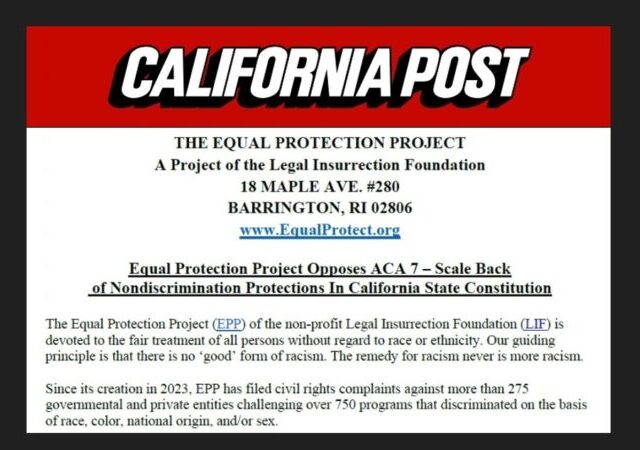
The Equal Protection Project has filed a Position Statement Opposing ACA-7 with the California legislature. Here is the text of our opposition in full:
The Equal Protection Project (EPP) of the non-profit Legal Insurrection Foundation (LIF) is devoted to the fair treatment of all persons without regard to race or ethnicity. Our guiding principle is that there is no ‘good’ form of racism. The remedy for racism never is more racism.
Since its creation in 2023, EPP has filed civil rights complaints against more than 275 governmental and private entities challenging over 750 programs that discriminated on the basis of race, color, national origin, and/or sex.
EPP opposes California Assembly Constitutional Amendment 7 (ACA 7), a California legislative proposal that would amend, subject to voter approval, the state constitution to allow for race-based and sex-based preferences in most public education programs.
Passed in the state assembly with the bare minimum two-thirds threshold required to advance a constitutional amendment in California, ACA 7 is now being considered by the state Senate. If approved by the Senate, it would be placed on the ballot for potential approval by the voters.
Proposition 209, approved by California voters in 1996, added clear nondiscrimination language to the California Constitution:
“The state shall not discriminate against, or grant preferential treatment to, any individual or group on the basis of race, sex, color, ethnicity, or national origin in the operation of public employment, public education, or public contracting.”
Prop 209 applies to public employment, public education, and public contracting, and has become a bedrock protection against discrimination in California, setting an important example for other states. In 2020, California voters reaffirmed their commitment to non-discrimination when they rejected Proposition 16, which would have repealed Prop 209.
Rather than an outright repeal, ACA 7 seeks to so thoroughly narrow Prop 209’s constitutional protections as to constitute a de facto repeal as relates to education. Specifically, under ACA 7:
- “Public education” would be removed from Prop 209’s constitutional prohibition on discrimination and preferential treatment based on race or sex.
- The ban on race and sex-based preferences would apply only to public employment, public contracting, and “higher education admission and enrollment.”
- K–12 education policies, grant programs, state-funded initiatives, and other aspects of public education would no longer be constitutionally barred from using race- or sex-based preferences.
In other words, while ACA 7 preserves some of the prohibitions on discrimination in higher education, it substantially narrows those protections in higher education and would permit the government to discriminate in all aspects of K-12 education and most aspects pertaining to colleges and universities.
This proposed amendment comes in the wake of the U.S. Supreme Court’s 2023 decision in Students for Fair Admissions v. Harvard, (SFFA) where the Court ruled that race-based admissions programs violated the Equal Protection Clause of the Fourteenth Amendment to the U.S. Constitution. While the language of ACA 7 carves out higher education admissions from permissible discrimination, it authorizes discrimination in every other facet of education. This carve-out is an overly narrow reading of SFFA, which while it took place in the context of university admissions reiterated a broad protection: “Eliminating racial discrimination means eliminating all of it.”
ACA 7 violates the promise of equality that the Fourteenth Amendment and Prop 209 protect.
Accordingly, EPP opposes ACA 7.
Respectfully submitted,
William A. Jacobson
President and FounderBarrington, RI 02806
April 26, 2026
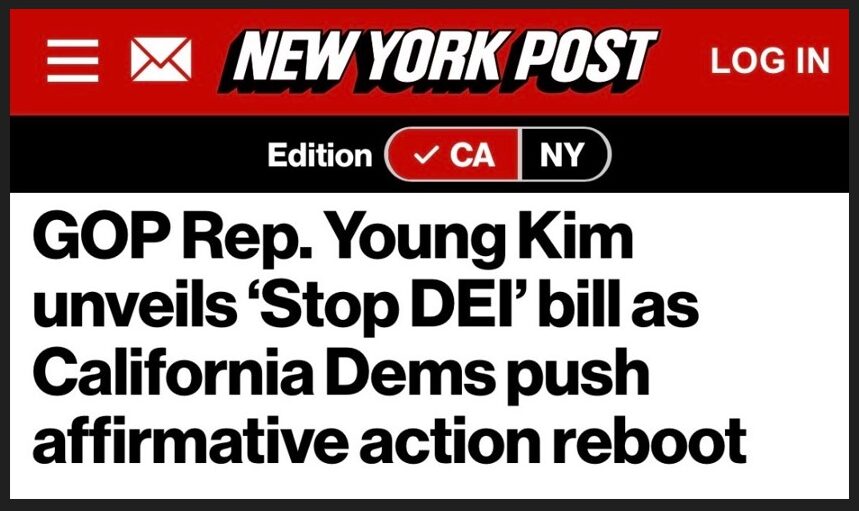
The California Post and NY Post covered our letter in an article about federal legislation being introduced by Congresswoman Young Kim:
Congresswoman Young Kim is pushing a bill that would prevent schools from receiving federal funds if the institution discriminates based on race, sex, ethnicity, color, or national origin in student aid decisions.
Kim’s action comes as California Democrats seek to revive affirmative action in public education.
The Stop DEI Act, which Kim plans to introduce Wednesday, is in direct response to ACA 7 — which if passed by voters, would amend the state’s constitution to allow for race-based and sex-based preferences in most public education programs….
Banning discrimination and preferential treatment based on sex or race would continue to apply to public employment and public contracting.
“Discrimination will be permitted under the state constitution in K-12. It would be permitted throughout higher education with the exception of admissions and enrollment,” William Jacobson, a law professor at Cornell and founder of the Equal Protection Project told The Post.
Jacobson said the carve out of admissions is an invalid attempt to circumvent the 2023 Supreme Court Ruling that barred race-conscious affirmative action in college enrollment.
“The U.S. Supreme Court ruling in the Harvard and University of North Carolina cases was in the context of admissions and enrollment, but the legal principles there, the equal protection legal principles of the Supreme Court ruling apply everywhere,” he said. “They don’t just apply to enrollment and admissions.”
The Cornell law professor sent a letter to the Higher Education Committee and the Appropriations Committee on Tuesday expressing his organization’s opposition to the measure, arguing it “violates the promise of equality that the Fourteenth Amendment and Prop 209 protect.”
If the constraints of the non-discrimination provisions were lifted, Jacobson said the Stop DEI Act could act as a deterrent for some schools.
“Her legislation, as it’s been broadly described, could have a good prophylactic effect,” he said. “But, of course, my point is why should we even need that? We shouldn’t need that. California should uphold its current code of conduct.”
Reminder: we are a small organization going up against powerful and wealthy government and private institutions devoted to DEI discrimination. Donations are greatly needed and appreciated.
================
Donations tax deductible
to the full extent allowed by law.







Comments
Meet the new Jim Crow party
Same as the old Jim Crow party
They’ll all get fooled again.
Leave a Comment