


Artemis II Crew Breaks Distance Record, Will Reach Maximum Distance From Earth Monday Night
The crew reached a maximum distance of 252,752 miles from Earth, breaking Apollo 13’s record.
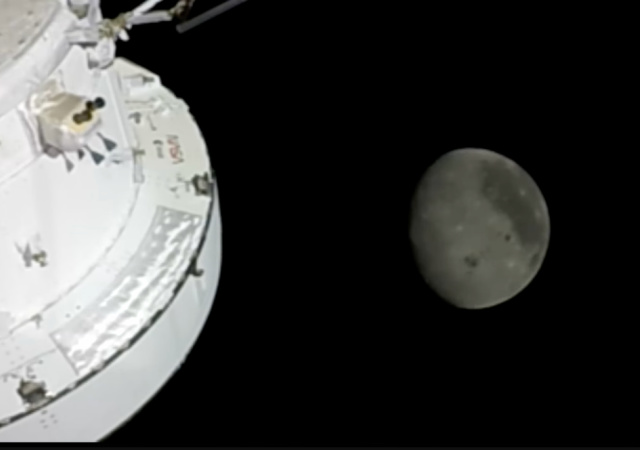
The Artemis II mission is unbelievable. I say we take the funds we give to NATO and the UN and give them to NASA.
At 1:56 PM ET, the Artemis II crew became the first humans to travel the farthest from Earth.
A new milestone for humankind: The crew of Artemis II are now the farthest any human has ever travelled, reaching a maximum distance of 252,752 miles from Earth.
This surpasses the previous record set by Apollo 13 in 1970 by about 4,102 miles. pic.twitter.com/DbLFvvdEfT
— NASA (@NASA) April 6, 2026
The Artemis II crew named one of the craters they called a “bright spot” after Commander Reid Wiseman’s wife Carroll, who passed away from cancer in May 2020.
I dare you not to cry.
To commemorate the Artemis II mission, the astronauts announced their suggestion to rename certain features on the Moon to honor the Orion spacecraft, named Integrity, as well as commander Reid Wiseman’s late wife, Carroll. pic.twitter.com/ejfhnItDo8
— NASA (@NASA) April 6, 2026
Here is the schedule:
- 12:41 a.m.: Orion enters lunar sphere of influence at 41,072 miles from the Moon.
- 1:30 p.m.: The science officer in mission control will brief the crew on their science goals for the upcoming flyby.
- 1:56 p.m.: The Artemis II crew is expected surpass the record previously set by the Apollo 13 crew in 1970 for the farthest humans have ever traveled from Earth.
- 2:45 p.m.: Lunar observations begin.
- 6:44 p.m.: Mission control expects to temporarily lose communication with the crew as the Orion spacecraft passes behind the Moon.
- 6:45 p.m.: During “Earthset,” Earth will glide behind the Moon from Orion’s perspective.
- 7:02 p.m.: Orion reaches its closest approach to the Moon at 4,070 miles above the surface.
- 7:07 p.m.: Crew reach their maximum distance from Earth during the mission.
- 7:25 p.m.: “Earthrise” marks Earth coming back into view on the opposite edge of the Moon.
- 7:25 p.m.: NASA’s Mission Control Center should re -acquire communication with the astronauts.
- 8:35-9:32 p.m.: During a solar eclipse, the Sun will pass behind the Moon from the crew’s perspective.
- 9:20 p.m.: Lunar observations conclude.
Apollo 13 set the record in April 1970 during its emergency return when it reached 248,655 miles from Earth.
Artemis II will reach 252,760 miles from Earth.
Now let’s look at the moon. We’ve all seen the moon, right?
Well, the astronauts released photos of the moon’s dark side, a side humans have never seen.
History in the making
In this new image from our @NASAArtemis II crew, you can see Orientale basin on the right edge of the lunar disk. This mission marks the first time the entire basin has been seen with human eyes. pic.twitter.com/iqjod6gqgz
— NASA (@NASA) April 5, 2026
Look at Earth.
One last look at Earth before we reach the Moon.
This view of the Earth was captured on April 5, the fourth day of the Artemis II mission, from inside the Orion spacecraft. The four astronauts will reach their closest approach of the Moon tomorrow, April 6. pic.twitter.com/z2NJUGWkKc
— NASA (@NASA) April 5, 2026
Donations tax deductible
to the full extent allowed by law.







Comments
Que Pink Floyd.
Seems wrong:
“Apollo 13 set the record in April 1970 during its emergency return when it reached 428,655 miles from Earth.
Artemis II will reach 252,760 miles from Earth.”
I thought Artemis will set the record.
Also since many of the Apollo missions circled the moon, hasn’t the dark side been seen??
Regardless glad things are going well (besides the toilet that is).
Perhaps a couple of digits were transposed…248,655 miles (rather than 428,655 miles) is about 4K shorter than the 252K.
yes that’s it. looked it up. well done, i was being lay before,
Yes! Thank you for pointing that out. I switched them. 🙂
Yes, that was my first objection. Apollo CSM pilots all laid eyeballs on the far side of the moon. Artemis’s trajectory is different and the lighting is currently better, and they were able to see a region not covered by any of the CSM orbits, but let’s can the Democrat “Record Firsts” glurge.
Yes. The quoted material doesn’t say they are the first humans to see the far side of the moon, but that they’re the first to see the entire Orientale basin. “This mission marks the first time the entire basin has been seen with human eyes.” A much more modest claim.
also lazy
Farthest human from Earth? Pshaw.
What about that dude in the convertible?
What about John Carter?
What about all those abductees? Surely some of them ended up going well out past the orbit of the moon?
Others who have travelled far.
Richard Dreyfus.
Ryan Gosling
Keir Dullea and Gary Lockwood
Leonard Nimoy.
Now, if they had named a crater after HIM I might have moistened a bit.
It’s still glurge, but at least it’s not Inside Baseball.
I was dared to not cry. I was up for the challenge. Still don’t care about the first DEI Moonshot in NASA history.
Matt Damon. He was a Martian
True! Good movie and Damon was good in it. (hurts to say that)
What about Captain Kirk and the crew of the USS Enterprise.
“Farthest Than”?!
s/Farthest/farther
The headline has been corrected, but the body still contains this sentence: “At 1:56 PM ET, the Artemis II crew became the first humans to travel the farthest from Earth.” That’s obviously false. There have been many humans who have traveled “the farthest from Earth”. Each time a human went farther than anyone had gone before him, he traveled “the farthest from Earth”. Then the next person who went a bit farther did the same, and so on.
s/428/248
No such thing as dark side of the moon. Dark side is a misnomer. There is the near side and the far side. “Dark” side gets just as much sunlight as the near side does.
It’s poetic. Like “Heart of Darkness,” or “Good Government.”
“Good government” is an oxymoron, like “military intelligence”.
It’s dark to us. because we can’t see it from where we are.
dictionary.com gives 18 definitions of “dark” as an adjective. Number 13 is “hidden; secret”. That’s the sense in which the far side of the moon is known as “dark”.
True… moon gravity locked so that only one side always faces earth. Apollo 13 had to loop to live… no choice. A free return path to start with here was a choice…. and a safe one. Entering lunar orbit and then TEI… a bigger ball game for later. Apollo is still the big leagues.
No. That really doesn’t work.
Huh? How does it not work? Why do you think it’s called the dark side? Do you think anyone ever imagined that it’s always dark there, or that it’s dark there more often than it is on the near side?! It’s obvious that #13 is the definition being used.
No, the right answer is “It’s all dark.”
I know you’re old enough to know your Pink Floyd.
What a nothingburger. The difference is 4,102 miles, attributable entirely to the moon’s elliptical orbit. Look folks, this was not only done before, but 56 years ago and for less than half the cost per launch in constant dollars.
Since I drove a Semi over 4,000,000 miles, 4k doesn’t impress me much.
They ought to add the square of their velocity to their distance to get something meaningful.
Isn’t this the first US manned spacecraft to deploy solar panels? If so that is an accomplishment because solar panels can be cranky to deploy. Now let’s see if they can pull them back before landing.
The ISS has solar panels. Skylab has solar panels. I think various experiments aboard the shuttle deployed solar panels, as well.
A moon mission? Yeah. Not sure how to properly word any first related to that.
ISS and Skylab were stations not spacecraft. The shuttle itself didn’t have panels unless they added them after I ceased to follow it carefully.
The solar panels are a part of the Service Module. The SM separates from the Crew Module before reentry. No need to pull anything back in. There have been many manned spacecraft with solar panels. The first was Soyuz 1 in 1967.
The first American spacecraft to have solar panels was the Apollo 11 lunar module.
No it didn’t.
Thanks for the info about the orion SM. You’re right there would be no need.
Farthest away? Woman must have been driving
Nonsense. It was the guy driving who refused to ask for directions that caused the extra 4,000 miles on the odometer.
So they were sleeping, she decided to drive and got them lost. Dude woke up and took over then refused to ask for directions and boom! 4,000 mile detour? Sounds legit.
they might never ever to return
want to return
They might ride forever in the streets of Boston.
‘neath the streets of Boston….