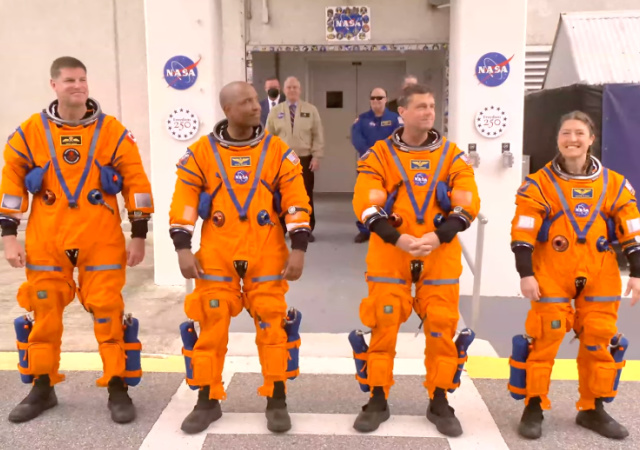
*UPDATE* Commander Reid Wiseman, Pilot Victor Glover, and Mission Specialist Christina Koch from NASA, and Mission Specialist Jeremy Hansen from the CSA (Canadian Space Agency) are officially on their way to the moon!
Artemis II is sending humans into deep space once again!!
——–
I always hate it when Leslie goes on vacation because she brings us interesting topics with her expert analyses.
However…it allows me to write up her interesting topics!
Like Artemis II! No, I am not talking about my fabulous cat Artemis. She’s the queen, but no one tell her that NASA didn’t name the mission after her!
NASA plans to launch Artemis II tonight with a two-hour window opening at 6:24 PM ET.
NASA has a live blog with all the latest updates.
You can even watch all the operations live: NASA’s Artemis II Live Mission Coverage (Official Broadcast).
Commander Reid Wiseman, Pilot Victor Glover, and Mission Specialist Christina Koch from NASA, and Mission Specialist Jeremy Hansen from the CSA (Canadian Space Agency) aim to make history as the first humans to travel the farthest from Earth. Leslie wrote in January:
Artemis II is NASA’s first crewed test flight of the Space Launch System rocket and Orion spacecraft, a roughly 10‑day mission that will send four astronauts on a lunar flyby to validate life‑support, navigation, and other systems before future Moon landings. It is the first journey by humans to the vicinity of the Moon since the Apollo 17 mission.
Artemis II missed its February launch due to a hydrogen leak.
Fueling has been going well so far this morning. The weather also appears to be cooperating.
NASA hit a milestone at 12:23 PM ET:
Liquid oxygen (LOX) fast fill is now complete for the SLS (Space Launch System) upper stage, marking another major milestone in tanking operations. Teams have confirmed the upper stage is in good shape and are proceeding with the LOX vent and relief test. This step helps verify proper pressure regulation and ensures the system is ready to transition into topping and, later, replenish operations.
The weather briefing went well, too:
NASA astronauts Reid Wiseman, commander; Victor Glover, pilot; and Christina Koch, mission specialist; along with CSA (Canadian Space Agency) astronaut Jeremy Hansen, mission specialist, were briefed on wind speeds, precipitation, lightning risk, and sea states for splashdown contingencies, ensuring all safety criteria are met before proceeding with launch operations.Weather officials with NASA and the U.S. Space Force’s Space Launch Delta 45 are tracking 80% favorable conditions during the launch window, with primary concerns being the cumulus cloud rule, flight through precipitation rule, and ground winds.With the weather briefing complete, the crew and ground teams remain aligned and ready to continue toward liftoff, keeping Artemis II on track for its historic mission to send astronauts around the Moon.
The cumulus cloud rule does not allow launches through cumulus-type clouds with tops higher than the 41 degree F. temperature level.
Now I get to bring out my weather geek! (I would have majored in meteorology, but chose Oklahoma State since I could live at home.) A cumulus cloud is the beginning stage of a storm, potentially growing into the cumulonimbus cloud.
The severe storms you experience usually come from cumulonimbus clouds. You can generally determine the power of the storm by looking at the echo tops, which measure the height of the cloud.
The higher the echo top, the stronger the storm.
Therefore, the cumulus cloud contains a lot of energy, meaning the rocket’s exhaust, which is huge, could create lightning.
CLICK HERE FOR FULL VERSION OF THIS STORY