


Artemis II Concludes Successful Mission with Splashdown off San Diego’s Coast
“America is back in the business of sending astronauts to the Moon and bringing them home safely.”
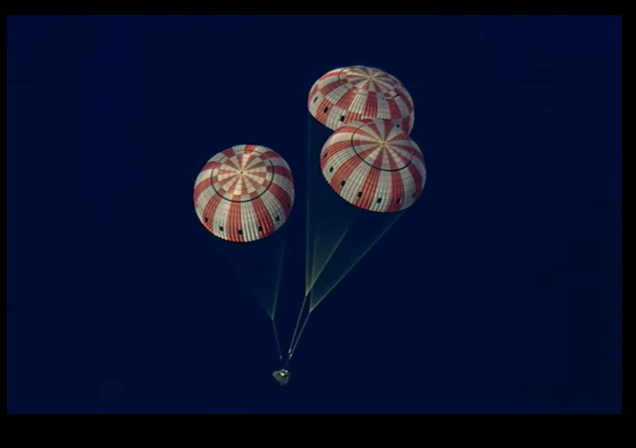
NASA’s Artemis II mission ended with a precise Pacific splashdown off the coast of San Diego, California.
The mission confirms that the U.S. can once again send astronauts to the Moon’s orbit and bring them safely home. “Integrity” slammed into the atmosphere at 24,000 mph, shrugged off searing plasma, deployed its parachutes, and delivered its four‑person crew to recovery teams almost exactly where planned, a result that NASA chief Jared Isaacman has hailed as a landmark for American spaceflight under his tenure.
Orion's main parachute has deployed. The spacecraft has a system of 11 chutes that will slow it down from around 300 mph to 20 mph for splashdown.
Get more updates on the Artemis II blog: https://t.co/7gicm7DWBt pic.twitter.com/ReXHTfkFld
— NASA (@NASA) April 11, 2026
This landing was more than a feel‑good replay of Apollo‑era footage. It proved that the Orion spacecraft, its heat shield, parachute system, and life‑support hardware can function together in real deep‑space conditions, not just in modeling and uncrewed tests. Artemis II also showed that crews can live and work inside Orion despite plumbing problems, handle navigation updates and trajectory burns around the Moon, and still arrive back in one piece.
Just as important, the mission hardened the operational playbook. Flight controllers rehearsed contingency procedures with real human lives on the line, refined communications across the distances of cislunar space, and demonstrated their ability to manage a high‑energy reentry from beyond low Earth orbit.
Under NASA Administrator Jared Isaacman’s leadership, NASA has stressed that this kind of incremental, data‑driven risk reduction is the only serious path back to the Moon, and Artemis II moved Orion and its support systems from “we think this will work” to “we’ve flown it with astronauts.”
All of this sets the stage for Artemis III, and further development of our lunar exploration and base-development plans. With the capsule and its basic mission architecture now flight‑proven with a crew, NASA can shift its focus toward the harder problems: integrating a human‑rated lunar lander, coordinating with commercial launch providers, and building the logistics to support repeated surface expeditions.
Today’s successful conclusion is the first step in an ambitious agenda Isaacman has championed as essential for long‑term American leadership in space. In that sense, the successful Artemis II splashdown is both an ending and a beginning, closing the chapter on whether America can still fly people to lunar distance and opening the question of what the nation will actually do on the Moon after the Artemis missions III, IV, and V are launched.
Many Americans took a few moments to watch the landing from various streaming services and apps. Not all of the interested viewers were human.
My cat watching live with me 🐱 pic.twitter.com/OsYLfsB4Bn
— HappyHumanX (@HappyHumanX) April 11, 2026
Isaacman was full of praise for the exceptional crew.
America is back in the business of sending astronauts to the Moon and bringing them home safely.
Reid, Victor, Christina, and Jeremy did an outstanding job. These talented astronauts inspired the world and represented their space agencies and nations as humanity’s ambassadors to the stars.
This was a test mission, the first crewed flight of SLS and Orion, pushing farther into the unforgiving environment of space than ever before, and it carried real risk. They accepted that risk for all we stood to learn and for the exciting missions that follow, as we return to the lunar surface, build a Moon base, and prepare for what comes next.
And they were not alone. The entire NASA workforce, our commercial and international partners, and the hopes and dreams of people all over the world were with them. The astronauts know it, and you should too. This mission would not have been possible without you.
And splashdown!
America is back in the business of sending astronauts to the Moon and bringing them home safely.
Reid, Victor, Christina, and Jeremy did an outstanding job. These talented astronauts inspired the world and represented their space agencies and nations as… pic.twitter.com/wOioBBvGhX— NASA Administrator Jared Isaacman (@NASAAdmin) April 11, 2026
The U.S. Navy’s recovery team also deserves a special shout-out. Bravo.
The first face the Artemis II crew will see upon their return to Earth will be the face of a U.S. Navy Sailor.
Meet the Dive Medical Recovery Team of Artemis II: https://t.co/bB8leMmgFw pic.twitter.com/nwkcYqz3nU
— U.S. Fleet Forces (@USFleetForces) April 10, 2026
The shuttle landed like a plane, Russian spacecraft land on land (ouch), and the SpaceX Crew Dragon capsules are picked up by private recovery ships. Artemis is the first Navy recovery since the joint US-Soviet Apollo-Soyuz mission in 1975. pic.twitter.com/iN2aSFOWBO
— Mark Davis (@MarkDavis) April 11, 2026
After 50 years….we are so back, baby!
🚨 This is what real LEADERSHIP looks like!
NASA Administrator Jared Isaacman is personally aboard the USS John P. Murtha, the primary recovery ship as the team prepares to pull the Artemis II astronauts out of the Orion capsule after splashdown. pic.twitter.com/V0umYj6P4A
— Gunther Eagleman™ (@GuntherEagleman) April 11, 2026
Donations tax deductible
to the full extent allowed by law.







Comments
They exited finally and did NOT appear to have grown any extra appendages.
They had a comms hiccup with the Search and Rescue satphone that seemed to really trouble them – to the point of (at one point) pushing the timetable for power off to 30 instead of 15 minutes. Then they made it 15 again. Then it took an hour for the boats to close in and finally attach the collar and big life raft and open the hatch.
I think that part needs a BUNCH of work.
But it was otherwise (well, except the toilet, which had no impact on the recovery) a textbook mission. Kudos to the crew, and thanks to God they’re back safe.
Any word on the heat shield?
Well it worked well enough to survive a return from the moon,
When the woman in mission control asked them if they’d pressed the PTT button on the satphone, I spewed coffee all over my monitor. There was quite the pause before they answered so I wonder what was being said by the crew in the background.
It did seem like an awkward extraction–copters and boats circling the module for half an hour before they began the process. Heavier seas could have made that really difficult. I blame Trump for that. Nonetheless, it was as exciting as all of those launches and recoveries I watched as a boy. We’re back, baby.
“I blame Trump for that.” This is not an attack but curiosity since I was unable to watch the landing and so I don’t know what happened.
Did Trump interfere somehow in the process? Are you just being sarcastic? I really am curious.
The recycled tech of only a capsule returning and throwing away the boosters and the rest of the spacecraft is outdated.
Using old shuttle tech is foolish.
NAS can only launch this system once or maybe twice per year at 1 billion per launch.
Space X with reusable boosters can launch twice per month.
It’s plain they will switch systems
Boo ya
Very good news! I admit I watched that entry period that was on camera with the memory of the spacecraft that broke up on entry about 15 years ago, a Saturday morning I believe. Relief.
It was almost 25 years ago.
Tempus Fugit…….
Proud to be American. What this country can accomplish. And what it is doing, that no one else could, in space and on Earth.
I’m conservative and have to ask two questions…why did you go and how much did it cost?
After the Wright brothers 12 second flight, a lot of people concluded it was just a folly and too dangerous to do again. Imagine if they had listened.
The Wright Brothers paid for their own flight.
Hey! It kept them off your lawn!
At some point humanity will outgrow the earth. We will eventually colonize the moon and Mars and who knows where else. I don’t know how many attempts it will take. I don’t know if this is the step that will directly lead to those attempts or if it will fail and humanity will need to start again in 20, 50, or 100 years. But the attempts need to happen. And they need to start sometime. I don’t know if now is the right time. But then, how do we ever know when the “right” time is to try something? And what is the cost of not trying it?
Has anyone checked on the flat-earthers? Are they OK? Are their lithium levels all right?
It’s their chlorine levels you have to monitor.
I don’t understand the criticism I keep seeing of Artemis II as being a lame repeat of Apollo 8. This was always going to be primarily an engineering mission.
Artemis has as its goal creating permanent human habitation on the Moon. Suppose the Artemis program had been started in the late 1970s or early 1980s (the Apollo program was able to get humans to the moon for a few days but was not really suitable for long-duration missions lasting a month or more). I can guarantee you there would be one or more uncrewed missions followed by one or more crewed missions designed to check out the new system.
IMO Artemis is unsustainable in its current form. For one thing: it is hideously expensive. That is because of idiotic political considerations. The SLS has been called the Senate Launch System with good reason.
For another: Apollo was designed to work as a single system, with all parts working together. By contrast Artemis is a patchwork of old shuttle technology and newer innovation put together (sometimes not very smoothly). The political decision made by politicians to preserve old jobs in the SKS is causing serious problems.
But for now NASA can take a well-deserved victory lap. They deserve all the accolades they are getting. As I told my engineering students: this is history in the making. Sending humans to the Moon and bringing them back safely will always be a huge technical accomplishment and is NEVER easy or routine.
The problem I have with Artemis is that it’s basically 50 year old capsule technology. At least with the space shuttle we had what was effectively a space plane and that is the direction we should be going in if we want to do really do space. Not spam in a can on top of a rocket.
They criticize because they can’t stand that America and only America can do this. They claim it is easy.
If it’s so easy, why hasn’t anyone else been able to do it?
To the moon Alice, to the moon…
Do you know what the astronauts told their families before they left?
I love you to the moon and back.