


USDA Launches Campaign Focusing on ‘Product of USA’ Label Rules for Meat, Eggs, and Dairy
On this National Agriculture Day, the focus on the voluntary label standard serves as both a marketing tool and a statement of values.
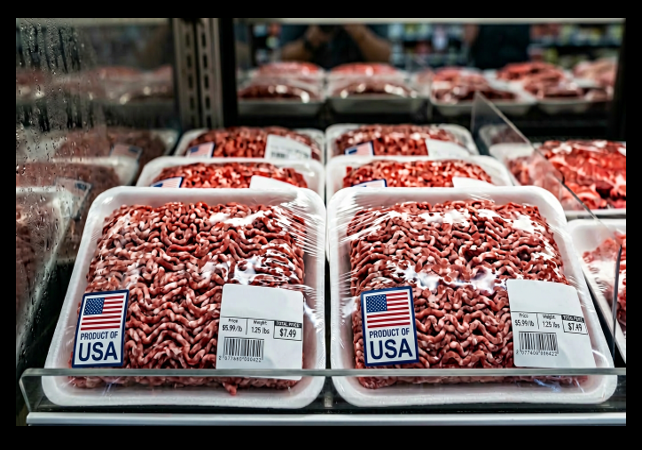
March 24th is National Agriculture Day.
This year, it was commemorated by Agriculture Secretary Brooke Rollins, who spent the day highlighting how the voluntary “Product of USA” meat label is used in a new campaign promoting the standard.
Rollins made the announcement during her opening remarks at a March 24 Ag Day at USDA event in Washington, D.C.
“This new label is about enhancing competitiveness for our producers — our great American producers — by leveling the playing field and increasing transparency through truthful labeling,” Rollins said. “What our ranchers raise in this country is the very best in the entire world.”
The voluntary labeling standard went into effect on Jan. 1, 2026, and is now being promoted by USDA. Its finalization was first announced by former Secretary of Agriculture Tom Vilsack in March of 2024 at the National Farmers Union Annual Convention.
Under the standard, the “Product of USA” label is reserved exclusively for meat, poultry, and egg products from animals born, raised, harvested, and processed in the U.S. Any company that makes the voluntary claim has to meet those requirements. The prior practice allowed imported products to make the claim after minimal processing, according to USDA.
Born here. Raised here. Harvested here. Processed here.
The TRUE AMERICAN standard. 🇺🇸pic.twitter.com/wMFYiRWYbw
— The White House (@WhiteHouse) March 24, 2026
Health and Human Services Secretary Robert F. Kennedy Jr., a proponent of all the delicious and nutritious goodness of beef, highlighted his agency’s push for real food over processed items.
“Our farmers and ranchers are essential to putting real food back at the center of the American plate and delivering on the Dietary Guidelines for Americans,” said Health & Human Services Secretary Robert F. Kennedy Jr. “‘Product of the USA’ labeling puts American producers first, gives families clear, honest information and empowers them to choose food raised right here at home.”
“U.S. producers are the best in the world, and produce the highest-quality products,” said Sen. John Hoeven (R-N.D.). “A ‘Product of USA’ label benefits our ranchers and provides transparency and confidence for consumers. We appreciate Secretary Rollins and the Trump administration for their efforts to support our farmers, ranchers and rural communities.”
🚨 JUST IN: The Trump administration just launched a national campaign promoting the "PRODUCT OF USA" label — exclusively for meat, poultry and egg products from animals born, raised, harvested and processed in America
Awesome! Made in America is the way to go 🇺🇸 pic.twitter.com/AWGxdRx1Bj
— Eric Daugherty (@EricLDaugh) March 24, 2026
As the labels are for eggs and meat, which are now a key component of the Food and Drug Administration’s upside-down food pyramid, it’s worthwhile to check the projected prices for Americans.
While the egg supply seems to be recovering from the bird flu, meat supplies may remain tight.
Among food categories, beef and veal prices remain elevated, even after a slight monthly dip. USDA reports beef prices were 15 percent higher in January 2026 than a year earlier, reflecting tight cattle supplies and continued strong consumer demand.
Beef and veal prices are forecast to increase 5.5 percent in 2026, with wide uncertainty depending on cattle herd expansion and market conditions.
In contrast, egg prices are expected to fall significantly. Retail egg prices dropped more than 34 percent year over year in January 2026 as production recovered following Highly Pathogenic Avian Influenza outbreaks in late 2024 and early 2025.
USDA projects egg prices will decline 27.4 percent in 2026, as flock sizes and output continue to rebound.
… [P]oultry prices are expected to remain relatively flat, while pork prices are projected to rise modestly.
On this National Agriculture Day, the focus on the “Product of USA” label serves as both a marketing tool and a statement of values.
We can celebrate the achievements of American ranchers and poultry farmers, and continue to strengthen our country’s food supply chain and food security.
While beef prices may still test household budgets and herd sizes remain uncertain, there’s cause for cautious optimism: consumers are gaining clarity, domestic producers are gaining ground, and families can choose food that best suits their needs from sources they can trust.
Donations tax deductible
to the full extent allowed by law.







Comments
This is a great idea. Most people don’t know that a lot of the beef sold in stores comes from Australia, Brazil and Argentina. There is nothing wrong with their beef but it would be nice to support American producers and know what you are buying.
We could support them further by getting Congress to call off the dogs from the EPA and other alphabet agencies that make the lives of ranchers so miserable.
That and start looking to use anti trust v the 4 conglomerates that have vertical integration and market control over about 80% of beef, pork and chicken. Plus boosting smaller processors and losing up the regs for their products used within their State. Pushing more support to local farming co-op, getting rid of goofy nanny state regs like the stupidity of going after Amish farmers and their consumers. Make local farm to table easier for consumers and producers.
Food security is National security,.especially for a continental size Nation where with the multiple climates/regions we can grow and produce almost everything domestically except for a very few things coffee and bananas.
They can grow bananas in Hawaii so we can do that too
Hawaii also grows coffee.
This is happening slowly but surely under Trump. For example, the FDA under RFK, Jr. has suspended it’s testing of raw milk and raw milk products in April 2025. They said it was because of budget cuts but RFK Jr has stated it was really because he is pushing more natural and organic food instead of processed food and people should be able to eat what they want.
That is being done by Trump’s Administration. He is slashing the regulatory assault of Biden that caused the number of ranches and food processors to drop in an effort to stop people from eating meat. The revision of The Waters Of The United States that Biden’s EPA used as a hammer to control essentially the entire country was revised after a court decision hamstringing the out of control bureaucrats in the deep state.
Last I checked, the US has a “Country of Origin Labeling” law for food. That was opposed strongly by the grocery biz.
I believe the big meat packers and, possibly, the National Cattleman’s Beef Association (NCBA) won a won a ‘wrinkle’ in that legislation by allowing beef to be labeled “North American”.- instead of “USA”.
The military is ritghtly scrutinized for cozy relationships with defense contrctors. They got nothing on the revolving door between the Ag Department and food production advocacy groups.
Lately, I see a disturbing amount of foods, mostly packaged, coming out of China, which I avoid like the plague. I don’t even like touching the boxes.
A fine idea. One that will be make the democrats mad, Not just the labelling (Xenophobic racist, nationalistic) but the content (meat and eggs oh my),
suppose the animals were illegals who crossed the border?
will the dems say they must be labeled as american…made in the usa
This is interesting, since my wife and I were just looking at a shrink-wrapped rib-eye from WallyWorld produced by Tyson Foods. Tyson is a global entity, and while the package clearly stated that it was “packaged” in the US, there was exactly ZERO information on the country in which the beef was raised.
I’d love it if they were to apply the “Product of USA” on their packaged beef, and now that there’s a standard for it, we will understand that we’re supporting Brazilian, Argentinian, Australian, or some other rancher than folks here in the US…IF we keep buying it.