


Patel: Make it Easier to Denaturalize Those Who Want to Harm America
“…we need a collaborative effort from the legislative branch to make sure criminals in this country are jettisoned from this country, especially if they violate the rights of the Constitution and American safety.”
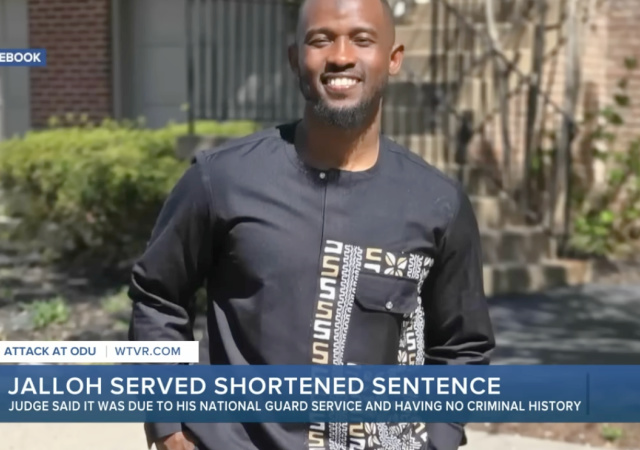
FBI Director Kash Patel appeared on Sean Hannity’s show to tout the agency’s successes in 2025 under President Donald Trump.
But Patel stressed there’s always room to improve, especially when it comes to naturalized citizens who want to harm America and face sentences for terrorism.
Mohamed Jalloh, a naturalized citizen from Sierra Leone, opened fire on an ROTC class at Old Dominion last week, murdering the instructor and injuring others.
The former National Guardsman had been convicted in 2017 of supporting ISIS and expressed a desire to conduct “an attack similar to the November 2009 attack at Ft. Hood, Texas.”
But last week’s tremendous tragedy where a member of our military was killed in Norfolk by an individual, who has been investigated for terrorism, is a stark reminder of what we must do.
That individual was convicted and sentenced for terrorism before, and no one bothered to denaturalize him and remove him from the country.
But Sean, here’s what most Americans don’t know. In the Trump Justice Department in the first administration, that individual, we sought a sentence of 240 months. The judge in that case downward departed and gave him nearly half of that time. Had the judge given the sentence that the Trump administration wanted, that individual would still be in prison and not have conducted that terror attack.
But it goes to the more important point. We need stronger legislation to remove individuals from this country who want to do us harm. The FBI is always going to be standing on the watch, but we need a collaborative effort from the legislative branch to make sure criminals in this country are jettisoned from this country, especially if they violate the rights of the Constitution and American safety.
It seems the U.S. will only revoke your citizenship if you mess up during the naturalization process:
- A. Person Procures Naturalization Illegally
- B. Concealment of Material Fact or Willful Misrepresentation: Concealment of Material Fact or Willful Misrepresentation or Membership/Affiliation with Certain Organizations
- C. Other than Honorable Discharge before Five Years of Honorable Service after Naturalization
That’s…it.
No crime, even federal crimes or terrorism, leads to denaturalization.
Even if the government invokes any of those criteria, it has to go through a court. The government cannot just revoke citizenship.
The DOJ must initiate a civil or criminal court proceeding.
The Supreme Court even narrowed the scope:
In 2017, the Supreme Court held in a unanimous decision in Maslenjak v. United States that only an illegal act that played a role in an individual’s acquisition of U.S. citizenship could lead to criminal denaturalization, narrowing the scope under which an individual may be denaturalized under 18 U.S.C. § 1425. In Maslenjak, the government under the Obama and Trump administrations sued to revoke Diana Maslenjak’s U.S. citizenship for making false statements regarding her husband’s membership in a Bosnian Serb militia in the 1990s. The Supreme Court ruled that if an applicant made a false statement during the citizenship process, the statement must have played some role in the individual obtaining citizenship in order to warrant the revocation of citizenship. The court stated that “small omissions and minor lies” that did not influence the award of citizenship do not necessitate denaturalization. Yet, it remains to be seen how courts will determine whether a false statement played a role in an individual obtaining citizenship.
[Featured image via YouTube]
Donations tax deductible
to the full extent allowed by law.







Comments
Once again our Democrat enemies will fight this too.
Anyone who values the constitution will fight it, unless what he’s proposing is an amendment.
There is nothing in the Constitution that is at issue here, nor would there be any amendment necessary.
The court’s ruling noted above was based on the text of the federal law.
As Patel correctly points out, this can be fixed by amending the law or passing a new one.
That is incorrect. The courts have consistently held, without any dispute, that once someone validly has US citizenship nothing can take it away.
Ms Chastain made a fundamental error here. Maslenjak was not about revoking the naturalization. The government wasn’t even trying to do that. The government knew full well that it couldn’t, because there was no question that the naturalization was valid despite Ms Maslenjak’s lie, and therefore couldn’t be revoked.
Rather the government charged her with a crime for having lied. It argued that although the naturalization was valid, Ms Maslenjak should be convicted of a crime for having told a lie, however immaterial, and throw in prison for that. When she came out she would still be a citizen, but at least she would have served time.
The sixth circuit bought that argument, but the supreme court rejected it 9-0. It said that the text of the law made it a crime only to “procure naturalization contrary to law”, and since the government agreed that the naturalization remained valid, therefore it was not procured contrary to law.
So you see that the entire case was premised on the fact that the naturalization was valid, but a crime had been committed while procuring it, and the government argued that that itself was a crime.
Milhouse always knows best, and what he knows is that the right, sadly of course, is always wrong and the party he’s a registered member of is, again sadly, always right.
ESPECIALLY when his party is blatantly wrong.
Azathoth always always always lies, because it’s his nature and he’s incapable of telling the truth about anything at all.
Weird how you can never cite any of MY supposed lies, but make as if virtue surrounds your endless life of lies, Democrat.
For anyone new here, Milhouse screams ‘liar’ or ‘lies’ any time he is refuted.
You refute your own point: “validly” gain citizenship is defined by federal law.
People are denaturalizes on a regular basis. The federal government has a shockingly high success rate in such cases.
Federal law defines the conditions under which a person may be denaturalized.
The case noted above creatively stretched the limits of the statute, which is the SOLE reason the courts rejected it.
Any future amendment to that law, or passage of a new law, that allowed for denaturalization based on the conditions matchung those in the case would be upheld by federal courts.
Of course it is. But once it has been validly obtained, no law can take it away.
For instance back in the 1940s (I think) Congress made a law that if someone becomes a citizen of a foreign country they lose their US citizenship. The Supreme Court struck that down because it contradicted the 14th amendment.
So no amendment to the statute could invalidate a naturalization over an immaterial lie.
And you imagine Democrats will fight this in the name of Constitutional integrity? If so, you don’t understand Democrat’s motives and goals.
I don’t care what the Democrats will do, because they have no integrity. I’m only interested in the truth, and the truth is that US citizenship, one validly obtained, can’t be revoked.
I can see specifying a list of crimes as automatically denaturalizing a naturalized citizen. The list should be short and the crimes severe.
I’m also thinking that there should be some wordage covering when the person arrived here. It’s a lot different considering denaturalizing someone who arrived when they were 18 than someone else who arrived when they were 2 and knows no other country.
No difference at all b/c the point of the denaturalization is in response to a specific set of criteria. IOW if the shoe fits then they gotta wear it. It shouldn’t matter if they’ve been naturalized for five decades or five months. nor if they came here at age 20 or 20 months. What should matter is whether the criteria apply or not. If they do then they gotta go.
The other issue is when the pathway to effect removal becomes so narrow as to be unusable as a practical matter then folks will stop attempting to use that path and find a different route to the destination of ending that particular person’s ability to reside in the USA.
As I have pointed out here repeatedly, US citizenship once validly obtained, can never be revoked, for any reason whatsoever. It doesn’t matter what a person has done, before or after naturalization, so long as the naturalization itself was valid.
“Denaturalization” is a very misleading name, because by its own terms it doesn’t revoke a naturalization at all. What it does is prove that there was never a valid naturalization in the first place.
It’s exactly the same as when someone claims to be a citizen by birth, and the government proves that they were actually born somewhere else; we don’t call that “debirthing”! By proving that they were born in Canada or wherever, the government establishes that they were never a citizen in the first place, and thus there’s nothing to revoke. The same is true with “denaturalization”.
Either a person has been naturalized or they haven’t. If they haven’t, then they’re not a citizen and never were one. If they have then the constitution says they are a citizen the only power on earth can take that away from them is completely voluntary and sincere renunciation.
If Patel doesn’t like this, his only recourse is to propose a constitutional amendment, and it is impossible to pass one of those without broad bipartisan support. No one party can possibly muster all the votes required.
so while I agree that you cant take away something that never existed
the point would be,,,,,,
is that it did exist,,at some level
and that level was considered a reality..even if in the long(er) run it turns out it was never real
( by what you are ,,and I am agreeing with,,stating)
How Can U.S. Citizenship Be Legally Removed?
Once you get U.S. citizenship, you typically retain it for life. However, there are certain rare situations in which a citizen may lose their citizenship. Denaturalization involves involuntarily having your citizenship taken away. Renunciation involves voluntarily giving up your citizenship.
Denaturalization
https://www.justia.com/immigration/naturalization-citizenship/losing-your-citizenship/
I’m wondering if you would be in favor of such an amendment. I would be concerned about whether it could be worded properly.
Then call it anti naturalization if it makes you happy. But send them packing either way.
The point is that if the naturalization was valid it cannot ever be revoked. There is no such thing as actual “denaturalization”. The constitution forbids it. So it doesn’t matter what crimes a person commits after having been validly naturalized.
the constitution does not forbid it
it shows how it must be carried out
The constitution does forbid it It says that “All persons born or naturalized in the United States, and subject to the jurisdiction thereof, are citizens of the United States”.
Are citizens. Was this person naturalized in the USA? Was he subject to US jurisdiction at the time? Then he is a citizen.
Taken literally this would even include people who’ve voluntarily renounced their citizenship. The reason we don’t read it that way is because that would be contrary to the position the USA has held since its beginning, that a person has the right to change his citizenship. That was the pretext for the War of 1812 — the UK didn’t recognize renunciation of citizenship, and regarded its former citizens as still being that, and therefore subject to conscription. So we went to war, in truth for many more important reasons, but officially to stop the UK conscripting our citizens. We could hardly then impose the same rule ourselves, so the 14A must be read so as not to do that.
re: millhouse march 19 11:26 am
“are citizens” and then since it is a reality ( going back to another comment you made)
it can then be taken away as long as its done properly
. If a person is to be denaturalized – no matter whether it is a criminal or civil case – that decision must be made by a federal judge after the person has been given the opportunity to present their case against denaturalization. Because each case must be heard by a judge, there are significant resources needed to bring each denaturalization case.
https://www.ilrc.org/community-resources/faqs-how-denaturalization-works
No, it can’t. The constitution defines the person as a citizen, no matter what process has been done.
A conviction for a crime will lead to the revocation (at least temporarily) of a person’s liberty. It can also result in the loss of property (in fines and penalties), and even in the loss of life (rather permanent). A person who applies for citizenship is applying for a boon. Naturalization itself is not a right, because application for naturalization can be rejected. There is no right to the boon. And, if acquired, if citizenship becomes a right, it can be withdrawn as any other right may be withdrawn as punishment upon conviction for a crime. There’s really no good reason why citizenship should remain inviolate when the state can impose a death penalty upon conviction certain crimes. If the state can take your life from you, why shouldn’t it be able to take your citizenship away? (Indeed, the penalty for treason is death. Even a natural born citizen can be put to death for treason. Isn’t the death penalty in this situation a form of withdrawal or cancellation of a person’s citizenship? When someone is convicted of treason and hanged, does anyone say, “At least they didn’t take away his citizenship”?)
Even for treason, citizenship can’t be revoked. The constitution says that anyone born here, or naturalized, is a citizen. It gives it as an unchangeable fact. And so the courts have ruled that it can’t ever be taken away involuntarily.
Execution is the revocation of one’s life. And you think that doesn’t include revocation of citizenship? Can the person executed still vote? Have a right to a trial by jury? Keep and bear arms? No, the person executed by the state has lost everything. But you think he’s lost everything except his citizenship?
That’s right. The person died a citizen.
In Chicago they can 🙂
https://www.ilrc.org/community-resources/faqs-how-denaturalization-works
If a person is to be denaturalized – no matter whether it is a criminal or civil case – that decision must be made by a federal judge after the person has been given the opportunity to present their case against denaturalization. Because each case must be heard by a judge, there are significant resources needed to bring each denaturalization case.
It’s more than that. If no flaw can be found in the naturalization, then it can’t be revoked no matter how many resources are devoted.
“small omissions and minor lies”
So, it all depends on how important the meaning of “is” is?
And this is why the “rule of law” doesn’t apply, anymore. It’s also why you (SCOTUS) have no moral authority remaining.
Of course it does. It always does. No one can be convicted of perjury or fraud for an immaterial lie. There is no law and can be no law against immaterial lies. Not everything is everyone’s business. Only lies that affect a decision matter.
No, it didn’t. What it held was always the case. As the criteria you cited clearly state, the concealment or misrepresentation must be of a material fact. Just as lying under oath about an immaterial fact is not perjury, doing so in the process of naturalization is not fraud, and therefore cannot invalidate the naturalization.
In any perjury trial, one of the things the government must establish is that the lie was material. Same thing here. If you are asked a question and the true answer would result in your application being rejected, then if it is discovered that you lied about it that means the naturalization was invalid. But if your application would have been accepted even if you told the truth, then your lie is immaterial and doesn’t affect the validity of the naturalization.
It amazes me that this is a surprise to anyone. The constitution says anyone who is born here or who is naturalized, is a citizen. End of story. Nothing can change that, except voluntary renunciation. Thus the only way someone can be declared not to be a citizen is if they were neither born here nor naturalized. So you have to prove one or the other of those things.
It’s important to note that this only applies if the naturalization was granted in the first place “on the basis of honorable service”. In other words, alien enlists in the US forces and is granted provisional citizenship by promising to serve honorably; if he gives five years of honorable service, or is discharged honorably before that, he keeps it, otherwise he doesn’t because that was the basis in the first place.
just tell the dems that
*denaturalized* means
the person is transing
and besides guys…look at his smiling face
you think that the media could even find that kind of ear-to-ear grin from a bad guy!!?!??!
Let’s focus on not letting the rotten apples in.
Denaturalization is tricky. If we open the door to a constitutional method, it will largely be weaponized by Democrats against Republicans.
So not thrilled to spend energy on this before we fix immigration. Reminder that everything Trump has done to fix could still easily be undone …
TPS, Amnesty, lottery – all these needs to be fixed.
Natural born Citizens ain’t subject to denaturalization. That and the ability to run for President set Natural born Citizenship in a separate category from Naturalized Citizens.
No. The constitution makes no difference between citizenship by birth in the USA and citizenship by naturalization. Both are equally irrevocable, provided of course that they actually happened.
The presidency and vice presidency are the only cases where it makes a difference how someone obtained their citizenship.
Chill. That’s what I wrote minus your unsupported assertion the the US Constitution forbids removal of Citizenship for a naturalized Citizen. The plain text of the Constitution says no such thing. IMO the naturalized Citizen has a claim of property right interest in the grant of Citizenship made to him which absolutely requires full due process before stripping it. Obviously the current holdings of the Judiciary disagree with me, but that might not always be the case.
it does. It defines a naturalized person as a citizen. Therefore no law can say otherwise.
I love articles like this one; and this is excatly why I read this website. I am not a lawyer but always find it very interesting to read your comments and understand how “ideas” like this one lead to legal debates. To me and my non-lawyer mind this idea feels like a slippery slope. Open the doorway to this, and where does it end? Can you start denaturalizing people for disagreeing with certain political opinions, or expressing extreme viewpoints that are unpopular?
Generally the historic pathway to denaturalization has been:
1. Material lies during process of becoming a Citizen
2. Commies
3. Terrorists
4. Service in another Nation’s military (depends on which Nation and what timeframe)
5. Treason (actual, not the internet/pod cast host label)
6. Some sort of link to application process within a set timeframe from grant of Citizenship (sometimes five years sometimes longer) which has the presumption of intelligibility if it was known at time of grant
IOW some ideological beliefs and some actions have been the basis for seeking denaturalization but not mere unpopular opinions in isolation.
The only way to so-called “denaturalization” is to prove that there was never a naturalization in the first place.
In exactly the same way citizenship by birth can be “revoked” by proving that the person was not born in the USA, or was not born under US jurisdiction.
(There was recently a case of a woman born in the USA, but the government proved that at the time of her birth her parents were not under US jurisdiction because they were immune from US law. Therefore the court ruled that she was never a US citizen, even though she grew up here and had no idea that she wasn’t a citizen.)
Denaturalize? I’d rather we simply execute them. Milhouse no doubt will find fault with my simple solution.
If they’ve committed a capital crime, sure. This Jalloh person committed murder as an act of war against the USA. That’s treason, which is certainly a capital crime even if the murder itself were not.