


Chile, U.S. Plan for Strategic Collaboration on Rare Earths and Other Critical Minerals
Chile’s New President, José Antonio Kast, is governing as he campaigned.
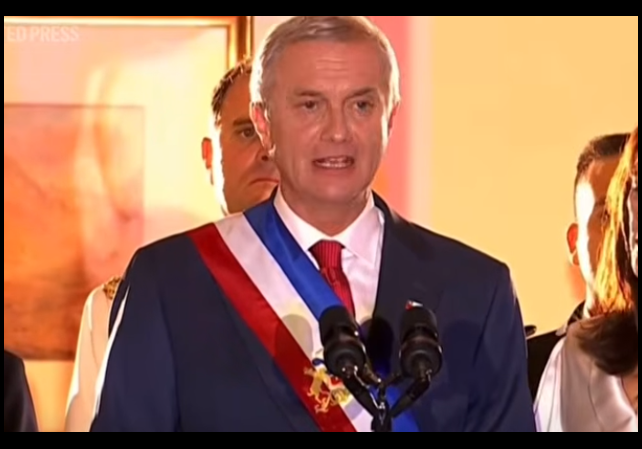
Late last year, my colleague Elizabeth Stauffer reported that “ultra-conservative” candidate José Antonio Kast had won a landslide victory in Chile’s presidential election.
And by “ultra-conservative,” what is really meant is running for office by promising to take actions that normal people want and need. Kast, a Roman Catholic and lawyer, had a campaign centered on restoring order, cracking down on crime and illegal immigration, and revitalizing Chile’s market-oriented economic model through spending cuts and pro-business reforms.
How is Kast doing at this point? Less than a week after his inauguration, construction of a border wall between Chile and Peru began.
Less than a week after his inauguration, Chile’s arch-conservative president on Monday began overseeing preparations to build a border barrier — part of his flagship campaign promise to block immigrants from crossing illegally.
From Chile’s northern frontier area of Chacalluta, where legions of immigrants have slipped across the Peruvian border into one of the region’s most prosperous nations, Kast vowed to implement what he calls his “Border Shield” plan. Among other steps, it involves the construction of a physical barrier at the nation’s northern border made up of ditches and fences and patrolled by drones and the military forces.
…Kast assured the public that “for all of Chile, this is a milestone.”
“We have taken clear and concrete decisions to close our border to illegal immigration, drug trafficking and organized crime,” he said. “We want to implement this without any delay.”
Kast is also moving to build up business and trade by taking advantage of the Trump administration’s plans to enhance and strengthen its critical mineral supply chain. Chile and the U.S. recently signed a joint statement to begin discussions on the development of rare earth mining.
The first meeting will take place within the next two weeks, it added. Areas of potential coordination include public and private financing for mining projects, the management of scrap for minerals recycling, and exploration for new projects that could help boost minerals supplies in both countries.
The Trump administration has been pushing to reduce reliance on China for a range of critical minerals, which are used in electric vehicles, semiconductors, defense systems and consumer electronics.
Chile is the world’s largest copper producer and second-largest lithium producer, although it relies on imports of other minerals.
“I believe there is much we can do with the United States and Chile to strengthen the supply chains of these minerals,” U.S. Deputy Secretary of State Christopher Landau told journalists in Chile, where right-wing Jose Antonio Kast was sworn in as president on Wednesday.
Interestingly, since President Donald Trump took office, the U.S. has invested more than $1 billion in critical mineral resource development across Latin America.
The spending surge under the second Trump administration reflects a broader shift in how governments view mining, with critical minerals increasingly treated as matters of national and energy security rather than simply commodities tied to the energy transition, according to a report by law firm White & Case.
Recent financing underscores the trend. The Inter-American Development Bank approved a $100 million loan for a $2.5 billion lithium project in Argentina, while the US Development Finance Corporation is considering a $465 million investment to expand Serra Verde’s rare earth operations in Brazil’s Goiás state.
Latin America sits at the centre of the strategic push, holding roughly 60% of the world’s lithium reserves.
Kast has wasted no time turning campaign promises into action, signaling a return to policies grounded in common sense, law and order, and economic realities.
His administration’s focus on securing Chile’s borders and strengthening ties with the U.S. on critical minerals development is smart policy and strategic leadership.
With Chile and America cooperating on issues that matter to both nations’ prosperity and security, there’s reason to be hopeful that this partnership will continue to grow stronger. It also makes a stark contrast to how some “allies” have responded to American requests recently.
Here’s wishing both countries success as they work together toward shared goals and a more stable future.
Donations tax deductible
to the full extent allowed by law.







Comments
success occurs when tds is absent
Ohhhh he’s going to build a fence and it will be a big beautiful fence.
Another SA ally. Trump locking China and Russia out of SA’s west coast is a true checkmate move. Despite the bluster, the EU ..
Negotiations for the EU-Mercosur trade agreement began in 1999. The agreement was later signed in January 2026, following multiple rounds of discussions over the years.
27 years to negotiate a trade deal? lol? The EU was forced to act, either sign, or Trump will swoop in and feed their precious deal into a paper shredder.
Not long after Milei won Musk turned up in Argentina and I was thinking Musk may want to build a SA data center hub, but news of that never came along.
Milei also just signed the Mercosur trade deal, which signals that he got what he wanted at the EU’s expense.
The underreported point is denying access to China while getting access for the USA is similar to a ‘pick six’ interception on your own goal line. The other team was about to score at least 3 but the defensive TD isn’t just a seven point swing it’s really a ten point swing. That’s what’s going with locking China out of rare earth minerals and oil/gas.