


Judge Temporarily Blocks DHS Rules for Congressional Visits to Detention Centers
This motion concerns the January 8 memo from DHS Secretary Kristi Noem, which required members of Congress to provide notice to bypass Cobb’s order blocking her June 2025 memo.
U.S. District Judge Jia Cobb in Washington, D.C., granted a temporary restraining order that blocks the Trump administration from preventing Congressional visits to immigration detention centers.
The TRO will remain in place pending further proceedings.
The 13 House of Representatives have challenged DHS’s policies regarding visits to the centers, including a requirement of at least seven days’ notice before such visits.
This motion concerns the January 8 memo from DHS Secretary Kristi Noem, which required members of Congress to provide notice to bypass Cobb’s order blocking her June 2025 memo.
Cobb wrote (I omitted the citations):
The Court assumes familiarity with the factual and legal history of this litigation, including as discussed in the Court’s December 17, 2025, memorandum opinion and order. The Court’s prior opinion found that the seven-day notice requirement as initially announced by ICE in June 2025 was likely contrary to the terms of a limitations rider attached to the Department of Homeland Security’s (DHS) annual appropriated funds. The rider, often referred to as Section 527, prohibits DHS from “us[ing]” appropriated funds “to prevent” Members of Congress from “entering, for the purpose of conducting oversight,” facilities “used to detain or otherwise house” noncitizens. The Court found that the June 2025 notice requirement had been “promulgated with Section 527 funds” and “continue[d] to be implemented and enforced through the use of Section 527 funds.” Accordingly, the Court issued an order under 5 U.S.C. § 705 staying the “effective date[] of implementation and enforcement” of the notice requirement.
Cobb granted the motion because he believes the plaintiffs met the four requirements, including showing a likelihood of success on the merits.
“The Court’s decision on this prong is made significantly easier given that many of the threshold issues implicated by this motion are identical to the ones addressed in the Court’s December 17 opinion and resolved in favor of the Plaintiffs,” explained Cobb. “Defendants’ argument that the standing analysis should come out differently relies on a mischaracterization of Plaintiffs’ current challenge, which like their first challenge, is premised upon the theory that the January 8, 2026, policy violates the terms of Section 527.”
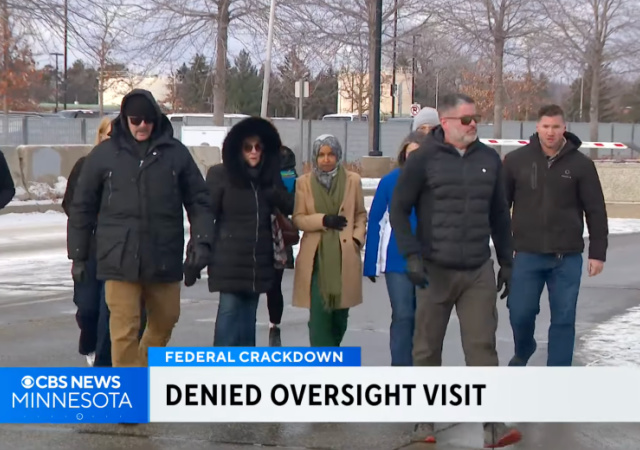
On January 12, Minnesota Democratic Reps. Angie Craig, Kelly Morrison, and Ilhan Omar attempted an oversight visit to an ICE facility in Minneapolis.
DHS denied them access:
News outlets reported the three U.S. representatives were escorted past a row of federal agents, who appeared mostly masked. Craig told MS Now that ICE officials said to her that the facility was funded by the “Big Beautiful Bill,” not congressional appropriations, so members of Congress couldn’t enter the facility.
Tricia McLaughlin, the assistant secretary for public affairs at DHS, cited the policy for the dismissal, stating that the three women were “out of compliance” and that the visit was improper.
Donations tax deductible
to the full extent allowed by law.







Comments
DEI Biden appointee
What do you expect?
J6ers were not given that privilege ….
What privilege? Appointing judges? Being appointed judges? They weren’t being held by DHS, and the BOP appropriation didn’t have such a provision.
If Omar trips into a cell can we just go ahead and deport her?
Well, I don’t have a problem with them visiting. They can come and stand in the wardens office and chat and drink coffee anytime.
I have a problem with them insisting on causing disruptions and fomenting lies. If they attempt to break detention protocol, they will be immediately removed. If their presence causes a commotion, they will be immediately removed. And they can bring NO ONE ELSE with them. Only the members themselves will be allowed in.
The problem is that the law funding DHS explicitly requires that they be allowed in to inspect the facilities whenever they like. No notice is required, and nothing may be hidden from them.
The only dispute is whether this policy can be implemented without using any of the funds that are subject to that provision.
let them visit
get pics of them socializing with law breakers and attach that fact with them supporting the ra pes and murders that have occurred via any illegal
hammer that home during any debates
No worries. Simplest process is Congress visits with a 7 day advanced notice which allows for increased staffing to provide not just security but the ‘VIP’ dog/pony show treatment. If a particular member doesn’t want to do that then they get treated like any visitor who would interact with detainees; strip searched, shoved into general population and left to fend for themselves until time to move the detainees out of that particular area. No special access, no security detail. Their choice.
Sign the waiver. Great someone will check on you in a half hour. Please remember I can’t risk officer’s lives if there is any incident until sufficient staff arrives which could be hours as there are 5 of us an 300 of them. Have a nice day.
The law doesn’t allow that. It specifically requires that they are entitled to enter and inspect the facilities with no notice.
Visitors to prisons are not strip searched, or shoved anywhere. And that’s people who are being allowed in as a privilege. Congressmen aren’t being given a privilege, they’re there as of right, so they can’t even be subjected to the restrictions that ordinary visitors are.
That’s all assuming, as the plaintiffs do and as the judge thinks is likely, that these facilities are being funded at least in part with money that’s subject to that provision.
Adopt a new policy as follows:
Require a 7 day notice for inspection if Congressional members request security for the visit along with funds prepaid from their offices,
Members need no advance notice if they agree to visit without security and assume responsibility for any adverse outcome.
Members may bring and pay for their own security, but must submit the names of all security personnel 14 days in advance for vetting.
Again that would violate the law. Even congressional aides (which these security people would be) must be admitted on 24 hours’ notice.
And again, that assumes this provision applies to the funds being used to implement this policy. The government claims it can segregate the funding, and ensure that the policy is implemented using only funds that are not subject to the provision.
If they said that they’re obviously wrong, but I don’t believe they said that.
The “OBBB” is a congressional appropriation. There is nowhere else funding can come from. The government is prohibited from spending any money that was not appropriated by Congress.
The issue here is that the bulk of DHS funding comes from last year’s continuing resolution that ended the shutdown, which continues the appropriations from the 2024 continuing resolution, which continued those from 2023. And all funds from that resolution are subject to § 527, which explicitly requires that DHS facilities used to detain people must allow Congressmen in with no notice whatsoever, and Congressional aides with 24 hours’ notice.
The “OBBB” appropriated additional money for DHS, which is not subject to that provision. The government is now claiming that all resources used to implement the new policy, right down to the computers, ink, paper, etc., as well as the salaries of all employees for the time they’re implementing the new policy, all come from that additional money and none from the continuing resolution.
The judge thinks that is very unlikely, and a former DHS and ICE official testified that it would be difficult or impossible to segregate the funding like that. It all goes in one pot and everything comes out of that. Therefore the judge thinks the policy is being implemented, at least in part, using the appropriation that provides the vast bulk of the department’s funding, and is thus subject to § 527.