


From Train to Nowhere to Yosemite Gateway: Newsom’s PR Makeover on Rails
An exercise in “value engineering” rather than real engineering.
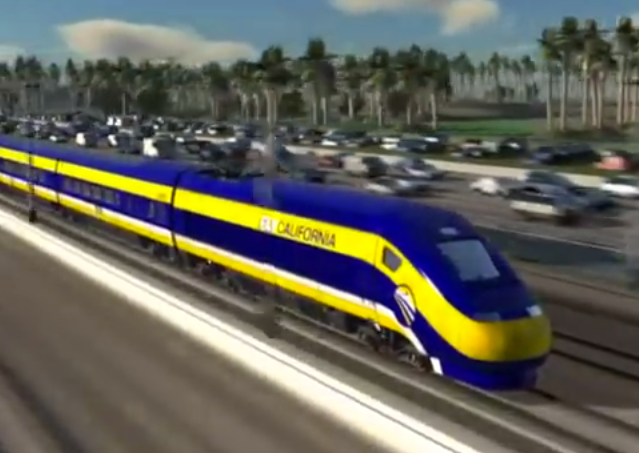
The last time we reported on California’s high-speed rail project to nowhere, my colleague Mary Chastain noted that President Donald Trump and his team had cancelled federal funding and were investigating where all the grant money for this fiasco had gone.
In an attempt to recover from this embarrassment and salvage some credibility ahead of the 2028 presidential campaign season, California Gov. Gavin Newsom portrayed the high‑speed rail as entering a “track‑laying” phase, emphasized Central Valley investments, and framed the project as proof that U.S. high‑speed rail is achievable despite past delays and cost overruns.
State and local officials framed the milestone as evidence of tangible progress on the nation’s only high-speed rail system under construction, with more than 80 miles of guideway and 58 structures completed in the Central Valley.
“Newsom joined community leaders and construction workers to celebrate the completion of the Southern Railhead Facility in Kern County—a major milestone that allows California to begin receiving and staging materials needed to install high-speed rail track and systems along the California high-speed rail corridor,” the governor’s office said in a news release.
The governor called the moment “another critical step in the track‑laying stage,” saying California was demonstrating that a U.S. high‑speed rail network “can be done.”
As of mid‑2025, about $13.8–14.6 billion has been spent on the project, and the original vision marketed around 2008 assumed the full Los Angeles–San Francisco system would be operating between 2020 and 2030, with the “last rail” effectively laid by about 2030.
Desperate to change the narrative from abject failure, California High-Speed Rail leaders are now promoting a plan to market a relocated Merced high‑speed rail station as a “gateway to Yosemite”.
Even then, there would be a 70-mile bus ride between the train station and the national park.
California’s flailing High-Speed Rail project is undergoing yet another marketing smokescreen, with soaring costs leading officials to pitch a pipe dream of bullet trains depositing riders at Yosemite National Park.
Facing ballooning costs and missed deadlines, the boondoggle – now estimated to cost well over $100 billion if it’s ever completed – has state rail officials and Central Valley leaders floating a plan to shift the future Merced station out of downtown and rebrand it as a Yosemite access point.
However, the newly proposed station, which would reportedly be about four miles southeast of the originally proposed station in downtown Merced, would still require bus shuttles to ferry tourists 70 miles to trailheads.
“This is just gaslighting,” Assemblymember David Tangipa (R-Fresno) said. “Their model is just to rename it and let’s make everyone feel good.”
Apparently, $1 billion could be saved by this move!
According to reporting by The San Francisco Chronicle, California High‑Speed Rail Authority officials began scouting alternative station locations in late 2025 as part of an effort to reduce costs, speed up construction, and move away from an earlier proposal that would have bypassed Merced entirely.
When Peter Whippy, chief of external affairs at the California High‑Speed Rail Authority, presented the southeast station proposal to Merced City Council on January 12, he said the change would streamline construction and lower costs, a strategy known in the industry as “value engineering,” per The Chronicle.
A relocated station could save at least $1 billion, according to officials involved in the discussions.
…Under the concept, the station would not be located inside Yosemite National Park.
Any connection to the park would rely on additional ground transportation, such as buses, to carry passengers from the station to Yosemite Valley.
It might be better if the project developers focused on real engineering rather than “value engineering”.
Truly, this monstrosity will be the cherry on top of Newsom’s failure sundae.
@GavinNewsom ‘s political career is best defined by the Train to Nowhere.
Massive government waste contributing to the highest cost of living State in the USA. Gavin destroyed CA.https://t.co/p4MqOn4FjN— Joe F. (@JoeF61423228) February 11, 2026
Instead of a sleek express to Yosemite, Californians are getting a 70‑mile bus transfer and a billion‑dollar game of “rebrand and pretend.” At this point, “High‑Speed Rail to Yosemite” looks less like a gateway to granite cathedrals and more like a slow, expensive mule train to further waste, fraud, and fiscal abuse.
Donations tax deductible
to the full extent allowed by law.






Comments
The contractors keep telling themselves: “It’s just a job”. I know quite a few of them and they like the work, just not the project/the goal/the impending fail
Greasy Newsolini and the vile Commiefornia Dhimmi-crats are unabashed and brazen thieves, stealing money from the federal and Commiefornia fiscs, to funnel to their union cronies and other assorted Dhimmi-crat donors and courtiers.
In the private sector, financial profligacy and performance failures such as these, would fairly result in audits and criminal charges.
a major milestone that allows California to begin receiving and staging materials
So… a 10 year milestone in the project is … to build the parking lot where they will stash the rails before taking them out to lay them?!? This is usually done within a week or two on highway projects.
Yosemite is one of the most visited National Parks, and typically full during the popular seasons. You simply can’t “just drop in” unless you plan to drop out at nightfall. The roads were mostly created by the depression era civilian works agencies, and they become rather serpentine once you pass Mariposa. However, there is infrastructure in the valley for day guests, up to and including a medium sized market (serves the RV, tents and camping sites). Because of existing demand Yosemite has begun to restrict entry during busy times, though this is generally related to auto traffic. Travel from Merced would be at least 90 minutes each way, plus whatever hang up you find at the west gate.
It would be possible, perhaps practical, to use the no-where trail for such trips. But Yosemite, as it exists now, could not handle anything close to the traffic necessary to make this train-wreck profitable.
Turn the stalled California High-Speed Rail project—often dubbed a “train to nowhere”—into a must-see spectacle of unfinished grandeur, akin to the ongoing Crazy Horse Memorial.
Market it as a living monument to bold dreams, bureaucratic mishaps, and engineering ambition.
Charge admission fees starting at $20-50 per person, with packages for families and groups.
To paraphrase an Ozzy song;
The railroad to nowhere leads to Newscum.
Turn it into a tourist attraction by rebranding it as “The Rail of Dreams” Monument:
1. Develop a visitor center near key unfinished sections, like the Fresno viaduct or Merced tracks, with interpretive signage explaining the project’s history, delays, and over-run costs.
2. Partner with artists to install murals or sculptures along the route depicting “what could have been.”
3. Generate revenue from entry fees and branded merchandise like “I Survived the Train to Nowhere” T-shirts.
4. Build elevated observation decks and shuttle services to transport visitors to prime viewing spots of abandoned tracks, half-built bridges, and overgrown rail beds.
5. For thrill-seekers, add drone flyovers or virtual reality simulations of the “completed” rail zipping through the state.
6. Erect “Tunnel of Scum” sign at starting end.
7. Plant trees at end-of-line station, erect sign saying “YOSEMITY PARK.”
Very good!
HSR stops being high speed when it stops at smaller towns.
You could run a spur to Yosemite or even electric buses but then what? Clog the park with a ton of people and transportation to the point visitor numbers are curtailed and then it’s useless again.
Are they planning to use electric buses? $250-$500k more expensive than diesel and how are they going to charge them? Where is that ultra expensive power coming from and the round trip distance is right on the edge of range for the cheapest electric passenger buses out there.
Here is a stat for you:
Newsome’s Train to Nowhere – 10+ years, 0 miles 0f track
Transcontinental Railroad – 6 years, 1,900 miles of track
The original idea for HSR was LA to San Jose. With extensions to San Diego and SF. It was to be alternative to air travel.
Re-routing thru central valley has derailed the project. There will never be enough ridership from smaller towns to justify it.
Correct. It was never going to amount to anything more than a very expensive carnival ride.
I’m intimately familiar with the land between Merced and Yosemite. Given the mountainous terrain, the number of trestles that would be required, etc. etc. across deep ravines, this short spur could well cost more than the entire HSR boondoggle to date.
Re: the valley route making the entire project absurd, it was moved to the valley because the first – envisioned costal route because the cost of that route was incomprehensibly more expensive.
Speaking of cost, the estimate listed in the original proposition, for the entire San Jose to L.A. route was risible, at least a magnitude lower than the cost so far of the silly Merced – to – Bakersfield route.