


Chuck Schumer Suddenly Against ‘Berating Supreme Court Justices’
“He was like a 10-year-old, name calling, foot stomping, berating Supreme Court justices. He’s like a baby”
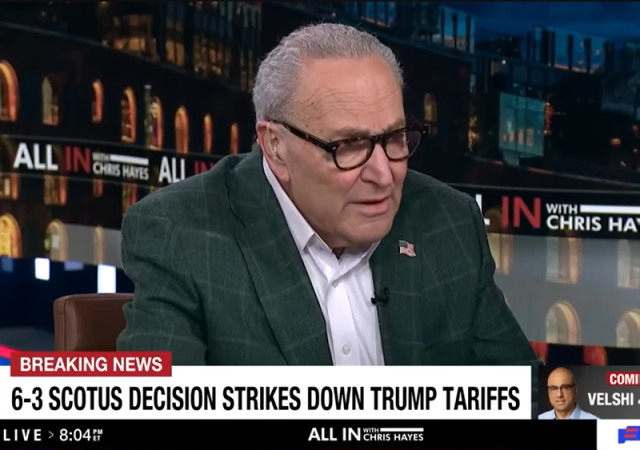
Senate Minority Leader Chuck Schumer (D-NY), appeared on MSNOW this week to gloat over the U.S. Supreme Court ruling against Trump on tariffs and had the nerve to accuse Trump of “berating Supreme Court justices.”
This, from the man who stood outside the court just a few years ago and threatened Justices Kavanaugh and Gorsuch that they would reap “the whirlwind” over Roe v. Wade.
I have combed through media reports on Schumer’s appearance, and it’s amazing how virtually no one is reporting what he said.
Take this report from The Hill, for instance:
Schumer hails Supreme Court tariff ruling as ‘a win for the wallets’ of Americans
Senate Minority Leader Chuck Schumer (D-N.Y.) on Friday hailed the Supreme Court’s ruling that struck down a significant amount of President Trump’s tariffs as a victory for Americans and the U.S. economy.
“This is a win for the wallets of every American consumer,” Schumer said in a statement. “Trump’s chaotic and illegal tariff tax made life more expensive and our economy more unstable. Families paid more. Small businesses and farmers got squeezed. Markets swung wildly.”
“We’ve said from day one: a president cannot ignore Congress and unilaterally slap tariffs on Americans. That overreach failed,” he continued. “Now Trump should end this reckless trade war for good and finally give families and small businesses the relief they deserve.”
The court’s 6-3 ruling represents a major blow to the administration’s economic policy and effectively wipes away one of Trump’s hallmark actions during his second term. The president has warned in recent months that striking them down would be a financial calamity for the U.S. given the tens of billions collected via these tariffs.
They left out the best part.
The only place I have been able to find the quote is on the MSNOW video page:
“He was like a 10-year-old, name calling, foot stomping, berating Supreme Court justices. He’s like a baby,” says Sen. Chuck Schumer on Trump’s response to the Supreme Court striking down his sweeping tariffs.
Western Lensman, a popular video clipper on Twitter/X, created a great side-by-side of Schumer’s comments:
Chuck Schumer with an assist from Stephanie Ruhle: Trump was berating Supreme Court Justices. It’s outrageous.
Both Chuck and Stephanie must've forgotten about the time Chuck actually threatened Supreme Court Justices.
Wasn’t mentioned. pic.twitter.com/MaItTilpSg
— Western Lensman (@WesternLensman) February 21, 2026
Note how host Stephanie Ruhle didn’t push back on Schumer at all.
It must be nice to be a Democrat.
Here’s the full segment if you’re interested:
Featured image via YouTube.
Donations tax deductible
to the full extent allowed by law.






Comments
Chuck Schumer has ZERO INTEGRITY.
Au contraire, Upchuck Shumer’s integrity is less than 0 and by a considerable amount.
More proof.
Look for his picture in the dictionary next to the word “sphincter.”
He is a punk and a thug. He always will be.
I’m wondering, since when has upchuck become an economist? He’s been in office and our debt is now at 37 trillion or so, projected to go higher.
So why hasn’t anyone ever questioned him how he’s been in office and his economic ignorance has never been questioned.
Schumer is a hypocrite willing to say or do anything if he perceives it might benefit him and his position. So he’s for berating the Supreme Court justices until he’s not and then we’re all supposed to forget his infamous “I want to tell you, Gorsuch, I want to tell you, Kavanaugh, you have released the whirlwind and you will pay the price.” 2020 speech when the SCOTUS. overturned Roe v. Wade.
Hypocrite. Hypocrites all. And Schumer is the worst of the lot.
Chuck Schumer is the Snidely Whiplash of the Democrat Party.
I’m not really sure why he’s gloating. Trump clearly anticipated this ruling and has adapted his strategy accordingly. Tariffs aren’t going away, they’re simply going to be imposed under different statutes.
I have a theory – hear me out – that Trump is moving towards a fiscal scenario in which the 16th Amendment can be repealed.
If he can do that it’ll be the greatest accomplishment by a politician since…
I’m having trouble thinking of one.
The countless trillions that have been stolen from the American people in the century since ratification of the 16th has been the most caustic acid eating at our liberty. The 16th deserves to die.
If your repeal can come about somehow plus the minimum 10% fraud that is built into our annual budgets can be found out and eliminated..
Repealing the 16th amendment would probably do nothing at all. It certainly wouldn’t get rid of the tax on earned income, which is what most people’s income is. There was never any question about Congress’s authority to tax that. The only challenge to the income tax was to taxing income derived from property, such as rent, interest, and dividends.
The Supreme Court decided that that’s what the constitution means by a “direct tax” — a tax on something for merely existing. And the constitution says that if Congress imposes such a tax it must be “apportioned among the states according to their respective numbers”; I have never seen any explanation of what that is supposed to mean, or how it could work for anything except a poll tax.
So at most repealing the 16A would make income from rent, interest, and dividends tax free; most people don’t get their main income from those. But even that’s unlikely. If the 16A were repealed it’s unlikely that today’s Supreme Court would agree that taxing rent, interest, and dividends is a direct tax. The last time it ruled on the Direct Tax clause was in the 0bamacare case, and its discussion of the clause was very unclear.
Decades ago, I think it was George Will who suggested adding by amendment the words “of up to 25%” after “The Congress shall have power to lay and collect taxes on incomes”
Nothing at all?
Surely you cannot be serious.
Put a tariff/tax swap aside for a second.
Low income people pay nothing into the system and their votes reflect a desire to keep it that way. I have to make up for their laziness.
High income people pay professionals to game the system to their favor to limit their tax exposure. I have to make up for their greed.
The income tax was sold to the American people as a small levy on the super rich. That was a (bleeping) lie. It’s an absolute crime that I work until mid April to fund this 🐂💩.
What we learned in 2025 is that the waste, fraud and abuse in our federal government alone (never mind the states) is far worse than we could have imagined.
I’m tired of being robbed and you should be too.
Yes, Peter, repealing the 16th would certainly do very little, and would probably do nothing at all.
The tax on earned income would continue exactly as it is. Congress never needed an amendment to tax earned income, so the repeal wouldn’t affect it.
At most income derived from property, i.e. rent, interest, and dividends would become untaxable; That wouldn’t affect most people. But in all likelihood that wouldn’t happen either. The Supreme Court would likely hold that the tax on such income is not a direct tax, so it too would be unaffected, making the repeal entirely without any effect at all.
The welfare are not gaming the system at all. They are taking advantage of the tax laws that our congress people wrote and passed.
Decades ago, I held stock in general electric. I was at a party and someone was bitching about the fact that General Electric paid in income tax. I said that I was happy that they had a team of tax lawyers working for them to make sure that they didn’t pay any taxes because it made my dividend checks higher.
That sound that I heard was their head exploding.
The welfare -> the wealthy
Quite right. There is no “gaming the system of tax loopholes”. The tax laws are written as they are and if you can find a legal way around them then you can save a bunch of money. With the internet and AI it is increasingly easy to find all these “loopholes”.
Same with welfare ho’s. They are not gaming anything. They are smart enough to use the system to the maximum extent they can unless they are engaged in fraud of course.
Millhouse, not being critical, but this is something I have studied extensively.
The income tax is an indirect tax. Indirect taxes are not taxes on things, they are taxes on revenue taxable activities, occupations, and events. As SCOTUS has explained, the revenue generated by the actions are used as the measure of the tax. Yes, this makes it look as if the income itself is being taxed, but this is not what is happening. It’s not the money/profit that’s being taxed, it’s the activity that produced the profit. This is why it’s called “indirect” – the tax is indirectly determined by the profit made by the activity.
A direct tax is (as you say) a tax on people (as in a poll tax) or things such as the number of chimney on a building (you may be aware that such taxes have been imposed in the past). Federal direct taxes must be apportioned so that a bill for its share of the federal budget can be delivered to every state based on its population. How the revenue is raised by the States is up to them. They can dun every person for their share (a poll tax), or they can raise the revenue in any manner consistent with their own constitutions and laws.
Indirect taxes, OTOH, are levied according the rule of (geographic) uniformity. This means that two manufacturers of spirits (the manufacture of spirits being a revenue taxable activity) are subject to the same tax on their distilling operations no matter where they are operating within the country. (They may end up paying different amounts for having different profits, but the tax rates will be the same in every place, they can’t differ by location. Doing so would make the tax unconstitutional.)
The three cases you should read are:
Pollock v Farmers Loan & Trust
Brushaber v Union Pacific RR
Stanton v Baltic Mining Co.
The first sets the table for Congress’ perceived need for the 16th Amendment, and the latter two are the “income tax” cases (both delivered the same day) that explain what the amendment was meant to do and how it does it, and explains, just as importantly, what it didn’t do. (To wit, it “granted the Congress no new powers of taxation” as per Stanton.)
How does this make sense? Let’s say Congress wants to tax chimneys. How can it possibly be apportioned according to population? Not all states have the same number of chimneys per capita.
And the tax is not on the states. No federal taxes are on the states. Federal taxes are always on individuals, not the states in which they happen to be located. So why would the state government be involved at all?
The nearest I can come to understanding it, and it makes little sense to me, is that if Congress wants to raise $100 million from a chimney tax, it can’t simply count how many chimneys there are and divide $100M by that amount to arrive at a flat rate per chimney. Instead it must allocate that $100M target by state according to its population, so that if for instance CA has 10% of the population the tax must aim to raise $10M from people in that state, and it must then divide $10M by the number of chimneys in CA. That way the per-chimney rate would be different in each state. But that just sounds bizarre. Can that really be what the framers and adopters intended?!
Some learned in such things believe the only direct tax contemplated by the authors was a poll tax. A direct tax must be apportioned. The tax bill is for budget is handed to each state according to its population (that’s the apportionment). How the money is collected is up to the States. (Unless Congress demands a poll tax itself.) The States can simply also apportion the tax directly to each person in the state, but I don’t know if that was ever done. Indeed, I don’t know if a direct tax has ever been levied.
Direct taxation isn’t in my lane, because I’m concerned with the income tax and it’s an indirect tax. Read the three cases. In them, you will learn 1.) there are two “great classes” of taxes, direct taxes and indirect taxes*; 2.) that direct taxation is on tangible things; and 3.) that indirect taxes are on intangibles, to wit, revenue taxable activities, occupations, or events. Regarding the latter, the Internal Revenue Code specifically exempts “State revenue-raising activities” from income taxation. Note it is the activity of raising revenue that’s exempt from the tax, not the revenue itself. That’s because the income tax is a tax on activities not things.
In the 1880s Congress passed an income tax (the second income tax, the previous tax having earlier sunsetted). Pollock complained the tax was administered in a way such that it was indistinguishable from a direct tax and was therefore unconstitutional for not having been apportioned. SOCTUS agreed, saying although income taxes are within the class of indirect taxation (and therefore not subject to apportionment), the then-current income tax was, in fact, in its effect (the court having explained that it had to examine both the letter and the effect of the income tax law) indistinguishable from a direct tax (agreeing with the plaintiff) and was therefore unconstitutional for lack of apportionment. The 16th Amendment nullified the decision, preventing the courts from considering the income tax as anything but an indirect tax no matter how it is administered, effectively preventing Pollock’s complaint from being brought again against a similar tax. (As it otherwise could be brought against our current income tax. Everyone thinks it’s a direct tax on money earned. It is not. It’s a tax on the activity that generates the profit. However, it looks like a direct tax and would be unconstitutional according to Pollock, but it isn’t because the 16th Amendment defanged that argument.)
Here’s the amendment:
The Congress shall have power to lay and collect taxes on incomes, from whatever source derived, without apportionment among the several States, and without regard to any census or enumeration.
Here’s how it should be read (with an understanding of the afore-mentioned cases):
The Congress shall have power to lay and collect indirect taxes on incomes, from whatever revenue taxable source derived, without apportionment among the several States, and without regard to any census or enumeration.
It’s literally a counter to the argument made in Pollock by giving leave to Congress to make exactly the same type of tax as contemplated in Pollock because the amendment now prevents Pollock’s argument from being used against it.
Please read the cases. As I said, I’ve studied this. In the 1980s I knew those cases inside and out and could quote extensively from them. I realize you (and many others reading this) are encumbered by a life-long misunderstanding of the income tax and the 16th Amendment. It doesn’t help that many texts used in law schools say (about Stanton) that the amendment gave Congress the power to collect a new tax (when if in fact says the opposite). Task yourself with finding the quote in Stanton in which SCOTUS says the amendment granted Congress “no new power of taxation.” Then go to a law library, find three or four law school text books that mention the case, and see if they don’t flat-out lie about it. (I have seen this with my own eyes several times over the years. To this day, if I have a law text book in my hands, I look up those three cases, and, if they’re mentioned at all, the text almost invariably mischaracterizes or outright lies about what SCOTUS says in them. I used to hang out at the Brown University book store, and I never saw a law text book there that stated the truth about these cases. Never.)
*Here’s why people think the 16th Amendment is required for an income tax. They believe because an “income tax” isn’t mentioned in the Constitution that Congress has no authority to create such a tax. These people are wrong because the income tax is merely a type of indirect tax. The Constitution authorizes practically any kind of tax, because all taxes are either on tangible things (and therefore are direct taxes) or intangible events and activities (and therefore are indirect taxes), and Congress has plenary authority to impose any direct or indirect tax with the only restrictions on the power being the that former must be apportioned and the latter must be (geographically) uniform (the same tax everywhere in the U.S.).
Dave, I don’t understand how a tax on people can involve the government of the state in which they happen to live. Surely it’s the individuals who owe the money, and they owe it to the federal government. So how can a state government be interposed?
And if Congress decides to tax chimneys, how can a state decide to tax something else instead?
I’m not proposing a different way that it could work, I’m saying that your explanation doesn’t make sense to me, but nothing else does either. I don’t understand how it was ever intended to work. It’s no wonder to me that it’s never been tried.
As for the case that led to the 16A, my understanding is that it held that taxing income derived from property is the same thing as taxing the property itself, merely for existing. How is a tax of 10% of all rental income different from a tax on all land in the amount of 10% of the rent it fetches? Therefore, the court said, the income tax as applied to rent is a direct tax that must be apportioned, whatever the **** that means. Likewise with interest and dividends. Taxing interest is the same as taxing capital, and taxing dividends is the same as taxing shares. But it had no problem with the tax on earned income, because that’s clearly not a tax on any object, but on the work that generated the income, and that’s just fine.
Therefore if the 16A were to be repealed this would not affect most people’s income taxes at all. Wages and salaries would be taxed exactly the same as now. As for rents, interest, and dividends, my bet is that the current courts would disagree with Pollock and say that taxing capital is a direct tax, but taxing the interest it generates is indirect and therefore can continue the same as now.
I am interested in your comment, and would appreciate it if you were to correct me on anything you think I got wrong here.
Pardon my density…
If they didn’t need the 16th for an (earned) income tax, why’d they do the amendment? Why no (earned) income tax til they had that amendment?
It’s not like our
extractive overlordsmoral and intellectual superiors like having to find authoritah for stuff they wanna go do. Still less do they like asking for authoritah they don’t yet have. Start askin n people might start asking back what they’re doin. Inconvenient, that.So, another question: what were they looking to get from this authorization, — since they didn’t need it to tax income — worth diin tbe ritual n raising the issue?
What don’t you understand? They didn’t need any amendment to tax earned income. And they did have an income tax before the amendment. On all income, whether from labor or property. Then the Supreme Court struck down the tax on income from property, so they amended the constitution to allow that. The tax on income from labor continued undisturbed and unchallenged throughout.
I don’t understand your second question. They didn’t need the amendment to tax earned income. They did need it to tax income derived from property, since the Supreme Court decided that is a direct tax and must be apportioned.
So if the 16A were to be repealed it would at most affect only income from property. If the current court agreed that a tax on such income is a direct tax, then such income would no longer be taxed, unless they figured out what “apportionment” means in this context. But my bet is that the current court would not agree that it is a direct tax, in which case the 16A does nothing and its repeal would do nothing.
Repeal of the 16th Amendment is not necessary. SCOTUS stated “The 16th Amendment gave Congress no new powers of taxation” (Stanton v Baltic Mining Co.).
Without going into detail, the amendment was passed to nullify an earlier decision (Pollock v Farmers Loan & Trust) that placed a constraint on how income taxes could be levied. The 16th Amendment refutes that decision. This is why the language of the 16th Amendment is so difficult for most to understand. If you don’t know that it’s a reply to Pollock it’s difficult to make sense of it. Knowing (and understanding) Pollock makes the amendment easier to understand.
The upshot is the amendment’s repeal would not prevent the institution of an income tax, as the income tax is a type of indirect tax and Congress has authority to levy both indirect and direct taxes under its general power to tax. (Income taxes were levied before the amendment. The tax in question in Pollock was an income tax. It wasn’t struck down as unconstitutional per se, but as unconstitutional for being indistinguishable from a direct tax and direct taxes require apportionment – with the tax under review not being so apportioned. That’s as much as I care to write about this here! A complete understanding would take pages.)
Of course the 16th gave Congress a new power, otherwise Congress wouldn’t need an Constitutional amendment to tax income
No. Congress has always been able to lay direct taxes, it just has to apportion them, and I don’t understand what that means, though Dave has tried to explain it to me. The 16A exempted the tax on income derived from property from that requirement. Not only can Congress tax it, which it always could, it no longer has to apportion it as it has to do to all other direct taxes. Whatever that means. So it doesn’t give Congress a new power, it just reclassifies certain direct taxes as if they were indirect.
But the tax on earned income (i.e. wages and salaries) is indirect, so it never had to be apportioned. The 16A does not affect it at all, so repealing it would also not affect it at all.
See my post below at around this time. Schumer is trying to craft a narrative in case the economy improves under Trump going forward.
Trying to keep food down. Please, no Schumer videos!
Trump is wrong in this particular instance, and he did in fact react like a small child, but Schumer is the last person in the world with the right to tell him so. If Trump reacted like a ten-year-old, then Schumer did like a five-year-old. At least Trump didn’t threaten the justices.
The fraud once threaten members of that court.
This gives Trump the opportunity to give tax payers a large rebate with the tariff money collected. The Democrats claim it is the American tax payer who has paid the tariffs. Okay give it back to the American tax payer. Do not give the money back to the importers or the foreign companies.
If this was an illegal tax on ordinary Americans, they should get the money.
The media portrayed the tariffs as a burden on the consumer, but that’s not how they work. Everyone in the chain from the manufacturer to the retailer eats a small portion of any tariff, with the buyer paying merely the balance. This is usually not a large amount, as most products are already being sold for what the market will bear and simply can’t be sold for too much more. If buyers are burdened with too much of the tariff, the retailer won’t be able to sell the items. All industries would rather maintain their markets and make less profit than have to abandon a market for not being able to compete on price. So, this is what they do – everyone takes as small a hit as necessary to continue to sell products. The buyer does not pay the entire cost of any tariff.
That’s ridiculous. The tariffs must be repaid to the people who paid them in the first place, which is the importers. What they do with the money is their business.
If you were illegally hit with a $500K tax on your business, and managed to pass $400K of that on to your customers in raised prices, and then you won your case and recovered the stolen money, would you pass any of that refund on to your customers?! Of course you wouldn’t.
At the end of the day, the Democrat will always support screwing the people.
Even when the Democrat was insisting that it was the people (and not the businesses or the nations) who were bearing the brunt of the tariffs.
Azathoth is lying through his evil fangs, as usual. Every word this person writes is a vicious, evil lie. I don’t understand why he hasn’t been banned. He poisons the entire forum with his presence. Never has anything to contribute. He only exists to libel and attack me.
A consumer rebate plan would be sued into oblivion by the companies who now have legal recourse to pursue compensation.
Schumer is not being an idiot here, just playing to the lowest common denominator.
He knows that if enough Dems shout about the courts reining in Trump it will mitigate any momentum he gets from improving the economy. Their media allies will claim it is in spite of him instead of because of him.
Chuck-U Schumer stands as the devil himself in the well of the Senate and on American soil. He is a charlatan, a political whore, with an emphasis on evil.
St. Michael the Archangel, defend us in battle. Be our defense against the wickedness and snares of the Devil. May God rebuke him, we humbly pray, and do thou, O Prince of the heavenly hosts, by the power of God, thrust into hell Satan and all the evil spirits who prowl about the world seeking the ruin of souls. Amen.
He’s a Charles-atan?
easy solutions abound
no incone tax and everyone pays a flat tax not on their income
but on goods
and yes that includes the poor b/c we pay their way anyways
and yes that does eliminate the government freebie/favortism of 503 etc etc charitable donations etc
people who want to give will continue to give
Repeal the 16th and replace it with a flat tax of 10% for everyone. With that you can downsize the IRS by 90-95%. Also gets rid of thousands of pages of tax codes. Also gets rid of all the 501c3’s and 4’s and other charity giving. No longer need trusts to prevent Uncle Sam from getting his hands on generational wealth. Sunsets existing trusts and subjects them to same 10% flat tax per year. It’s way past time to do all these things. It’s fair and all you need is your w-2 and a single Nile piece of paper to fill out. Write your check and you are done. The bonus is that because it’s an amendment Congress can’t increase it. Another benefit is it ties Congress’s hands on income and all that progressive BS they peddle.
Flat tax on what? All income? Then you have to define income and you have to decide on what is deductible, exactly like now. You can’t tax gross receipts, with no deductions. That would result in confiscating more than 100% of many people’s incomes! Anyone whose net income is less than 10% of his gross receipts, which is a lot of people. So you’d need hundreds of pages of regulations, just like now. Mostly they’d have to be the same regulations.
Yeah, whatever happened to the “reap the wind” rant?
More lies from Chuckie Scummer:
“The court’s 6-3 ruling represents a major blow to the administration’s economic policy and effectively wipes away one of Trump’s hallmark actions during his second term.”
Uh, no. Trump’s putting it all back under different statutory authority previously granted to the Executive by Congress. Just more lies from the NY state reptile.
Every President seems to overreach their statutory nor constitutional authority in some manner and has to be corrected by SCOTUS. Obama did it, Biden did it, and Trump did it. Trump pushed the limits in using IEEPA to levy tariffs just as Biden pushed the limits with his C-19 vaccine mandate and his student loan forgiveness schemes.