


Utah’s Desert Yields Rare Earths Motherlode, Challenging China’s Grip on Critical Minerals
Andre Zeitoun, CEO and founder of Ionic Mineral Technologies: “A watershed moment for American resource independence.”
I recently reported that the U.S. has been rapidly securing its pipeline to critical minerals, supporting the development of a Brazilian mine while an American firm merges mining with rare earth elements (REE) processing capabilities.
These developments were the result of President Donald Trump’s team exploring partnership opportunities with other countries to both mine and process REEs, gutting China’s essential monopoly on these minerals. This move followed months of threats of export controls by China.
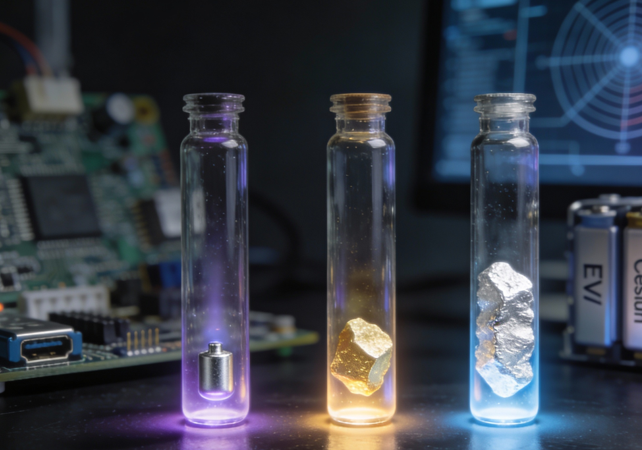
Well, there is more good news to be had. Ionic Mineral Technologies, a U.S.-based advanced materials company focused on nano‑silicon anode materials, has confirmed it has identified a high‑grade deposit of 16 different critical minerals and rare earth elements at its Silicon Ridge project in Utah’s Lake.
Ionic MT had leased the land as part of its business producing nanosilicon for lithium-ion batteries, which are used in electric vehicles. But the company told WSJ Pro Sustainable Business that what it found was a host of other minerals, in what it says may be the most significant critical mineral reserve in the U.S.
Ionic MT said it discovered high grades of 16 different types of minerals, everything from lithium to alumina, germanium, rubidium, cesium, vanadium and niobium at the site in Utah’s Silicon Ridge Mountains.
Ionic MT said it has had several meetings with the Trump administration and that the White House has expressed “clear enthusiasm about our work and its potential national impact.”
Rubidium and cesium, which are used for atomic clocks, can be found at the Utah site, along with scandium, which is essential for the aerospace industry. The U.S. currently relies on other countries to secure rubidium, cesium and scandium.
Independent tests show the Utah deposit is a halloysite‑hosted ion‑adsorption clay, a geological type known for concentrating valuable minerals. In practical terms, it shares the same clay‑hosted footprint that is similar in profile to China’s deposits.
Critically, Silicon Ridge demonstrates what Ionic MT characterizes as an ‘IAC-Plus’ profile: rare earth concentrations comparable to China’s deposits, but with subsequent hydrothermal, magmatically enriched grades of critical technology metals including gallium, germanium, rubidium, cesium, scandium, lithium, vanadium, tungsten, niobium, and a full suite of light and heavy rare earths (La–Lu, Y).
“This confirmation is a watershed moment for American resource independence. For the first time, we have a domestic, shovel-ready source for a full spectrum of critical minerals, all extractable with a faster, cleaner process than traditional hard rock mining and extraction,” said Andre Zeitoun, founder and CEO of Ionic MT. “With our mining permits and processing facility in place, we can now move rapidly to production, reducing a key strategic vulnerability for the United States.”
— Faytuks Network (@FaytuksNetwork) December 11, 2025
The company already has the mining permits and processing capabilities in place to make the most of its mining permits.
“This confirmation is a watershed moment for American resource independence,” Andre Zeitoun, CEO and founder of Ionic MIT, noted.
Zeitoun added that the deposit represents a rare opportunity to produce a wide spectrum of critical minerals within the US, using a faster and cleaner extraction process than traditional hard-rock mining.
“With our mining permits and processing facility in place, we can now move rapidly to production, reducing a key strategic vulnerability for the United States,” he continued.
The company’s method relies on low-temperature ion exchange rather than high-heat processing or heavy acids, with recovery rates of up to 95 percent.
In a year when America has been scrambling to loosen China’s chokehold on the minerals that power everything from missiles to EVs, Silicon Ridge looks like an early Christmas present from Utah’s desert. Instead of rare earth wish lists going to Beijing, this discovery hints at a future where the U.S. can stuff its own stockings with homegrown critical materials, turning a long‑running supply‑chain nightmare into a made‑in‑America holiday miracle.
I CLEARLY HAVE BEEN VERY GOOD THIS YEAR! Looks like more rare earths mining stock is going to be in my Christmas stocking this year! https://t.co/bCVOB2n0i4
— Leslie Eastman ☥ (@Mutnodjmet) December 12, 2025
Image by perplexity.ai
Donations tax deductible
to the full extent allowed by law.




Comments
Keep it up and dial up the pressure
FYI they are private but if they IPO for capital this is pretty much a no brainer. I expect they will stay private though as it’s the smarter play.
True. If publicly traded, anybody can buy shares anywhere.
One more thing. Let’s not underestimate silicon and semiconductor chips. That’s one of many reasons why Taiwan must remain free.
Excellent news!
Good news!
WAY off-topic: Happy Beethoven’s Birthday to one and all.
Just don’t call me your Sweet Babboo.
-LOL!-
(My favorite strip with Schroeder was the one where he is asked how he can play all those complex pieces on a toy piano when the black keys are just painted on. His response: “I practice a lot.’.
I like special where Sally wants him to play Jingle Bells and his piano sounds like everything from a baby grand to a pipe organ.
And Jane Austen’s 250th on the 16th too.
Waiting for a district court judge with an unpronounceable name to halt mining while a lawsuit filed by some Indian tribe is heard.
Good news for the Mormon state!!!
Cue the Environmental protection lawsuits to prevent development.
The thing about ‘rare earths’ is not that they are particularly rare but that they occur in low concentrations or mixed with other ores such that it is costly and messy to mine and extract them. That’s why China has grabbed so much of the supply because it is difficult to adhere to WEIRD environmental regs during mining and processing.
it will be good to start getting electronics that don’t include the labor of black child slaves.
not american black children
since brazil is owned by the chinese…………..
“Panda” Xi will be upset.