


Harvard Program Caught Trying To Hide Discriminatory Language After Complaint Filed By Equal Protection Project
“Students of Color” restriction scrubbed: “Sometimes they say the quiet part out loud. And that’s what we found with the Harvard Union Scholars Program…. That they changed the language after the New York Post ran an article about it and after our complaint to me is a sign of consciousness of guilt.”
On December 7, 2025, our Equal Protection Project filed a complaint and request for investigation with the U.S. Department of Justice regarding a paid internship run jointly with Harvard and AFSCME (the municipal workers union).
The “Union Scholars Program” was for “historically marginalized” students – a euphemism for non-white student as we noted in our complaint:
The Union Scholars Program is explicitly race-restricted. Its eligibility requirements state that applicants must “[b]e a college student of a historically marginalized community.”13 The phrase “historically marginalized community” 14 is often used as an alternative to “underrepresented minority,” and AFSCME makes this meaning clear elsewhere.
14 “Historically marginalized communities” is the inclusive alternative to the term “Underrepresented Minority.” See https://ohr.dc.gov/sites/default/files/dc/sites/ohr/page_content/attachments/OHR_ORE_RacialEq uity_ILG_April2023.pdf [https://archive.is/wip/2hNo6] (accessed November 16, 2025). Further, courts often define the term “historically marginalized communities” to include “Black,” “African-American”, “people of color,” or “Hispanic”/”Latinx” persons, and to exclude “white” persons. See New Georgia Project, Inc. v. Attorney General, State of Geogia, 106 F.4th 1237, 1239 (11th Cir. 2024) (defining “historically marginalized communities” as including “Black” and “Latinx” citizens); see also Menders v. Loudon Cnty. Sch. Bd., 65 F.4th 157, 160, 165 (4th Cir. 2023) (equating students who had been “historically marginalized” with “students of color”); Newman v. Google LLC, 687 F. Supp. 3d 863, 870 (N.D. Cal. 2023) (defining “historically marginalized consumers” as those being “like” the “African American and Hispanic” Plaintiffs, and not “white” persons); Finn v. Cobb Cnty. Bd. of Elections & Registration, 682 F. Supp. 3d 1331, 1334 (N.D. Ga. 2023) (discussing “the voting rights of historically marginalized communities, including those of Black and Latinx voters”); FSC Interactive, LLC v. Rogers Collective, Inc., No. 22-cv-4450, 2025 WL 790444, at *1 (E.D. La. Mar. 12, 2025) (referencing brief in support of motion for partial summary judgment for definition of “historically marginalized groups,” which included “women” and “people of color”); Voice of the Experienced v. Ardoin, No. 23-cv-331-JWD-SDJ, 2024 WL 2142991, at *25 (M.D. La. May 13, 2024) (noting that the term “historically marginalized…focus[es] on Black Louisianans and communities of color.”)
The obvious, plain, and legal meaning of “historically marginalized” students was stated openly on AFSCME’s website, it meant “students of color”:
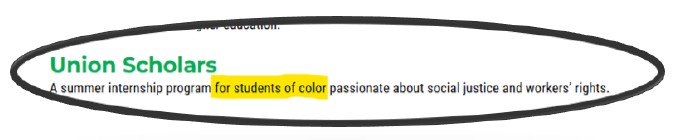
AFSME said the quiet part out loud, and later regretted it.
On December 8, 2025, after the NY Post published an article about the case, highlighting the “students of color” language, AFSME changed its website. We know that it was after the NY Post publication because earlier that morning we archived the AFSME page showing “students of color” language (yellow highlighting added).

But later that day, as also captured in the archive, AFSME changed “students of color” to “students of historically marginalized communities” (yellow highlighting added).

This is why we always archive web pages.
Legally the change doesn’t matter, because “historically marginalized communities” means non-white. But the attempt to scrub the evidence reflects a consciousness of guilt.
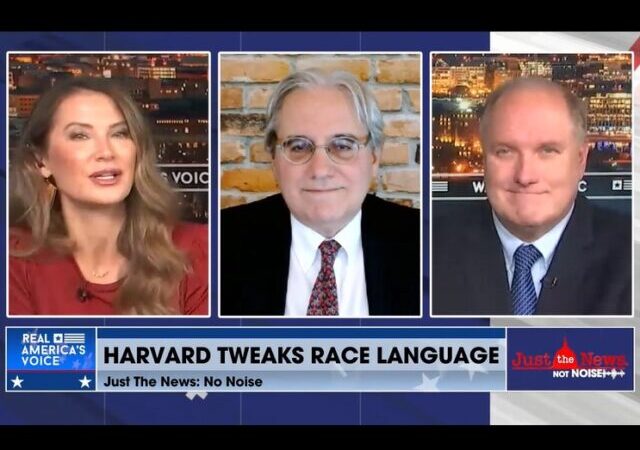
I appeared on Just the News with John Solomon and Amanda Head to talk about the case. (I also talked about race-based congressional redistricting and campus antisemitism, you can watch the full segment at the bottom of this post.)
Here’s the excerpt regarding our Harvard-AFSCME case:
Transcript (auto-generated, may contain transcription errors, lightly edited for
Head (00:07):
Welcome back, everybody. The government and Harvard University are still going at it over diversity, equity, and inclusivity programs, even after the Supreme Court ruled that most race-based affirmative action programs in admissions violate the 14th Amendment. Well, as it turns out, Harvard still reserved a scholarship for ‘students of color’. But after it was pointed out by a complaint filed to the Civil Rights Division of the Justice Department, that phrase was changed to ‘historically marginalized communities’. So, joining us now to discuss this, the founder of Legal Insurrection and the Equal Protection Project, the group who filed the complaint, Cornell Law, professor William Jacobson. Professor, thanks so much for being with us tonight.
WAJ (00:46):
Thanks for having me on.
Head (00:49):
You know, we as a society typically applaud rebranding. Madonna reinvented herself at least a half a dozen times, and everybody was a congratulating her. But when you rebrand your anti-whiteness, your racism, it’s definitely not something to be applauded. And it still is just racism, isn’t it?
WAJ (01:07):
Yes. And sometimes they say the quiet part out loud. And that’s what we found with the Harvard Union Scholars Program.
It’s a scholarship, an internship program that’s quite lucrative for students, a summer program that nets them over $10,000 that they run with AFSCME, the Municipal Workers Union. And it’s a joint program between Harvard and the Union. And they talk about historically marginalized communities. But that’s something of a defined term. We all know what that means. That means non-whites.
And they actually admitted it on the website because in a very prominent place, they said, this is for students of color. They said the quiet part out loud, they said the euphemism of historically marginalized communities, they said out loud what we all know it really means.
And of course, after we filed a complaint with the Department of Justice and asked for an investigation, and after the New York Post ran an article about our complaint, what did they do? They changed the language again, but it’s a little too late because they’ve been discriminating, it’s right on their website.
We caught them, and changing it after the fact doesn’t really change anything.
[unrelated discussion removed]
Solomon (02:17):
So I want to go back to where we started this great conversation, and that is with the Harvard case and the new complaint that your great group has filed. It could have some more significant repercussions than even the issue at hand. Obviously, Harvard sued the Trump administration saying, Trump has no right to punish our university, take funding from us, because we’re just a good ally here. But if it’s shown in this case that they’ve just gone back and done discrimination again, could that strengthen the Trump administration’s hand that Harvard should be penalized the way it has been?
WAJ (02:45):
Well, it could.
Certainly the Department of Justice we hope will take our complaints seriously. It’s thoroughly documented.
The fact that they changed the language after the New York Post ran an article about it and after our complaint to me is a sign of consciousness of guilt. If they thought they were good, they wouldn’t have to change the language.
And what they’re doing is they’re changing the language to hide what they’ve been doing. But it’s too late because it’s all documented. It’s screenshotted, it’s archived. We do all those sort of things before we file a complaint so they can’t go back and change the record.
And I think the Department of Justice needs to seriously consider whether this blatant act, this open act of discrimination, is something that will factor into any deal they may strike with Harvard. Maybe they will take a tougher line or maybe they will prosecute this case. So I think it has potentially huge implications.
Head (03:40):
Yeah. Yeah, I think you’re right. Absolutely. Cornell Law professor and Legal Insurrection founder William Jacobson, thanks so much for joining us tonight and thank you for all your important work.
WAJ (03:49):
Great. Thank you too.
FULL SEGMENT
Donations tax deductible
to the full extent allowed by law.






Comments
Harvard’s credibility is going so far into negative numbers that it’s going to take a microbiologist or an astrophysicist to keep track of it.
The Hyperacute Interdynamics department is now rejecting all such grant offers.
Portland Public Schools seems to be dancing on a wire with their new black student center (open to all, but good luck whitey).
https://www.youtube.com/watch?v=N_wy1yi6FYs
https://www.oregonlive.com/education/2025/12/after-5-years-portlands-center-for-black-student-excellence-finds-its-home.html
Put these blatantly discriminatory institutions under a special master to monitor rigorous adherence to anti discriminatory policies in admissions, promotions and program guidelines that force them to forgo their desires to use group/tribal membership instead of individual evaluation on true merit.
Nope. The rot is too ingrained. Shut them down, let them lie fallow for a couple of generations, then start over.
A good test for compliance would be that awards not exceed the percentage of the recipients race in the population. If that percentage is excided, than the next time it could be awarded should be forfeit. That would mean that they could not give the first 8 awards would have to go to Caucasians 🙂