


FDA Moves to Curb Monkey Testing for Monoclonal Antibody Products
In addition to benefitting Americans by lowering the cost to develop new pharmaceuticals, the move will also help make the US more competitive with China.
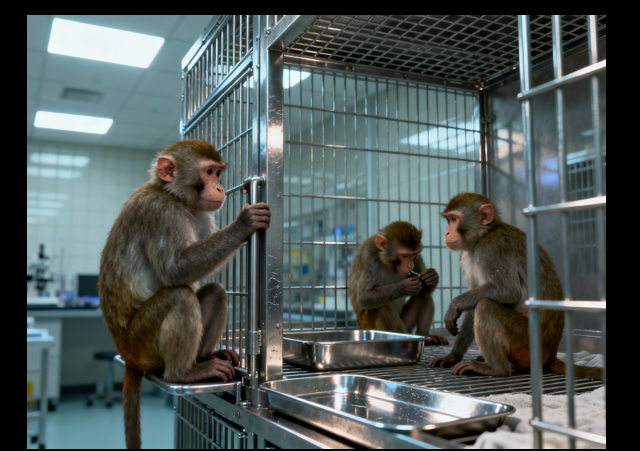
I recently reported that the federal Centers for Disease Control and Prevention (CDC) has been ordered to end research using monkeys.
Now the U.S. Food and Drug Administration has released draft guidance aimed at scaling back the use of laboratory monkeys in preclinical toxicity testing for certain monoclonal antibody products. A monoclonal antibody product is a medicine made from a single, lab‑produced antibody that is specifically designed to stick to one specific target in the body, like a marker on a cancer cell or an inflammatory protein.
According to the agency, this policy change is intended to streamline development programs and lower research and development expenses, with the potential for those savings to contribute to reduced drug prices ultimately.
Under current FDA requirements for monoclonal antibodies, companies conduct studies in animals to test for any harmful effects of a drug.
A typical preclinical program for a monoclonal antibody could involve more than 100 non-human primates, at a cost of roughly $50,000 per animal, the agency said.
The FDA said toxicity testing on primates that can last up to six months can now be reduced or eliminated, and that it is incorporating other types of risk assessments into its decision-making.
The guidelines follow the approach outlined in an announcement earlier this year, indicating that the FDA aims to reduce the use of animal testing through new research approaches.
The FDA’s animal testing requirement will be “reduced, refined, or potentially replaced” with so-called New Approach Methodologies, or NAMs data, which include the use of AI-based models to predict a drug’s behavior as well as side effects and testing on human organ-like structures made in a laboratory.
“There is currently no full replacement for animal models in biomedical research and drug development,” the National Association for Biomedical Research (NABR) said in a statement.
While AI promises to speed up many aspects of research, it largely depends on pulling from existing data, said NABR President Matthew Bailey.
Today we issued draft guidance outlining specific product types for which the FDA believes six-month non-human primate toxicity testing can be eliminated or reduced. The guidance reflects the FDA’s continued progress in modernizing nonclinical drug evaluation to make it more… pic.twitter.com/pqASW1oU5k
— U.S. FDA (@US_FDA) December 2, 2025
The FDA plans to use risk assessments that rely on human‑focused methods (e.g., computer‑based toxicity modeling, lab‑grown mini‑organs, and real‑world data on how drugs affect people) to inform regulatory decisions.
A typical nonclinical program with a monoclonal antibody product could include more than 100 non-human primates (often macaque monkey species), incurring costs of approximately $50,000 per animal. Yet many products that clear toxicity testing in animals do not receive FDA approval, predominantly due to safety or efficacy issues in humans.
“By incorporating a knowledge-based risk assessment, we can make better informed decisions about drug safety while maintaining the rigorous safety standards that patients depend on,” said Richard Pazdur, M.D., Director of the Center for Drug Evaluation and Research. “Risk assessments may leverage advanced methodologies. This evolution in our approach reflects both scientific progress and our responsibility to use the most effective tools for drug evaluation.”
In addition to benefiting Americans by lowering the cost to develop new pharmaceuticals, the move will also help make the US more competitive with China.
The change in animal testing guidelines, which the agency had signaled earlier this year, is one of a series of initiatives instituted under Makary to help streamline development and lower drugmaker costs. It comes as China’s biotech sector, which has fewer regulatory burdens and strong government support, has eroded the U.S.’ once-decisive advantage and helped fill more and more of the world’s pharmaceutical pipeline.
Which reminds me….we are at the 6-year anniversary of the Wuhan outbreak that morphed into the covid pandemic.
6 years ago today: A man in Wuhan starts feeling ill, becoming the first confirmed case of COVID-19. Later it becomes a pandemic & officially over 7 million (unofficially 14-33 million ) people are killed by this Chinese virus.
This is the big contribution of China for humanity. pic.twitter.com/cgvAAiMOpo
— Baba Banaras™ (@RealBababanaras) December 1, 2025
Donations tax deductible
to the full extent allowed by law.






Comments
They better hold up. Caesar has warned us “Apes do not want war. But will fight if we must.”
We must stop all
Animal testing
This is the way