


European Union Surrenders to Reality on 2035 Ban on Gas-Powered Cars
Allowing a mere 10% to be sold after 2035 may not seem like much, but I expect that percentage to steadily increase.
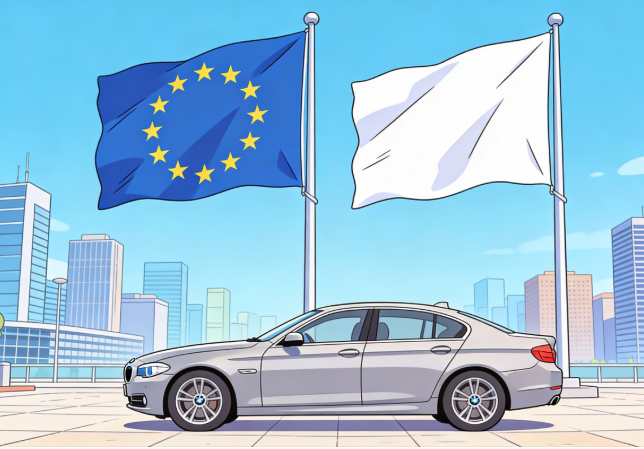
There have been many interesting changes to the climate recently… and the one I am referring to here is the political one.
Less than 2 months ago, President Donald Trump declared victory over “climate crisis” hysteria as it has become apparent that a global, man-caused disaster is unlikely to occur, and the media has begun to signal defeat in their drive to push this narrative.
Bolivia and Chile have joined Argentina in electing business-oriented leadership uninterested in pursuing economy-crushing climate inanity.
Bulgaria was slated to join the Eurozone this January. Still, citizen protests have arisen, driven partly by resistance to rule by bureaucrats from afar, which have likely resulted in new leadership less likely to embrace those plans.
Clearly, the influence of both climate cultists and European politicos is waning.
In a critical sign of political climate change, and after years of mandating an end to internal combustion engine (ICE) vehicles by 2035, combustion and hybrid cars will likely remain on sale in the European Union after 2035 under a proposed change that softens the bloc’s original plan for a 100% phase‑out of ICE options.
On Tuesday, the European Commission proposed applying the ban, approved in 2023, to only 90% of vehicles, down from 100%. This means the remaining 10% of new cars made after 2035 could still be plug-in hybrid vehicles or those with internal combustion engines.
The move, unveiled by the EU’s executive arm alongside other measures to support the bloc’s car industry, represents a setback for tackling climate change, although the commission’s president, Ursula von der Leyen, said Europe remains “at the forefront of the global clean transition.”
“From 2035 onwards, carmakers will need to comply with a 90% tailpipe emissions reduction target, while the remaining 10% emissions will need to be compensated through the use of low-carbon steel … or from e-fuels and biofuels,” the European Commission said in a statement.
The proposal is likely to be approved by European lawmakers. Prior to the announcement, Reuters reported that Manfred Weber, president of the EPP, the largest party in the European Parliament, said the EU was planning to scrap the ban and indicated that he supported the new plan.
Allowing a mere 10% may not seem like much, but I expect that percentage to increase steadily. However, as with the elite media, the bureaucrats are likely slow-rolling their tacit admission that the climate crisis was built on pseudoscience. Furthermore, it is the beginning of an acknowledgement that the automobile manufacturers’ warnings about the technical realities of this E.U. pipe dream were correct.
As a reminder, about one year ago, I wrote about BMW’s CEO, Oliver Zipse, arguing that the 2035 ban on ICE cars was unrealistic and could increase reliance on Chinese batteries.
At the this month’s Paris Auto Show, BMW’s CEO, Oliver Zipse, made it clear that Europe needs a new regulatory approach, one that leverages its own strengths in technology and doesn’t hinge so heavily on battery imports.
“A correction of the 100% BEV target for 2035 as part of a comprehensive CO2-reduction package would also afford European OEMs less reliance on China for batteries,” Zipse said according to Auto News. “To maintain the successful course, a strictly technology-agnostic path within the policy framework is essential.”
Perhaps, in addition to making cars that function in today’s world and that people want to drive, it is a sign that Europeans are beginning to detach themselves from a heavy reliance on anything Chinese. That, too, would be a win for the nations on that continent.
The moves, which require approval from EU governments and the European Parliament, mark the bloc’s biggest retreat from its green policies enacted over the previous five years.
It follows Ford Motor announcing on Monday a $US19.5 billion ($A29.4 billion) writedown as it axes several EV models, in response to US policies and weakening EV demand.
European car makers including Volkswagen and Fiat owner Stellantis have also flagged soft EV demand and urged looser targets and lower fines for missing them.
…German manufacturers are under particular strain as they lose ground in China to local rivals and face growing competition at home from Chinese EV imports.
As she often does, Hot Air’s Beege Welborn distills this development into a high-octane summary.
It’s kind of interesting how – let mix my metaphors here now – the Brussels Brahmins split the baby to supposedly appease the industry, which catches serious grief here for their ‘heavy lobbying,’ while bowing to the brutal reality check of what the ban was going to do to the collective European economy. That is not emphasized as much.
In fact, it’s not even discussed, as no one likes to admit, especially the Imperial EU hierarchy, that they’ve been running high on unicorn fart power instead of fact-based decisions for their regulation spewing.
In a nutshell, carmakers and E.U. member states argued that a full ban was too abrupt, risking jobs, competitiveness, and consumer backlash, and E.U. legislators appear to have listened. The result is a compromise in which electric vehicles remain the main destination, but combustion cars get to coast in the right lane for a while longer.
Europe is declining BECAUSE of the EU pic.twitter.com/cPfUfjy1UE
— Douglas Carswell🇬🇧🇺🇸 (@DouglasCarswell) December 16, 2025
My 2026 prediction is that ICE cars will continue down European roads into the foreseeable future, because deadlines will get extended and percentages increased.
Donations tax deductible
to the full extent allowed by law.






Comments
Fools and their serfs. That is the best description I know of for the Eurotrash citizens and their EU overlords.
no more tax breaks for write downs /write offs etc
that way when a company makes its decisions
it has to live with the good andddd the bad
instead of the taxpayers unwittingly or not bailing them out…again
If the E.U. tackled Islamofascism/Muslim supremacism/Muslim terrorism with the same fervor, enthusiasm and heavy-handedness with which it deals with the contrived/non-existent issue of “climate change,” Europe would be a much safer and better place.
It never was about “the climate.” It was always about control.
Eat the bugs, serfs, and live in your pods. You’ll escape your 15-minute city if and only if we say so.
At least in this AI image, the wind is blowing the two flags in the SAME direction. 🧐
“while the remaining 10% emissions will need to be compensated through the use of low-carbon steel “.
How does the composition of steel alloy even enter into the conversation?
Sure – lets mandate weaker steel and thus less crashworthy cars…