


Court Temporarily Lifts Order Blocking Trump’s D.C. National Guard Deployment
The one-page order said the ruling will stay in place as the U.S. Court of Appeals for the D.C. Circuit considers the administration’s appeal.
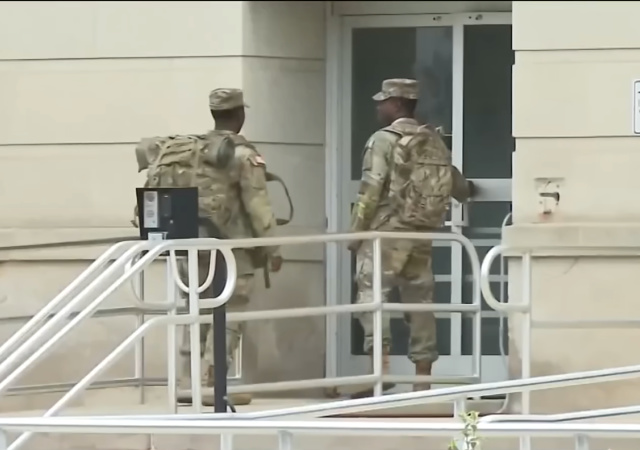
A three-judge panel on the U.S. Court of Appeals for the D.C. Circuit temporarily lifted an order that blocked President Donald Trump from deploying the National Guard in D.C.
The one-page order said the ruling will stay in place as the court considers the administration’s appeal.
“The purpose of this administrative stay is to give the court sufficient opportunity to consider the motion for stay pending appeal and should not be construed in any way as a ruling on the merits of that motion,” the judges wrote.
In September, D.C. Attorney General Brian Schwalb sued the Trump administration, claiming the deployment “subjected the District to serious and irreparable harm.”
U.S. District Judge Jia Cobb sided with Schwalb on November 20, a week before a man shot two National Guardsmen in D.C.
“The Court finds that the District’s exercise of sovereign powers within its jurisdiction is irreparably harmed by Defendants’ actions in deploying the Guards,” Cobb ruled.
The administration appealed Cobb’s ruling, insisting the deployment is lawful:
This deployment is plainly lawful. The D.C. Guard is a federal entity over which the President serves as Commander-in-Chief. Even without express statutory authorization, he may deploy them to a federal enclave for federal purposes without judicial second-guessing. In any event, the President also has express statutory power: Federal law authorizes both the D.C. Guard and Guard members from other States to provide “[s]upport of operations or missions undertaken … at the request of the President or Secretary of Defense,” which is exactly what deployed Guard members are doing. 32 U.S.C. § 502(f)(1), (2)(A). If that were not enough, the D.C. Code recognizes the Guard’s permissible use “to aid the civil authorities in the execution of the laws,” D.C. Code § 49-404, and the Commanding General’s power to “order out any portion of the National Guard” for any “duties” he “may deem proper,” id. § 49-102. It is hard to imagine a decision less susceptible to judicial overriding than the Commander-in-Chief’s directives that are squarely authorized by multiple federal laws.
[Featured image via YouTube]
Donations tax deductible
to the full extent allowed by law.






Comments
“The Court finds that the District’s exercise of sovereign powers within its jurisdiction is irreparably harmed”
What “sovereign powers?”
Has this twit ever read the constitution?
I was going to say thr same thing. The TDS is strong with district judges.
She’s a black woman. I’m not even sure she can read.
DC exercises sovereign powers under the DC Home Rule Act. The judge found that the deployment irreparably harms that exercise.
The idea that the government, when exercising it constitutional authority, can cause actionable “harm” is ludicrous. Any “harm” caused by the exercise of such authority is lawful policy. Let’s look at the converse – DJT has deployed the NG in D.C. and crime has dropped precipitously. He then decides to withdraw the NG and is sued by the city’s government for the harm the NG’s withdrawal would cause (increased crime). Can the court order Trump to maintain the presence of the NG? No. Because if the deployment of the NG is within the POTUS’ authority, his decision to withdraw them is just as valid, and vice versa.
Consideration of harms and benefits is the basis for policy. Such considerations are separate and distinct from the authority itself. Having the authority, policy that flows from its exercise is at the discretion of the official exercising such authority. Courts have no authority to dictate policy. A government act is either constitutional or its not. If it is, acting or not acting under lawful authority is a policy decision (unless mandated by law).
When deciding whether to grant a temporary injunction, as in this case, one of the most important considerations is whether failure to grant it will cause the plaintiff irreparable harm.
So yes, the harm to DC’s sovereignty is a legitimate factor in the decision to grant an injunction while the case is heard.
Injunction… temporarily lifted
Injunction… temporarily lifted
Injunction… temporarily lifted
When Trump issues an EO, it’s like he’s buying a gun, and has to come back after a five-day waiting period,
You eventually get the gun anyway, but in the meantime the proggies get to f* with your life.