


Chinese and Japanese Boats Have Standoff Near Disputed Islands as Tensions Increase
Earlier this year, Chinese cutters ram and use water cannons against Philippine fishery vessels near the Spratly Islands.
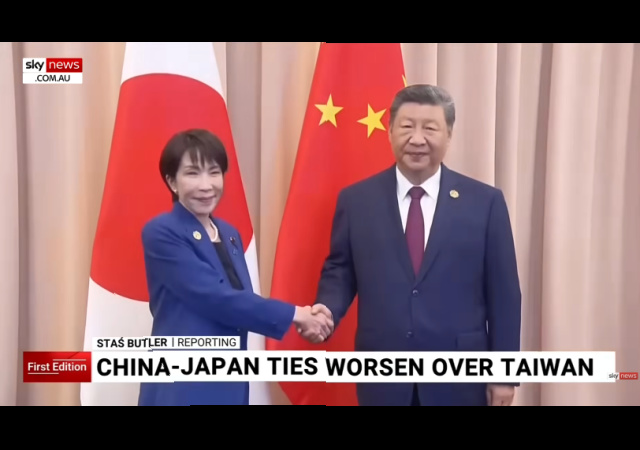
I recently reported that Japan scrambled aircraft after detecting a suspected Chinese drone near its southern island of Yonaguni, an island close to Taiwan.
The move came after harsh remarks from a Chinese diplomatic official and other forms of protest by China that followed in the wake of Japan’s new Prime Minister Sanae Takaichi verbalizing that her country would be willing to defend Taiwan. Shortly after the drone event, Japan signaled it was moving ahead with missile deployment to this very island.
Now, China and Japan’s coast guards are giving vastly different accounts of a recent standoff between their boats near a group of islands in the East China Sea.
China’s Coast Guard said on Tuesday that a Japanese fishing vessel had illegally entered the waters of the Diaoyu Islands – which Tokyo calls the Senkaku Islands. China claims them as their territory, despite the islands being administered by Japan.
Japan’s Coast Guard, meanwhile, said it intercepted and expelled two Chinese Coast Guard ships as they approached the fishing vessel.
The confrontation comes as diplomatic ties between the two nations spiral, after Japan’s leader made controversial comments about Taiwan last month.
…Taiwan is located about 160km south-west of the Senkaku Islands.
It seems China’s claims are questionable. Imagine my surprise! https://t.co/gnOkvEsRlc
— Leslie Eastman ☥ (@Mutnodjmet) December 4, 2025
The accounts suggest that the Chinese boats were harassing the fishing boat, a pattern consistent with other incidents. For example, Chinese cutters rammed and used water cannons against Philippine fishery vessels near the Spratly Islands in October of this year.
The incident occurred on Saturday morning near Manila’s largest possession in the disputed waters while the vessels were anchored, according to a Philippine Coast Guard news release. The three Bureau of Fisheries and Aquatic Resources offshore vessels were in the area to support a Kadiwa mission, an initiative started by President Ferdinand Marcos Jr. to provide protection and logistical support to Philippine fishermen in the disputed waters amid Chinese harassment and harsh weather conditions.
Sandy Cay, known to China as Tiexian Jiao and the Philippines as Pag-asa Cay, was the site of an April incident in which Chinese and Philippine forces asserted their respective claims.
The report resembles Japan’s Coast Guard account, except for the absence of water cannons.
The only thing the two sides agree on in today’s event is that there was a Japanese fishing boat in the area. The Japanese Coast Guard says it detected Chinese vessels on the so-called “rights-protection patrols.” China is reported to have four Coast Guard vessels on one of these patrols that began in mid-November.
The Japanese say they warned the Chinese Coast Guard not to approach the fishing boat. They report positioning between the Chinese vessels and the fishing boat and intercepting two China Coast Guard vessels. The Japanese report that they stayed with the fishing boat until the Chinese withdrew.
Japan has every right to be concerned about Chinese interest in its fishing waters. In 2020, I reported that a Chinese fishing fleet plundered the ecologically sensitive area around the Galapagos Islands.
Some call it a floating city, a flotilla of 260 mostly Chinese fishing vessels near the Galapagos archipelago that is stirring diplomatic tension and raising worries about the threat to sharks, manta rays and other vulnerable species in waters around the UNESCO world heritage site.
Yet the vast fleet is in international waters, outside a maritime border around the Galapagos and also outside coastal waters off Ecuador, which controls the archipelago. That means the fleet, one of the biggest seen in years off South America’s Pacific coast, is likely to fish with minimal monitoring until its holds are full.
China’s massive fishing fleet had spent 73,000 hours in ONE month ravaging the waters right off the Galápagos Marine Reserve
It is a UNESCO World Heritage site with unique species found nowhere else on Earth.#China is ranked as the world’s worst nation in IUU fishing index. pic.twitter.com/DxrorgT1PD
— Nguyen Ho (@NguyenHo1096438) November 29, 2025
Unless other nations give China a big incentive to stop, the thuggery will continue…by sea and by air, apparently.
Donations tax deductible
to the full extent allowed by law.







Comments
Just sink the fishing fleet. Let China fight the war they are itching for in our hemisphere instead of theirs. Close the Panama canal to them as well to make it even harder for them to supply a fleet on the other side of the world from them.
I like it. Their neighbors have to start getting aggressive or their going to wake up in a different world soon that no one will like
China won’t stop fishing like this until an all out effort is made to sink their entire fleet. Chinese culture doesn’t care for others or the environment. They are literally human locusts. It’s time people accepted that.
Drones are down in costs. Could buy a fleet of those to sink these ships.
The Chinese regime are a force of evil and oppression in this world. Show them no quarter. A pox on western businesses who sold out to them in pursuit of the almighty dollar.
near a group of islands in the East China Sea.
You mean the Philippine Sea, right?
Naturally not America’s fight lets have China take over the world and impose a new world order or should we abandon the anti-Trump isolationist bullshit?
Taiwan has a far better claim than China.
“China claims Korean peninsula, as well as Australia, as renegade provinces, producing 15th century maps to support their claim. Threatening they also have maps of San Fransisco, but admitting they already own that, politically.”
Also, Japan has controlled the Senkaku Islands since 1895, with a brief interruption from 1945 to 1972 when the U.S. administered them. Japan has occupied the islands for approximately 130 years, excluding the U.S. administration period. China’s claim would appear to be weak and sabre rattling for the home team?