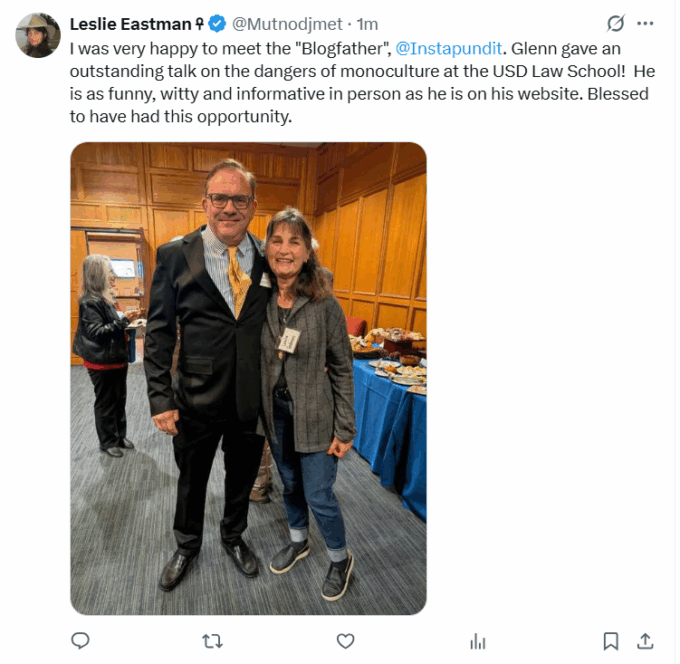
Last night, I was privileged to meet Professor Glenn Reynolds before his talk given as part of the 2025 Bowes-Madison Distinguished Speaker Series Lecture at the University of San Diego School of Law.
Glenn (aka Instapundit and “The Blogfather”) has always been such an inspiration to our team at Legal Insurrection, as well as many others (including members of the San Diego Local Order of Bloggers, who joined me at the event). His talk was a perfect blend of his experiences as a law professor at the University of Tennessee and a keen analyst of current events. He is every bit as witty and informative in person as he is on his blog, so the evening was a treat.
Glenn used his lecture to dissect what he called America’s “ruling class monoculture” — a social and institutional alignment that allows toxic ideological conformity to spread with little resistance. He argued that this monoculture, concentrated among the nation’s elites, has damaged not only political discourse but also the judiciary itself.
Borrowing the “Front Row Kids” and “Back Row Kids” concept from social analysis, Glenn described two cultural archetypes. The “Front Row Kids,” he explained, are high achievers who thrive in academia and elite professions. Yet, when these high performers find themselves less materially successful than the “Back Row Kids” (those whose paths lead to trades, entrepreneurship, or other non-elite success), they often become resentful. Over time, Front Row Kids have come to dominate the judiciary, media, academia, and political class, forming an insulated monoculture that often looks down on “Back Row Kids”.
Among the most detrimental aspects of this division is reflected in our current judicial process, perhaps most notably in the constant reversal of President Donald Trump’s executive orders and administrative actions. The judicial Front Row Kids use their position to enforce their notions of the rest of the nation.
Diversity of experience and values helps make a system stronger to fight against the “woke mind virus”. Ideally, the democratic process shakes up the system and allows for more diversity that makes us more resilient against bad ideas that are harmful to our citizens, our economy, and our country. However, the process of promoting people in our society has morphed so that the right credentials are valued more than the real-world experiences.
For example, in earlier generations, judges came with a wide array of backgrounds (i.e., farmers, veterans, business owners). This approach brought a variety of knowledge, skills, and insights to the bench. Today, Glenn observed, the judiciary is filled with a narrow slice of America: Graduates of elite law schools who share similar worldviews. This sameness weakens the legal system’s resilience to ideological fads and the “woke mind virus.”
He revisited the 1970 Supreme Court case Goldberg v. Kelley, a landmark on welfare rights, as an example of what happens when courts expand constitutional doctrine without real-world grounding. The decision increased the administrative and financial burden on government agencies administering welfare programs. States and localities had to implement new procedures (such as pre-termination hearings, written explanations of decisions, and opportunities for recipients to present evidence and cross-examine witnesses) before terminating benefits. These requirements meant more staff, more paperwork, and more time spent on each case, which increased the cost of running welfare programs. Such decisions, Glenn asserted, reflect a judiciary more shaped by classroom theory than lived experience.
Glenn proposed several reforms to combat institutional conformity. These included reducing gate-keeping in higher education, appointing judges from non-Ivy League backgrounds, limiting the use of law clerks so judges craft their own opinions, and even expanding the Supreme Court (though, he initially posed the idea in humor).
If the Court truly functions as a “super-legislature,” as Glenn discussed in his talk, then it should reflect a broader range of American life. He proposed an example of having each state’s governor appoint one SCOTUS member, which would dilute the power of an individual justice. Such changes, he added, might also reduce the hyper-partisan drama surrounding Supreme Court nominations that now dominate presidential campaigns.
At a time when public trust in major institutions continues to decline, Glenn’s call for greater representation within the judiciary offered both a diagnosis and a potential roadmap to get our country headed in a better, healthier direction.
Upon reflection, I would like to share that my blogging friends and I left the event more upbeat and energized than we have been in a long time. Honestly, there’s something hopeful in hearing him argue that more diversity…not just in race or gender, but in life experience…should be embraced and cherished, especially if we want a robust and healthy democracy.
CLICK HERE FOR FULL VERSION OF THIS STORY