


Equal Protection Project Supports First Amendment Rights of Anonymous Donors at Sixth Circuit
The IRS can provide whatever privacy assurances it likes, but the record of government data breaches and purposeful leaks, and the resulting harm to millions of individuals, is well-documented and will continue to occur.
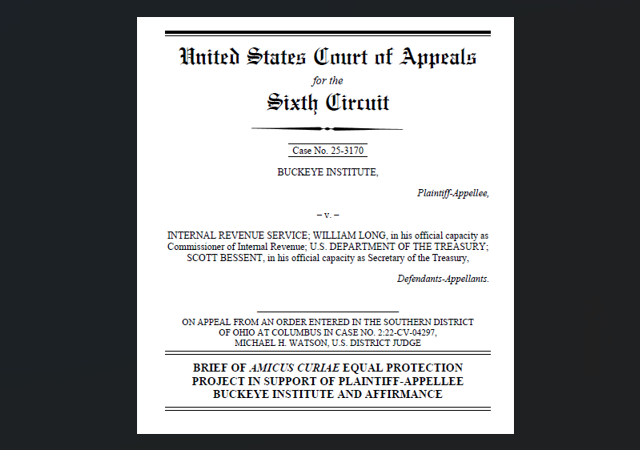
On November 21, 2025, the Legal Insurrection Foundation’s Equal Protection Project (EPP) filed an amicus curiae, or “friend-of-the-court,” brief in the U.S. Court of Appeals for the Sixth Circuit in Buckeye Institute v. IRS.
At stake in this case is not only the free association rights of Americans expressing themselves anonymously through donations to charitable organizations, but the ability of those organizations to continue serving the public interest.
Founded in 1989, The Buckeye Institute is a tax-exempt nonprofit research and educational institution whose mission is to advance free-market public policy in Ohio.
Most 501(c)(3) tax-exempt organizations must annually disclose to the IRS the total of the contributions and gifts received by it during the year, and the names and addresses of all “substantial contributors.” Substantial contributors are those whose aggregated contributions total more than $5,000 and more than 2 percent of the total contributions received by the organization in the reported tax year.
These filings are available for public inspection upon request, but the IRS is required to redact the names and addresses of contributors.
Just four years ago, the Supreme Court struck down a California law that required tax-exempt charities to provide this same information to the government as a matter of course. The Court rules that, absent “a substantial relation between the disclosure requirement and a sufficiently important governmental interest,” compelling charitable organizations to disclose the names of their donors violates the First Amendment right to association.
This case asks the Court to apply the same rule to the IRS’s virtually identical across-the-board requirement that 501(c)(3) organizations disclose their substantial contributors to the
federal government.
EPP’s amicus brief offers the Court three additional reasons it should protect the First Amendment rights of anonymous donors that Buckeye offers.
First, we address the high likelihood of such potentially government-held private donor information becoming public through technological access to online data or leaks. In 2020, reports indicated the number of exposed government records increased by two hundred and seventy-eight percent from four and a half million breaches of records in the first quarter of 2019, to seventeen million breaches in the first quarter of 2020.
And things have only gotten worse.
The IRS can provide whatever privacy assurances it likes, but the record of government data breaches and purposeful leaks, and the resulting harm to millions of individuals, is well-documented and will continue to occur.
Second, we examine the worsening ideological divide and use of political violence in the United States.
Americans are more divided over political differences and more likely to vilify members of the perceived “other side” than at any time in the last two decades.
An American Psychiatric Association’s recent survey found that thirty-one percent of Americans expect to have a heated political conflict with their own family members.13 It gets worse. Twenty percent of respondents reported cutting ties with a family member because of disagreement over political issues.
Even more striking, a substantial number of Americans now support the use of violence against perceived political opponents.
While many people are shocked and outraged by these and other violent events, a good many other Americans supported them. Thirty-eight percent of respondents said it would be “somewhat justified” to murder President Trump, while thirty-one percent said the same about Elon Musk.
Such targeting is likely to occur if and when otherwise anonymous donor information becomes public.
Third, we address the long-held tradition in the United States of anonymous political participation. Indeed, many of our Founding Fathers exercised this exact option to protect themselves and their property from reprisal.
While most Americans no doubt hope that political conflict with fellow citizens and neighbors might always be resolved through the “better angels of our nature,” history shows that all too often that has not been the case.
Time and time again, anonymity has therefore proved an essential tool in fully participating in the political marketplace of ideas while also protecting oneself and one’s family from harm.
The IRS may assure targeted charitable organizations that it can be trusted with their otherwise anonymous donors’ sensitive personal information.
But the government is not only ill-prepared to stop the spread of sensitive donor information, but in terms of potential animus towards disfavored associations, it is unwilling.
The Supreme Court should rule in favor of the Buckeye Institute and uphold the free association rights of citizens and nonprofits.
Reminder: we are a small organization going up against powerful and wealthy government and private institutions devoted to DEI discrimination. Donations are greatly needed and appreciated.
———–
Timothy R. Snowball is a Senior Attorney at the Equal Protection Project.
Donations tax deductible
to the full extent allowed by law.







Comments
I totally agree with keeping privacy for fear of political reprisals and general harassment, hence my use a of a handle for most interactions on the internet.
My only concern with anonymity of donations to organizations within our political framework is the ability of large donations from outside our country to affect politics here in the US.
Are there rules in place now to guard against outside influences?
Yes, persons who are not U.S. citizens should not enjoy 1st A rights. Also, entities (nonpersons) should not be entitled to claim 1st A rights.
That is ridiculous. The freedom of speech is not granted by the constitution, it’s inherent in human nature and all the constitution does is protect it. Therefore it must protect it for all people within its jurisdiction, i.e. all people who are in the USA, as well as US citizens and residents wherever they are. And so the courts have consistently held for over 200 years.
As for what you call “entities”, they are legally persons. More than that, they consist of persons acting in concert. If we lose our rights whenever we act together as a corporation, then we have almost no freedom at all. Every newspaper, every publisher, every movies studio would be subject to censorship at the government’s whim. Even Legal Insurrection would not be protected.
Good grief, Milberg, you get stupider every day. You write “The freedom of speech is not granted by the constitution, it’s inherent in human nature” which is at best debatable and certainly at odds with civil power structure throughout history. The constitution does afford protection to speech but its extent is subject to judicial interpretation.
To suggest that foreign actors are permitted to donate but be anonymous is beyond stupid.
The best information I got from this article is that I can tell the IRS I made a tax-deductable gift of (fill in the amount) and they will not be able to deny it. My tax liability just went WAY down!
Not really. You’d still be subject to audit and at that point would need to submit a letter from the organization confirming your contribution.
This lawsuit is just preventing the IRS from demanding the bulk release of all donor information.
At an audit you have to show receipts.
This is really very much appreciated. The IRS is another one of those opaque federal agencies that simply cannot be trusted.
The federal Corporate Transparency Act was challenged on 2 grounds – First Amendment (as here) and Congress’s lack of power to require disclosure of information from all small entities. Court action was mixed, including a nationwide injunction against enforcement based on the power issue, and the Trump Administration decided in 2025 to suspend enforcement against all domestic entities. But a number of states such as NY have enacted similar legislation. Why is no one challenging those laws under the Americans for Prosperity Foundation v. Bonta and NAACP v. Alabama precedents on the basis of First Amendment protection and how the information that Individual A owns LLC L could be misused?
If it’s true, as so many First Amendment supporters claim, that sunshine is the best disinfectant, then full disclosure of all contributors to anything is mandatory. And all contributions should be traced back to natural (e.g. real) persons, not collective or corporate entities.
The fact that the Founders hid behind pseudonyms is an interesting historical fact and totally irrelevant to the current discussion.
People need to a) stand behind their beliefs and not hide behind anonymous names and b) be prepared to suffer consequences from others for their actions. Of course, the First Amendment forbids the government’s restricting speech, but not the ability of private citizens to react lawfully to such speech.
It says nothing about private entities or citizens’ taking note of and reacting to such speech on their own.
Naturally, unlawful such activity must be punished. Incitement to riot, assault, extortion or threats of violence are unlawful in almost every context. First Amendment cases are no different.
Shunning, asking others to shun people, boycotting, picketing, or not hiring or even firing people by private entities on the basis of speech is perfectly acceptable and lawful.