


CDC Ordered to Phase Out All Monkey Research Programs
PETA is now thanking…the administration of President Donald Trump.
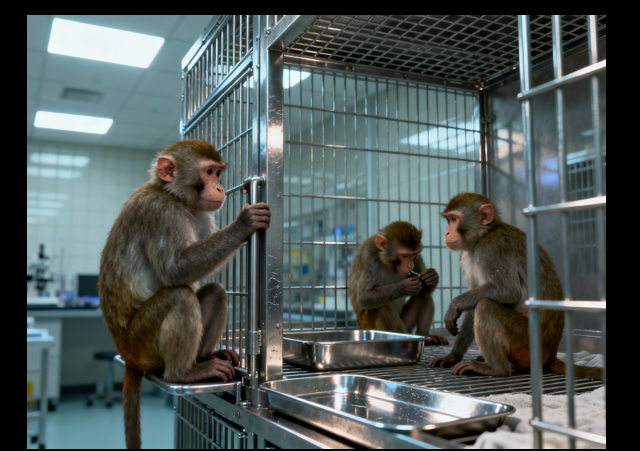
The federal Centers for Disease Control and Prevention (CDC) is being ordered to end research problems using monkeys, according to a recent exclusive report published by Science.
The directive, communicated to CDC staff by a former Department of Government Efficiency (DOGE) employee and recent college graduate who is now a top official at the agency, will end studies on approximately 200 macaques. The fate of the animals—largely used in work on HIV prevention—is unclear; some may be transferred to primate sanctuaries, others may be euthanized.
Apart from the retirement of research chimpanzees initiated by the National Institutes of Health (NIH) a decade ago, the move would mark the first time a U.S. agency has ended its in-house nonhuman primate program. “It’s unprecedented,” says Sally Thompson-Iritani, the assistant vice provost responsible for the University of Washington’s animal care program.
Since President Donald Trump took office in January, the heads of several U.S. research agencies—including the Food and Drug Administration (FDA), the Environmental Protection Agency, and NIH—have announced plans to reduce their reliance on animal studies. Instead, the agencies aim to invest more in organ chips and other “new approach methodologies.”
This directive aligns with a broader push across federal health agencies to scale back animal-based experiments since President Donald Trump returned to office in January. Instead of relying on nonhuman primates or other lab animals, these agencies are shifting funding toward advanced chip-based systems and human cell–derived models.
Science is reporting that the directive is being issued at the behest of Health and Human Services Secretary Robert F. Kennedy, Jr., and while some scientists are complaining about the directive (especially regarding studies related to HIV), others say it will have a limited impact on current research.
“I’m concerned that the research being done at the CDC will just be completely halted, even if the animals are in the middle of a study. That means we lost a lot of research knowledge,” [JoAnne Flynn,chair of the department of microbiology and molecular genetics at the University of Pittsburgh] says.
Even so, another primate researcher points out that “the studies at the CDC represent only a very small proportion of ongoing research studies in the U.S. at [National Institutes of Health–funded] research centers and universities,” says Nancy L. Haigwood, a professor and former director of the Oregon National Primate Research Center at Oregon Health & Science University. “These other studies will continue because they have been peer-reviewed to justify the experiments, meaning that the experiment can only be performed in nonhuman primates and not in the lab or other models.”
The order affects about 200 animals currently at CDC facilities, which will have to be either rehomed or euthanized.
BREAKING: Scientists at the U.S. Centers for Disease Control and Prevention (CDC) have been told to phase out all of their monkey research says @NewsfromScience
The directive, communicated to CDC staff by a former Department of Government Efficiency (DOGE) employee and recent…
— Scott Taylor (@ScottTaylorTV) November 21, 2025
I don’t normally cite People for the Ethical Treatment of Animals in my analysis. However, I would like to acknowledge that it is correct in one point — if 40 years of monkey research has resulted in a vaccine against the human immunodeficiency virus (HIV), the discovery is unlikely to happen.
The organization is now thanking…the administration of President Donald Trump.
PETA is thanking the administration for taking this decisive, visionary step and acknowledging what mountains of evidence have made clear: Experiments on monkeys aren’t delivering for humans, nowhere more obvious than the four-decade failure to produce a marketable HIV vaccine. Today, we’re celebrating a historic turning point—one that protects public health, respects endangered species, and helps propel research into a modern, animal-free future.
Interestingly, the most recent development related to HIV research occurred this September, when U.S. officials announced investment in the new HIV prevention drug called lenacapavir. The State Department indicates the goal is to make the product available to over 2 million people by 2028 and focus on transmissions from mother to child.
Clinical trial results for the drug, lenacapavir, showed last year that twice-yearly injections can provide almost complete protection against contracting HIV for individuals at risk in their intimate relationships and for preventing mother-to-child transmission. The medication is also used to treat HIV. The original discoveries that made this medicine possible were funded by the National Institutes of Health (NIH).
Scientists believe that the drug could help end the HIV epidemic. “It’s really the only way to bring this epidemic under control,” says Dr. Linda-Gail Bekker, director of the Desmond Tutu HIV Centre in the Institute of Infectious Disease and Molecular Medicine at the University of Cape Town. “We have 31 million people on treatment around the world, but if we don’t address protecting people who are susceptible to acquire HIV, we aren’t going to bring the epidemic under control.”
In conclusion: The time certainly has come for a review of how science is funded and whether the money is being used wisely… or simply to prop up areas of research that are clearly no longer promising. It appears the first steps in doing so are being taken.
Image by perplexity.ai.
Donations tax deductible
to the full extent allowed by law.







Comments
If they are still doing these experiments on dogs, like beagles, please stop right now.
That was the research that was halted at EPA with advocacy by PETA.
Actually there is a beagle rescue organization that was and is very prominent in stopping beagle exploitation/ experimentation
Not PETA
That’s why Fauci paid people in Africa to torture puppies to death with sand fleas.
he should have the same treatment
Asinine
Somewhere there is a talking Chimp who will lead his brothers to ultimate victory.
He’s the one in Leslie’s AI photo. That perfectly groomed lab chimp, just hanging around the lab outside his cage. Leslie makes the funnest AI photos.
Way past time to stop using animals in medical research. There are so many other ways that can be leveraged for research in microbiology.
Ok, how about we cutoff the planned parenthood supply chain that provides the remains of aborted babies for experimentation too? You know HUMAN BEINGS. Just a thought.
“if 40 years of monkey research has resulted in a vaccine against the human immunodeficiency virus (HIV), the discovery is unlikely to happen.”
Missing a “not”.
Terminating chimp experimentation will affect a cure for HIV?
oh no
Clearly a national law against animal experiments needs to be implemented
That’s for sure!
Yerkes primate research center houses a total of approximately 3,400 primates on 117 acres in NE Atlanta. 200 macaques is less than the monthly attrition rate. They have been in NE Atlanta for 60 years.
No story here.
None will be sent to any primate sanctuaries. The sad fact is that since they were all used for medical experimentation they will all be “humanely killed” and then disposed of in a manner that eliminates the risk that any disease can spread into the general population or elsewhere. The death warrants for these 200 macaques have been signed and now the CDC waits until nobody is looking to execute those warrants. That’s the truth of the matter and no amount of wishful thinking will change the fate of these primates.
I just hope they don’t have the same cruel death as those ostriches in Canada.
Dear CDC: How can you overlook Limu Emu? 🙂
I assumed as much the minute I saw the announcement. And it fits perfectly with what we know of the zero-moves-ahead thinkers at PETA that they felt forced to thank Trump for this.
They don’t have to be, ape / monkey sanctuary’s are full of animals experimented on
If our government had been honest all along about AIDS, (looking at you, Fauci), and people would be responsible in choosing their sexual partners, AIDS could have been eliminated long ago. However, political correctness took precedence and here we are today, taking shots to ward off the results of promiscuous behavior.
No, gays know and still engage in unprotected sex
When my girlfriend said she was leaving over my obsession with the Monkees, I first thought she was joking
And then i saw her face… 🙂
Now your a believer, huh?