


California Republicans Sue Newsom Over Prop 50
How did Newsom respond? “Good luck, losers.”
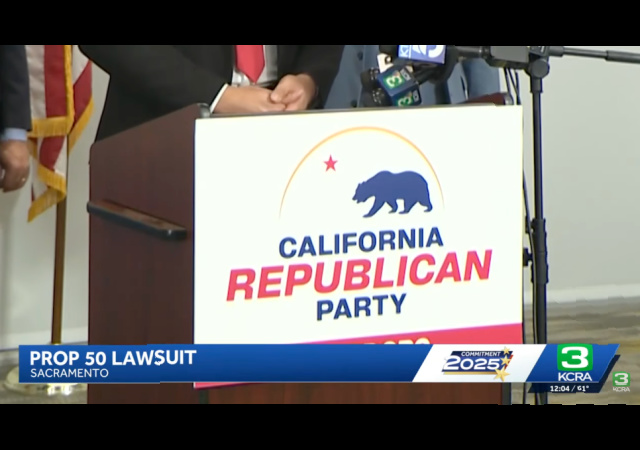
California Republicans have sued Gov. Gavin Newsom and state Secretary of State Shirley Weber over Prop 50.
California voters overwhelmingly approved Prop 50, which will allow the Democrat-led legislature to redraw five Congressional districts.
The districts will flip to Democrats.
The coalition claims Prop 50 is unconstitutional.
“Specifically, the California Legislature violated the Fourteenth and Fifteenth Amendments to the Constitution when it drew new congressional district lines based on race, specifically to favor Hispanic voters, without cause or evidence to justify it,” they argued.
The Republicans reminded everyone that the Court said basing districts on race contradicts the meaning behind the Fourteenth and Fifteenth Amendments: race does not matter.
Also, how can one invoke the Voting Rights Act when a minority group makes up the majority population of a state? Hhhmmm…
They point to the Equal Protection Clause and previous lawsuits over forming Congressional districts based on race (I added the emphasis):
The Equal Protection Clause of the Fourteenth Amendment guarantees every citizen the equal protection of the laws and the Supreme Court has held that its central mandate is racial neutrality in governmental decision making Miller v. Johnson, 515 U.S. 900, 904 (1995); U.S. Const.,
amend. 14, § 1. While the Constitution entrusts States with designing congressional districts, the Supreme Court has also held that states may not, without a compelling reason backed by evidence that was in fact considered, separate citizens into different voting districts on the basis of race. Cooper v. Harris, 581 U.S. 285, 291 (2017). As that Court has found, race-based districting embodies “the offensive and demeaning assumption that voters of a particular race, because of their race, think alike, share the same political interests, and will prefer the same candidates at the polls,” Miller at 912, which “is more likely to reflect racial prejudice than legitimate public concerns.” Palmore v. Sidoti 466 U.S. 429, 432 (1984).
“The Court also feared that race-based districting encourages elected representatives ‘to believe that their primary obligation is to represent only the members of that group, rather than their constituency as a whole,’ which is ‘altogether antithetical to our system of representative democracy,'” added the Republicans.
Then there’s the Fifteenth Amendment, which states, “The right of citizens of the United States to vote shall not be denied or abridged by the United States or by any State on account of race, color, or previous condition of servitude.”
The Republicans cited three Supreme Court cases:
When a state unlawfully engages in racial gerrymandering, it also violates the Fifteenth Amendment, which provides that the right of citizens to vote cannot be denied or abridged on account of race or color. U.S. Const., amend. 15, § 1. The Supreme Court has held that the Fifteenth Amendment “establishes a national policy … not to be discriminated against as voters in elections to determine public governmental policies or to select public officials, national, state, or local.” Terry v. Adams, 345 U.S. 461, 467 (1953). Therefore, a racial gerrymander, “the deliberate and arbitrary distortion of district boundaries … for [racial] purposes,” is a form of circumvention of the Fifteenth Amendment. Shaw at 640. “[S]tate authority over the boundaries of political subdivisions, extensive though it is, is met and overcome by the Fifteenth Amendment to the Constitution.” Rice v. Cayetano, 528 U.S. 495, 522 (2000).
People point to the Voting Rights Act to justify race-based districting. It’s narrow, though, and the Republicans don’t think it applies because, well, Hispanics make up the majority of California’s population (emphasis mine):
While compliance with the federal Voting Rights Act (“VRA”) may justify race-based districting under current law notwithstanding the Equal Protection Clause, Cooper v. Harris, 581 U.S. 285, 285, 292 & 301, the Supreme Court requires states to prove that, among other things, they in fact adopted the new district lines based on evidence that a minority race usually could not elect its preferred candidates due to the concerted opposition of voters of a white majority race. Cooper, 581 U.S. at 292–93, 301-302. Without proof of this condition, states have no lawful basis to enact racebased congressional districts.
However, California’s Hispanic voters have successfully elected their preferred candidates to both state and federal office, without being thwarted by a racial majority voting as a bloc. This is unsurprising because Latinos are the most numerous demographic in the state and California voters nearly always vote based on their party affiliation, not their race.
How can Hispanics be a minority when they make up 40% of the population?
Assemblymember David Tangipa pointed out that “Prop 50 will diminish ‘the voices of other groups.'”
How did Newsom respond?
Donations tax deductible
to the full extent allowed by law.







Comments
gop >>sorry wasting our money and time when they could ( at the national level) defund the socialists
but instead rinos side with leftists and the debt grows and america sinks
I seem to remember something from around 1773 about “Taxation without representation”
They have representation.
Had the UK given the colonists a member of parliament, or even 13 members, do you imagine that would have made any difference to the taxes?! The taxes would have passed just the same, but the revolutionaries would have been deprived of any way to complain about them.
After all it was the colonists who begged the UK to defend them, and then refused to pay even a small amount towards the cost of that defense, expecting the UK taxpayer to foot the entire bill. Imagine if Puerto Rico tried that on us. Imagine it came under attack from Cuba, desperately begged the USA to come in and defend it, and then expected US taxpayers to pay for it all. That’s how UK taxpayers felt about it then. They should have just given them an MP and been done with it.
I don’t think anyone considers a “representative” that in no way reflects their values or priorities as any sort of representation.
It doesn’t matter what anyone “considers”. That is exactly what the word means, in that phrase. All the revolutionaries claimed to be demanding was a vote, not that they would win.
It is the law that a representative represents all the inhabitants of his district, including not only those who voted against him, but also those who didn’t vote, and those not eligible to vote. They’re all his constituents.
“The House of Representatives will be composed of representatives who will be elected by the people in each district and must ultimately be accountable to every constituent.” (Federalist 57, by James Madison)
Since when in CA have the D’s been held accountable to the R’s? There is no representation of the R’s here.
An elected official represents all the people in the district that elected him, regardless of whether they voted for him, or whether they voted at all, or even whether they can vote. They’re all his constituents. And that is all “representation” means, or has ever meant.
There are few people so deranged as to defend the lies of the crown that led to the Revolution’
Unsurprisingly, our resident leftist demoralizer is one of them.
The Republican case looks like a slam dunk – in about 15 years after it has worked its way through the courts.
GOP lawsuit is a loser, but they need to fight the good fight.
I’d be more intrigued by a First Amendment challenge: for an overview see here: https://www.congress.gov/crs-product/LSB10164
Striking a partisan gerrymander on 1st amendment grounds has been problematic because the court “has been unable to determine a manageable standard for adjudicating such claims. ”
Still there is a stronger first amendment case against a partisan gerrymander, if such as standard can be found.
Districts should be compact and contiguous, neat little geographic boxes.
Also… almost certainly, this will end up at the Supreme Court. I would expect a mirror lawsuit against Texas. The 5th and 9th circuits will split, and the SC will take the case.
Partisan gerrymanders have been the US tradition ever since Governor Gerry (who, ironically, opposed the map that has gone down in history under his name, but refused to veto it because he thought the legislature had the right to be wrong).
The first amendment was not incorporated against the states, until the 1920s
Not the point. Most states have a first-amendment equivalent in their own constitutions.
The point is that gerrymandering is part of the American tradition, and the Supreme Court is going to be very reluctant to step in now and say “OK, everyone has done this for over 200 years, but no more”.
Isn’t that what they said about murdering babies?
Its not at all obvious. The original first amendment (“article the first”) included an amendment that would require 1 representative per 50k people. The framers would chafe at one rep per 800K people. The districts are too large as they envisioned them.
With much smaller districts, gerrymandering is almost a non issue.
No, it isn’t.
This is not true. That amendment, had it been ratified (which it still can be) would require a maximum of 1 representative per 50K, i.e. a minimum of 50K per representative. That means with 330M people it would require Congress to have a minimum of 200 members, and a maximum of 6,600. 435 would comply very nicely.
Clearly not true, as evidenced by the original Gerry-mander. Gerry was a signatory of the Declaration of Independence, and an active delegate at the Philadelphia convention. And the thing he’s most famous for is the gerrymander that bears his name!
Even before that one, in the first congress there were gerrymandered districts. Patrick Henry and his mates tried to gerrymander James Madison out of his seat. They failed; the district drawn so as to defeat him elected him anyway. But they tried, which means it was an issue.
would require a maximum of 1 representative per 50K, i.e. a minimum of 50K per representative.
No: although the wording is confusing, the intent was 1 representative per 50k after the population was over ten million. https://en.wikipedia.org/wiki/Congressional_Apportionment_Amendment.
With much smaller districts, gerrymandering is almost a non issue because of the law of large numbers. It would be very difficult to racially gerrymander too.
It is definitely an open question. Gerrymandering is a one-way power ratchet, and Gorsuch does not like one-way power ratchets (listen to the tariff case).
Dwb, that’s not what it says. It says “nor more than one representative for every 50K persons”.
Wikipedia claims there is “some agreement” that this is a scriveners error, citing an article by someone or other, who claims “most agree” on this, but offers no evidence. I think that unlikely. This was the text that Congress passed and sent to the states; and it was the text ratified by 23 state houses (2 each in 11 states, plus one in CT). I think someone would have noticed the error, if error it was, and sent it back to Congress for a redo.
But error or not, that was the text, and had it been ratified that’s what would have been the law. There is no such thing as adjusting a law for a “scrivener’s error” unless it’s “absolutely clear”; and there is no such thing at all for the constitution. Were 27 states to ratify it today, to make up the required 38, it would impose a maximum of 6,600 reps, not a minimum, and would therefore require no change at all. Which may be one reason why no one has ever tried to renew the ratification effort after it initially failed.
Again, the evidence is squarely against this. As I pointed out, there were gerrymandered seats in the first congress! And the practice gets its name from a map that Gerry, one of the founders, refused to veto (even though he opposed it). So it very much was an issue, even when districts were small.
So effin what?
So the Supreme Court is not going to strike them down, eedjit. They’ve part of the American way, part of how the system works, just like filibusters, They’re not going to come in 240 years later and change the rules on us, now that Republicans are finally starting to take better advantage of them.
The suit alleges that redrawing the maps violates the California constitution. Did any state legislative action or the referendum override this? There is no state constitutional claim, unless I missed it.
No, it doesn’t allege that. It alleges only violations of the 14th and 15th amendments to the US constitution.
It points out in passing that the state constitution prohibits mid-decade redistricting, and that’s why a referendum was needed and held. It does so merely to make the point that this is an unusual thing that the legislature has done, and it deserves more scrutiny.