


Upcoming Big Supreme Court Cases – Preview
Tariffs, Lisa Cook, congressional racial redistricting, and Girls’ Sports: “I think the court’s going to say that under Title IX, you judge sex discrimination and the rights you have under that statute based on reality, based on biology, not how you feel.”
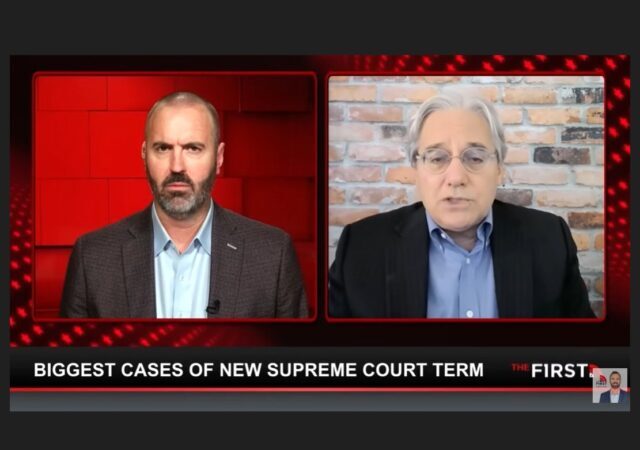
I appeared on October 1, 2025, on I’m Right with Jesse Kelly to talk about the upcoming Supreme Court term. I always enjoy going on Jesse’s show because the segments are long by TV standards, which gives us a chance to get into detail.
Here are the major cases we talked about:
Tariffs – And what will happen if Trump loses?
Lisa Cook – Trump’s attempt to fire her from The Fed
Girls Sports and Title IX – On which EPP submitted two Amicus Briefs
Congressional Redistricting and Racial Gerrymandering
Partial Transcript – Auto-generated, may contain transcription errors, lightly edited for transcript clarity (timestamps are to start of segment).
Kelly (00:05): The Supreme Court is about to begin another term. I don’t understand these terms. I don’t understand what they’re doing when they’re not in terms, and I also don’t understand what’s coming in this term, but I don’t have to understand any of that because Bill Jacobson understands it all. Joining me now, Cornell University law professor, the Great Bill Jacobson. Bill, what is the Supreme Court term and what do they do when they’re not in their term?
WAJ (00:29): Well, they still do some work. They still have emergency motions, but the term really is just when they hear oral arguments. And it starts first week in October and it runs through potentially June. So that’s what they call a term. And they’re essentially off for the summer, but they’re working over the summer. So term is just a docketing method to get things on the calendar.
Kelly (00:53): Okay. So term is just a term. Just see what I did there, Bill. Alright, so what’s coming? What’s coming up for this term?
WAJ (01:01): Well, we’ve talked about this before, the tariffs, the Trump tariffs is probably the most economically significant case that we’re going to face. And that has to do with whether President Trump, when he imposed the emergency tariffs, exceeded his authority.
There are two issues there. One is did he properly invoke there being an emergency? I think the Supreme Court’s going to say that decision is up to the president. But the more interesting one, which is where he lost in the federal court below, is whether tariffs are even a remedy under this emergency statute. And what they held below in the federal court of appeals was that even if he properly invoked the emergency, tariffs is not one of the remedies. Tariffs are reserved for Congress. The statute doesn’t mention tariffs. So he exceeded his authority.
I think it’s going to be a close call. I don’t know which way that one’s going to go, but his entire economic agenda in many ways, or at least a significant part of it, is built around the tariffs. So this is a very high stakes case.
Kelly (02:14): Okay. So help me understand this Bill, because you’re right, it’s always tariff this and tariff that. And we got a new deal with this country and a new deal with that country. And we struck a deal with the UK. Does that mean if they rule against him that all that stuff becomes unraveled? Is that what that means?
WAJ (02:32): It could, yeah. I mean, people are talking about perhaps hundreds of billions of dollars in tariffs that have been collected are going to have to be returned to people. So yes, it’s, it’s very high stakes. If they rule that what he did was without authority, then it all comes apart.
Kelly (02:51): Alright. Lisa Cook, how is Lisa Cook still with the Fed? How is this possible?
WAJ (02:57): Well, she’s appointed as Fed governors are to 14 year terms and the president can only remove somebody for cause, that’s the term in the statute. And the issue is whether she was removed for cause. The lower courts held that whatever she did before she became a Fed Governor cannot be cause to terminate her. And what she allegedly did, to be determined, but the accusation is that she committed mortgage fraud, that she pulled what is being accused, I think it’s of Adam Schiff, claiming two primary residences. Whether she did it or she didn’t is a different issue. But the judge below said that even if it was, that was long before she became a Fed Governor, and you can’t use something that they did prior to becoming a Governor as cause to terminate,
I don’t know which way that’s going to go. Most of the cases when it comes to firings have gone Trump’s way in the Supreme Court.
But this one’s a little different because it’s the Fed, it’s a separate statute, it’s more independent than some of the other supposedly independent agencies. And I think it’s going to turn on what does ’cause’ mean under the statute.
I think Trump’s going to win that one. No guarantees, don’t put money on it, but I think he’s going to win it because the analogy is if you conceal something during the employment hiring process that had it been disclosed would’ve disqualified you from the job, the fact that your employer finds out about it after you’re hired, I think is still cause to terminate. So I think he’s going to win this one, but as with anything in the courts, you can never predict to a certainty. But I think he’s going to win that one.
Kelly (04:44): Bill, switching gears, sorry, we’re moving fast, but it’s gonna be a busy term. There’s two gender identity cases. I hate even using that stupid word, but <laugh>, what are we looking at here?
WAJ (04:56): There are two cases in the Supreme Court. My group, the Equal Protection Project, happens to have submitted briefs on each one, that have to do with state laws requiring that for girls sports, that whether you’re female or you’re male has to be based on biology, has to be based on reality.
The lower courts held that that violated the rights of people who don’t want to do that. That the state legislatures didn’t have that power.
I think that’s gonna go the way of the legislatures. I think that to have any other standard other than a fact-based, reality-based standard when it comes to sex discrimination, I think would unravel Title IX, the sex discrimination statute, federal law. So I think that particularly given the court as it is now, the Supreme Court, the six three majority, six supposed conservatives, sometimes they are, sometimes they’re not. But I think that’s gonna go the way.
I think the court’s going to say that under Title IX, you judge sex discrimination and the rights you have under that statute based on reality, based on biology, not how you feel. So I think that one is going to go the way of the girls who are trying to protect their sports, against men who say they’re girls, participating in it. So I think that’s going to be a big win for girls in the Supreme Court.
Kelly (06:28): Finally, voting rights cases. There are three of these from my understanding. What’s at stake here?
WAJ (06:34): The key one is out of Louisiana and the issue is under the Voting Rights Act can, are states required to create majority minority districts, so majority essentially black districts. And that was the issue in order to comply with the law, do you have to engage in racial gerrymandering? Do you have to take race into account in order to create congressional districts? And that’s the issue.
And I think the Supreme Court, particularly in light of the 2023 affirmative action ruling, I think is going to say say No, you, you are not obligated to create and you can’t create congressional districts based on race. But that’s just the legal part of it.
The real part of it, the political part of it is that this could cause Democrats throughout the country to lose several congressional districts because when they are creating majority black districts, the Democrats have a stake because just given voting patterns, that’s likely to be a Democrat district. So that’s what’s really at stake. Democrats couldn’t care less about whether it’s majority minority. What they want is a district they think will vote reliably Democrat. And so that’s what’s really at stake.
The legal context is the Voting Rights Act and whether you can racially gerrymander congressional districts, the real fight is three to five seats might swing to Republicans if the Democrats lose in the Supreme Court.
Kelly (08:13): So it’s all about power, like always. Thank you Bill. I appreciate you educating us again.
Donations tax deductible
to the full extent allowed by law.







Comments
I would put the “Birth Right” issue up there with the tariff issue because in the long run it will be more expensive if it stays than giving all the tariff money back.
The tariff case causes me the most concern. If the court decides he wasn’t authorized to implement them, the consequences will be earth shattering, not just on the domestic economic front, as they are an essential pillar in Trumps efforts toward restoring a stable economy, but the global impact will be perhaps even more devastating, creating extraordinarily dangerous reverberations for the US.
If its determined by the SC that Trump doesn’t have the authority to invoke tariffs, couldn’t congress put an emergency bill together and invoke the tariffs instead?
People forget – congress delegated the power to set Tariffs to the president. So, he should win on that basis.
Lisa Cook will be fired when charges are filed. It obvious she is guilty. That is cause. Also, when the crimes occurred are irrelevant. Also, she still HAS the favorable loans, so the crime is on-going – she is benefiting each month.
Girls are going to win. If female and woman are just “words” and have no meaning, then Title IX has no meaning.
Voting rights – there is no obligation to have minority majority districts. That this is even a question is absurd. I’d be more concerned about districts that ignore physical and natural barriers.
My family is Lithuanian immigrants – we feel discriminated against. Where is MY congressional district?
Its majority minority districts are an obscenity to the constitution.
You want a district? These days they need to have arrived illegally.
Redstate has a SCOTUS scorecard for Trump but it’s behind a firewall unfortunately.
I fail to understand why these aren’t taken up under a Reconciliation bill by the House. They are an issue for the US budget also, and should not be considered policy with how often they have been used by past Presidents.