


Supreme Court’s Voting Rights Act Decision Could Reshape Battle for House Control
It’s possible that Republicans could “cement one-party control of the House for at least a generation.”
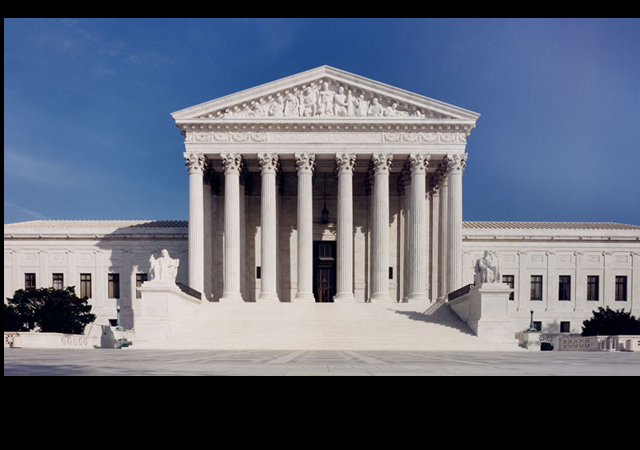
On Wednesday, the Supreme Court heard oral arguments in Louisiana v. Callais, a closely watched case that could reshape the congressional map and potentially deliver up to 19 additional seats to Republicans in next year’s midterms. The justices heard this case last term but declined to issue a ruling.
At issue is the constitutionality of Section 2 of the 1965 Voting Rights Act, the law’s most powerful remaining provision, which prohibits racial discrimination in voting. It requires that race be considered by mapmakers when drawing congressional districts to ensure that minority voters have adequate representation in Congress. Although we’re seeing a shift in voting trends in the age of President Trump, for decades, the vast majority of minority voters have cast their ballots for Democrats.
After a group of black voters filed suit, a district court judge in 2022 ruled that Louisiana’s congressional map “diluted black voting power” and required the creation of a second majority-black district. The court ordered the legislature to redraw the map ahead of the 2024 election, which ultimately led to Democrats winning a second congressional seat in the state.
A group of self-described “non-African American” voters, led by Phillip Callais, is now seeking to overturn the lower court’s ruling, alleging the remedial map was an “unconstitutional racial gerrymander.”
Additionally, Callais’ group argues:
[T]he race-based redistricting the court ordered to get in line with Section 2 is unconstitutional. Just as the Supreme Court ruled against race-based affirmative action at colleges and universities in 2023, they argue, the court should put an end to race-based political mapmaking under Section 2.
In seeking a rehearing in the Louisiana case, the Supreme Court asked all sides in the case to consider whether the state’s “intentional creation of a second majority-minority congressional district violates the Fourteenth or Fifteenth Amendments to the U.S. Constitution.”
If Section 2 is eliminated, states would be barred from taking the racial makeup of the population into account when drawing district lines, an outcome that would favor Republicans.
Conversely, as Politico notes, “advocates for minority voters warn a ‘colorblind’ interpretation of the Voting Rights Act would erode black, brown and Asian representation in American politics.”
According to Politico:
[T]he high court has signaled its particular interest in the argument that a core tenet of the Voting Rights Act may violate the Constitution.
Under Chief Justice John Roberts, the court has already curtailed many of the protections within the 60-year-old civil rights law. Weakening it further has long been a goal of some Republican litigators, who have argued it gives Democrats an unfair partisan advantage.
“It is time for the Supreme Court to finally eliminate this government-mandated business of divvying Americans up by race through redistricting and reaffirm our colorblind Constitution’s guarantee of equal protection under the law,” Adam Kincaid, president of the National Republican Redistricting Trust, said in a statement. His group has previously been involved in similar cases but isn’t representing any party in this one.
If the court again restricts the law in Callais, advocates warn of diminished political power of minority voters in federal, state and local elections.
Given the Supreme Court’s current conservative majority, it’s entirely possible Section 2 could be declared unconstitutional.
If that were to happen, Cliff Albright, co-founder and executive director of Black Voters Matter Fund, told NPR, it’s possible that Republicans could “cement one-party control of the House for at least a generation.”
A recent report from his organization notes that “what happens in the South doesn’t just stay in the South. This racial gerrymandering has the ability to not just disempower, disenfranchise Black voters and to eliminate Black elected officials and Latino elected officials. What happens in these states impacts the entire country.”
Albright estimates that “as much as 30% of the Congressional Black Caucus and 11% of the Congressional Hispanic Caucus could also be lost.”
This follows a summer redistricting battle that began after former President Trump urged Texas Gov. Greg Abbott to redraw the state’s congressional map in a bid to add five new Republican seats in Congress. In California, Gov. Gavin Newsom will learn on Election Day whether voters will approve a measure allowing him to strip the state’s Independent Citizens Redistricting Commission of its authority and return map-drawing power to the legislature for the 2026, 2028, and 2030 election cycles. If the measure passes, Democrats are expected to redraw the maps to create five additional districts of their own, countering Abbott’s advantage.
At any rate, the stakes in Louisiana v. Callais go well beyond any one state’s map — they could redraw the political lines of Congress itself.
Although it’s possible a ruling could arrive in December, the Court may wait until the end of its term in June to issue its decision.
Elizabeth writes commentary for Legal Insurrection and The Washington Examiner. She is an academy fellow at The Heritage Foundation. Please follow Elizabeth on X or LinkedIn.
Donations tax deductible
to the full extent allowed by law.







Comments
Blacks candidates can be elected in any district, provided they do what candidates have to do: offer programs appealing to the majority of their district.
The voting rights act presumes that blacks will only offer programs taking stuff from whites and giving it to blacks, which is a faulty and extinct view of black politics except among its so-called leaders.
For once you said something kinda not racist about race….progress?
Politics tends to draw people who are the least suitable for the job. They are often little more than con artists. Many, especially black politicians are not smart enough to cover up their crimes.
Isn’t it time to let black. er, Black candidates stand or fall on their merits? The entire country is not Jackson 1955. JACKSON is not Jackson 1955!
Just another affirmative action thing/
In Bakke (1978), Blackmun wrote:
It’s been almost 50 years. It’s already done all of whatever it was ever going to do. Time to take out the trash.
I’m very much with Morgan Freeman. We can bury all this racial stuff by just not talking about it.
I have one friend that – while very much a lefty – can carry on civil discourse. I pointed out to him that leftists, and especially the more vocal Democrats, would look at one of my work team and see a black man. Conservatives would see a man who is black.
Your last statement is somewhat humorous.
We laugh at the proggies for insisting that “colored person” is racist but “person of color” is respectful. It looks like conservatives sometimes make exactly the same argument, Who knew.
I am again reminded of a passage I read long ago in a work on human psychology. It said that when you think back on people you knew long ago but have mostly forgotten, it was quite common that you might not be able to remember their hair color, or accent, or one of their names, or even what color their skin was (I have had the latter experience). But the one thing you would never forget was whether they were a man or a woman. But that was written long before the proggies screwed THAT up, too.
I might not have been clear, Henry. What I meant is the left is seized the color first. The conservative sees of the man and among the characteristics of that man as he happens to be black.
No, no, I understood. It made me wonder whether or not that might be exactly the same basis by which the lefties argue that one term is demeaning and the other is not. Of course, as usual, the left pays lots of attention to the terms used, and not how they actually treat the people termed.
Bill Burr, when he was.still sane and trying to be funny v woke, had bit like this. Boils down to ‘white people’ get into trouble b/c they lead with the curse word while ‘black people’ put the curse word after. Example: ‘white guy’ says ‘This MF Asian walked in…’ and he gets called a racist. The ‘black guy’ says ‘This Asian MFer walked in…’ but nobody bats an eye b/c of the placement of the curse word.
If I were black, I would be thinking that the Voting Rights Act wasn’t providing very good representation.
Waters, Jackson-Lee, Johnson, Crocket, Holmes-Norton, McKinney, Bass. Such quality representatives!
If you’re a “dope boy” (Krystle Matthews), or a “cholo” (Cynthia Gonzalez), or a “Latin King” or “Vice Lord” (Chicago aldermen), you’re getting blue-ribbon representation you couldn’t otherwise buy.
I’m not a Democrat but live in a state where all reps and Senators are hard core leftist democrats. The percentage of non-democrat registered voters is 75%, F the voting rights act. I have no representation. Why should there’s be guaranteed.
^^^^THIS^^^^
Even if they do overturn the VRA provision completely, its effect on future House races is unclear. There are two ways of gerrymandering – packing and cracking. Packing concentrates your opponents voters in as few districts as possible and cracking splits them up and adds little bits of them to areas where your own voters have dominance. The cost of splitting up black majority districts is the Republican districts will now have smaller majorities, and be more susceptible to flipping in a wave election. If you spread your voters too thin you can potentially lose the whole map. Concentrating your opponents in 1 or 2 districts is a bit safer. It is a tradeoff of numbers v safety. All gerrymandering faces this dilemma.
If you accept that black, Hispanics, or other groups vote as a block, they would often have better representation on the issue if the are king makers with a large share in multiple districts, than 100% of one district.
We already know how the Democrat justices will vote. Funny how they can be relied upon to vote the “correct” way all the time.
Only real question is which of the others will be traitors and join them? 🤔
It’s revealing that the corporate/legacy media reporting about the fallout of ending the current judicial interpretation of Sec 2 VRA is 90% focused on the potential loss of d/prog Congressional Districts and/or the political power of the d/prog party. Everyone is supposed to pretend that the issue is about groups of individual Citizens having their voting power diluted but, when the rubber meets the road, the screeching is almost exclusively about the political fortunes of the d/prog party.
Yeah, I noticed that too. They “reported” the legal issues grudgingly.
To me, the biggest question is timing. It seems pretty clear that the VRA is going to be gutted, but will the decision arrive in time for the legislatures in the South to redistrict?
If I were a liberal on the Supreme Court, I’d slow-roll the hell out of it by dragging my feet in writing my dissent. I’ve seen speculation that the decision will come out in January, but I’m going to be surprised if the Court liberals don’t find ways to delay it until next June.
If it does come out in January, the Democrats can kiss the House goodbye next year. I think they’ll fail to regain it anyway, but gutting the VRA would probably add at least 10 points to the Republican margin in the House. It’s hard to overstate the demoralization that will hit the Democrats. I believe that, since 1900, there have been only three off-year elections in which the president’s party didn’t lose House seats. Given the current narrow margin, pretty much any D net gain would flip control.
There’s a three-step process that, if things work out for the Rs, will cement the Democrats’ expulsion to the wilderness for decades. First, next year’s mid-terms. Then, the ’28 presidential, the result of which will hinge on the condition of the economy that spring. Third is the ’30 census and redistricting, which will shift about 10 House seats (and therefore electoral votes) from blue states to red ones.
If those three things break for the Republicans, the Supreme Court will be 8-1 by the end of Vance’s second term at the very latest. The Congressional and White House situation will look like 1869-1933, a 64-year period when Democrats held the presidency for only 16 years, the House for only 26 years, the Senate for only 10 years, and a presidential/congressional “trifecta” for only 10 years.
Wouldn’t you think that ANY of the Democrats would be thinking about the category 5 hurricane that’s brewing out there and will wipe them off the map if it hits? I see NO signs whatsoever of that. Fetterman’s the only prominent Dem who’s charted any departure for uber-“progressive” orthodoxy, and guess what? The Pennsylvania Dems are plotting to defeat him in the next primary.
Okey doke, then, Democrats. Maybe you really do have a political death wish.
Given this is something of a rehearing they might be able to push out a ruling faster than we believe. Collegiality aside there’s 90 days to crank out drafts, review/respond, finalize and release by mid January. Very manageable. Holding the release hostage by slow walking a dissent isn’t very collegial and IMO would deserve very short shrift by the majority…but I suspect that Roberts will join the majority to both control the final majority opinion as well as the timeline and he is unlikely to push very hard for a quicker timeline.
I don’t know how their process works, or why some opinions aren’t released until the end while others are. I’d love to be wrong, but won’t hold my breath.
When the will is there.
Timeline of the famous 410 U.S. 113 (1973),
— Argued: December 13, 1971
— Reargued: October 11, 1972
— Decided: January 22, 1973
would erode black, brown and Asian representation
Faulty premise. You should not have any representation based on the color of your skin. That’s discriminatory, That’s the fundamental flaw in their argument.
Sadly, that is more/less the current judicial interpretation for how Sec 2 VRA should be implemented. That group membership effectively requires a member of the group to ‘fully’ represent the interests of the group. The larger failure of the logic IMO is the transfer of harm. If group A gets a special district ‘majority minority’ b/c the members of group B don’t share the same cultural beliefs/challenges and the differences between groups A and B are so stark that crossover voting/representation will not solve the ‘harm’ ….when we draw the new district as ‘majority minority’ to cure the harm claimed by group A then the ‘harm’ is transferred to group B members within the new district.
That’s the real problem. There’s no ‘neutral’ position to create in a political context b/c there’s always winners and losers. The current interpretation and implementation of Sec 2 VRA is the Judiciary putting its thumb on the scale and choosing which group is a winner or loser. The claimed ‘harm’ isn’t resolved by this merely transferred.
The problem isn’t gerrymandering.
The problem is the fact that each Representative represents about 700,000 constituents. This makes it hard for true representation because districts can cross multiple interests in a state.
For example, a district in my state covers urban, rural, agricultural, and geographic groups. People on one side of a ridge vote differently than those on the other.
The interests of farmers aren’t the same as those of the suburbs. Urban/suburban differences.
While 30,000 constituents will mean more than 10,000 representatives, we don’t need that.
But perhaps 500,000 constituents per representative. (About 700 reps). 400,000 (850 ish reps)
At least the size and makeup of the districts can be more representative and stop some level of dilution.