


Lockheed Targets 2028 Orbit Test for Trump’s Golden Dome Shield
New reports suggest China may have beaten U.S. in race for country-level missile interception potential.
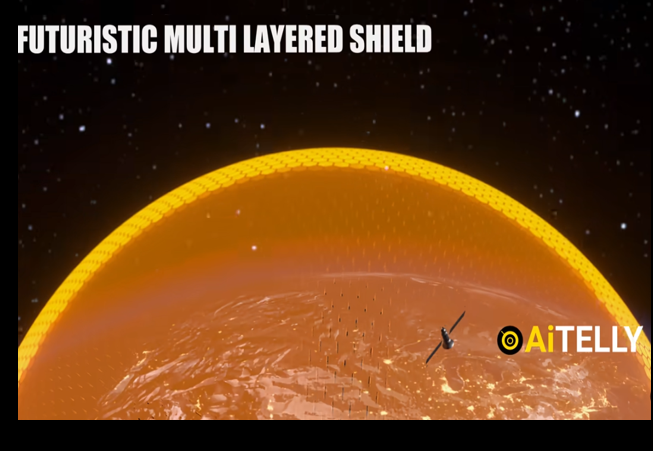
Earlier this year, I noted that the Chinese were unhappy with U.S. plans for a massive missile defense system inspired by Israel’s Iron Dome.
President Donald Trump, who appears quite fond of gold, and his team subsequently announced that the first test of the Golden Dome will be in 2028. The system is designed to shield this country, and potentially some of our allies, from advanced missile threats, including ballistic, hypersonic, and cruise missiles.
Lockheed Martin is preparing to conduct an on‑orbit test of a space‑based anti‑missile interceptor within the projected timeframe.
Lockheed Martin is aiming to conduct an on-orbit demonstration of at least one space-based anti-missile interceptor design no later than 2028. Interceptors deployed in space have been billed as a key element of the Trump administration’s Golden Dome missile defense initiative, but present considerable technical hurdles.
Lockheed Martin CEO Jim Taiclet talked about his company’s space-based interceptor plans and other work relating to Golden Dome during a quarterly earnings call today. In July, Northrop Grumman had separately disclosed the existence of an active competition for Golden Dome’s space-based interceptor component.
“We also submitted proposals for space-based interceptors and other emerging technologies,” Taiclet said. “We’re actually planning for a real on-orbit, space-based interceptor demonstration by 2028.”
Industry professionals indicate that many of the key components needed for the full Golden Dome system are in place.
The idea echoes President Ronald Reagan’s 1983 Strategic Defense Initiative, often dubbed “Star Wars,” which was dismissed at the time as science fiction. But today, the technologies once seen as far-fetched are rapidly advancing, according to defense leaders.
Gen. Michael Guetlein, appointed by the Trump administration to head Golden Dome, emphasized that key components of the system already exist, expressing confidence in achieving a test-ready platform by 2028. Still, it’s no easy feat.
“Intercepting a missile in orbit is a pretty wicked hard problem physics‑wise,” said Jeff Schrader, vice president of Lockheed’s space division. “But not impossible,” he added, noting breakthroughs in maneuverability and guidance systems.
Meanwhile, another satellite manufacturer has a test slated for next year.
Satellite manufacturer Apex announced it plans to launch a space-based missile interceptor demonstration next summer—the latest company to unveil plans to prototype technology that could contribute to the Pentagon’s Golden Dome missile defense project.
The Los Angeles-based firm said it will self-fund a demonstration of an interceptor host platform called Orbital Magazine. For the mission, one of Apex’s Nova satellite buses equipped with a software-defined radio will transmit and receive communications and provide power, heat, and environmental support for the interceptors.
CEO Ian Cinnamon told Air & Space Forces Magazine the demonstration, which the company is calling “Project Shadow,” is less about the interceptors—which will not be live—and more about proving the enabling technology works. While Apex is angling for a role in Golden Dome, the effort isn’t just a sales pitch, he said, but a chance to mature technology the U.S. military has said is central to homeland defense.
For those interested, here is a nice concept video from the U.S. Space Force.
Reports indicate that it may be a race with China to see who gets the missile intercept system in place first.
A Chinese research team claims it has developed a working prototype of a data processing system that could allow the country to detect and respond to airborne threats anywhere in the world—and says it has already been deployed by the People’s Liberation Army (PLA).
Though still in its early stages, the system is said to leverage breakthroughs in big data to integrate multi-domain sensor information. If successful, it would become the first known air defense system with global reach—well before President Donald Trump’s planned “Golden Dome” missile defense initiative gets off the ground.
China’s claims and world realities can be two different things. It will be interesting to see how much progress will be made next year on the system.
Donations tax deductible
to the full extent allowed by law.







Comments
Pretty sure DARPA has already deployed a missile defense system. We are merely catching up to 2005 technology.
They’re easy to defeat but the point is to raise the cost and risk of an unsuccessful attack enormously trying to manage that defeat.
“airborne threats anywhere in the world”
They forget about the B2 Spirit.
SDI redux. Old wine in new bottles. The original SDI was based on an orbiting X-Ray laser pumped by a nuclear explosion The theory was worked out by Peter Hagelstein (circa 1983) who was on staff at at Livermore Lab. As far as I know, the theory is correct. Implementation is another matter. This work did get him a position at MIT. SDI had many components and was very technically challenging. It also had many enemies including Richard Garwin. Much later former Secretary of Defense for Reagan admitted they never took SDI seriously. It was a bargaining chip.
In the 1980s we had many prestigious American physicists, like Garwin, telling us SDI couldn’t work. I knew some of them. Yet the Russians seemed to take it seriously. Why? Russia had many excellent physicists like Yakov Zeldovich. Our designers used his book, “Physics of Shock Waves and High-Temperature Hydrodynamic Phenomena as a reference. I never got an answer to what seemed to me like contradiction.
I don’t know anything about how Golden Dome is supposed to work, so at this point I lack an informed opinion. It seems to be promoted in a way reminiscent of SDI. Politicians generally know zip about anything technical, including Trump. They are at the mercy of their advisors who are pulled in many directions.
Yes, it’s Brilliant Pebbles on steroids. This system is supposed to take out ballistic and hypersonic missiles in mid-flight. Several issues from major to minor: 1. Orbital mechanics means there will be thousands of weapons platforms in LEO; 2. Each platform can be overwhelmed with multiple launches (the old decoy problem from BP only worse) from the same locale means tens of thousands of platforms; 3. The speed and limited distance means limited time to intercept so you need a fully automated system; 4. A fully automated space weapons system means tens of thousands of secure comms to prevent hackers from reigning destruction below and this does not exist; 5. It also requires stable solid fuel rockets on orbit that do not exist; 6.The RFP is on the street for $151B as an IDIQ purchasing contract for a system that does not exist and requires extensive R&D components that take years to develop so NO deliverables or quantities specified; 7. MDA has a grand total of 30 people – most without experience in this kind of space system – to manage the program. I’m afraid that Trump has yet another general in Guetelein that he will have to fire.
I’m still worried about having all of our attention diverted by an expensive Maginot Line, when the bulk of enemy countries or terrorist factions most likely to attack our country are most likely to be capable of delivery only by land or sea smuggling in the first place. The 9-11 flights originated in Boston, not Bahrain.
Think cruise missiles and drones off freightors anchored outside our 12 mile sovereignty line on the east coast.
I’d worry about warning lead time… except if it’s based on the same tech Israel uses to deflect attacks from Gaza, I suppose that’s not an issue, Anyway, I would think we already have a superior deterrent to that sort of thing, as Maduro is learning.
Yeah China will claim…the funny thing is it will be a long time before their system is stress tested by an external threat, if ever.
Of course, they will probably claim that happened, too.
The world will be a completely different place in 2028.