


Supreme Court To Hear Trump Tariffs Cases On Highly Expedited Schedule
Cases to be argued the first week in November 2025.
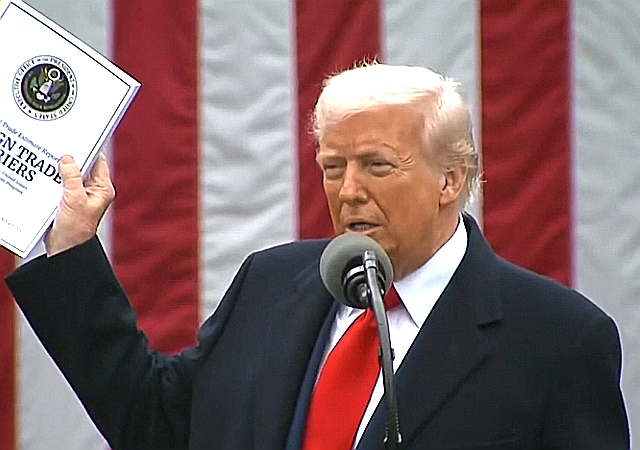
The Supreme Court has agreed to hear the challenge to Trump’s tariffs on a highgly expedited schedule.
You will recall that on August 29, 2025, the Court of Appeals for the Federal Circuit, which has jurisdiction over international trade disputes, among other things, had ruled in a 7-4 split that the tariffs exceeded Trump’s authority under the ’emergency’ provisions of congressional legislation. The effect of the ruling was put on hold until October 14 to give the government time to try to convince the Supreme Court to take the case.
The government filed a petition for SCOTUS to grant certiorari and to expedite hearing the case:
Pursuant to Rule 21 of the Rules of this Court, the Solicitor General, on behalf of the President of the United States and other petitioners, respectfully requests that this Court expedite resolution of this case to the maximum extent feasible, given the enormous importance of quickly confirming the full legal standing of the President’s tariffs under the International Emergency Economic Powers Act (IEEPA), Pub. L. No. 95-223, Tit. II, 91 Stat. 1626, and the urgent need for swift resolution. The en banc Federal Circuit’s erroneous decision has disrupted highly impactful, sensitive, ongoing diplomatic trade negotiations, and cast a pall of legal uncertainty over the President’s efforts to protect our country by preventing an unprecedented economic and foreignpolicy crisis.
As Secretary of the Treasury Scott Bessent explains in the enclosed declaration, the en banc Federal Circuit’s 7-4 ruling that the tariffs are unlawful, “though judicially stayed, raises legal uncertainty about [the President’s IEEPA] tariffs that gravely undermines the President’s ability to conduct real-world diplomacy and his ability to protect the national security and economy of the United States.” Bessent Decl. ¶ 3. “The recent decision by the Federal Circuit is already adversely affecting ongoing negotiations. World leaders are questioning the President’s authority to impose tariffs, walking away from or delaying negotiations, and/or imposing a different calculus on their negotiating positions.” Id. ¶ 7. In addition, “[t]he longer a final ruling is delayed, the greater the risk of economic disruption.” Id. ¶ 8. “For example, delaying a ruling until June 2026 could result in a scenario in which $750 billion-$1 trillion in tariffs have already been collected, and unwinding them could cause significant disruption.” Ibid. Moreover, “[t]he frameworks for trade agreements already in place contain additional provisions whereby the trade partners agree to significant purchases from and/or investments in the United States.” Id. ¶ 9. “If these agreed upon frameworks were unwound and the investments and purchases had to be repaid, the economic consequences would be catastrophic.” Ibid. 3
To that end, the government has proposed that the Court adopt a schedule with a decision on the petition for a writ of certiorari by September 10, 2025, and, upon a grant of certiorari, expedited consideration of the merits to the maximum extent feasible. Respondents have indicated that they will acquiesce in, or not oppose, certiorari ….
The SCOTUS Order scheduling the case provides:
ORDER IN PENDING CASES 24-1287 ) LEARNING RESOURCES, INC., ET AL. V. TRUMP, PRESIDENT OF U.S., ET AL. ) 25-250 ) TRUMP, PRESIDENT OF U.S., ET AL. V. V.O.S. SELECTIONS, INC., ET AL.
The petition for a writ of certiorari before judgment in No. 24-1287 is granted. The motion to expedite and the petition for a writ of certiorari in No. 25-250 are granted. The cases are consolidated, and a total of one hour is allotted for oral argument. Respondents in No. 24-1287 and petitioners in No. 25-250 shall file an opening brief on the merits on or before Friday, September 19, 2025. Any amicus curiae briefs in support or in support of neither party shall be filed on or before Tuesday, September 23, 2025. Petitioners in No. 24-1287 and respondents in No. 25-250 shall file response briefs on the merits on or before Monday, October 20, 2025. Any amicus curiae briefs in support shall be filed on or before Friday, October 24, 2025. A reply brief shall be filed by Thursday, October 30, 2025. The cases will be set for argument in the first week of the November 2025 argument session.
So what is likel to happen in SCOTUS? I discussed my thoughts in an appearance on the Jesse Kelly show not too long ago:
(Transcript auto-generated, may contain transcription errors, lightly edited for transcript clarity)
Kelly (00:42)
Okay. Tariffs, no tariffs; this or that… I don’t know. We’re not getting into that right now. What I want to know is why is this going to the Supreme Court? What are the laws? What’s the legality of all this? Joining me now is William Jacobson, Cornell University law professor, founder of Legal Insurrection. Okay, why is this a court issue? What’s happening? Why is it at the Supreme Court? Please make us smarter.
WAJ (01:09)Sure. Well, the authority that President Trump invoked for his tariffs was an emergency authority that the president has to deal with various international emergencies. And what the court ruled was that even if the statute applied–even if he properly invoked an emergency, the statute doesn’t provide for tariffs. So he did something that is beyond his authority under the statute, assuming the statute even applies.
So that was really the ruling, and the Supreme Court’s probably going to have to decide, because this was a ruling by the Court of Appeals for the Federal Circuit. We don’t talk about the Federal Circuit very much. It’s the Circuit that has jurisdiction over international trade disputes, among other things. So this will go, I presume, to the Supreme Court. The Supreme Court’s going to have to rule. Assuming a president properly invoked these emergency powers, do the emergency powers include tariffs when tariffs are not mentioned in the statute? And that’s going to be the issue.
Kelly (02:12)
Okay. Bill, you’re on the Supreme Court. Do they?
WAJ (02:18)
I think it’s within the President’s power. There is enough language in the statute. The statute does not purport to be exclusive to the remedies listed in the statute, and the President has some flexibility. So, I think he’s going to win in the Supreme Court, but I don’t have a high degree of confidence in that I might on other issues that you and I sometimes talk about. I think it’s going to be a close call. I think ultimately the Supreme Court will rule that the statute gives the President enough authority to fashion remedies to deal with the emergency, and that tariffs can be part of it.
l
Donations tax deductible
to the full extent allowed by law.






Comments
6/3
5/4 (sweet amy)
I wouldn’t rule out an unusual 5-4 split on both questions – (1) whether IEEPA authorizes tariffs as a means to regulate international trade and (2) whether the definition of “emergency” in IEEPA is left entirely to the political branches.
This should not be a close call. The president has discretion and it is much expanded when he uses foreign affair powers in conjunction. It would seemingly have to be an clear abuse. Not to mention that it’s not for the judge to mandate that it’s not an emergency if not specified in the statute.
If the Court upholds the tariffs, imagine Jackson’s dissent. The Crockett of the Court.
It is a close call. As far as the constitution is concerned the president has no power over international trade whatsoever. No discretion. The only power he has is whatever Congress has delegated to him by statute, and here he can’t point to anything in the statute that clearly gives him the power to impose tariffs. He says it’s implied, and the fact that no president until now has ever exercised that delegated power is just because none has ever wanted to. Maybe he’s right, but it’s certainly not clear that he’s right.
Nothing in the constitution gives the president a general “foreign affairs” power. He has the power to negotiate treaties, and the power to recognize or not recognize foreign governments and the extent of their respective sovereignties. That’s it. Those two powers give him considerable weight in foreign affairs, but nothing beyond them.
Not a close call, despite the “expert” analysis that sounds straight out of the Democratic hornbook. Sorry, not buying the extremely limited view that you and the judge offer, not based in law but politics.
The statute does not lay out the specific remedies or actions the President can take under emergency authority. Once again Congress delegated their authority through a poorly worded law and like other vaguely worded statutes someone walked right through and took charge. We have seen various administrative agencies do the exact thing whether the ATF or EPA.
If tariffs were among the powers Congress meant to delegate to the president in this statute, surely it would have said so. That’s the major question’s doctrine, or the mousehole doctrine.
Also, if there are no limits on the power delegated then it would violate the nondelegation doctrine.
@Milhouse “surely congress would have done so.” Your kidding, right? Congress passes legislation all of the time that is vague and government takes advantage of that. Congress did not specifically limit Trumps emergency powers in this case so he used it. For example, Congress did specifically limit the President’s Emergency Powers in the “War Powers Act”. We will see what SCOTUS says but I highly suspect it will come down to “Hey, Congress. Do your friggen job and write better laws and while your at it, don’t delegate your authority elsewhere then complain when someone takes you up on it”
Diver64, you’re just denying the major questions doctrine. Congress does not hide elephants in mouseholes. If it means to grant the president some major and novel power, it knows how to say so.
Yet presidents of both parties have used trade related tools (taxes, embargoes, restrictions) as leavers of foreign policy since the founding of the republic.
Irrelevant. This is not about trade related tools. It’s about one specific statute, which does not list tariffs among the things it authorizes the president to do, and which has never before been used to impose tariffs.
The power to “regulate” international trade surely includes the power to restrict the flow of goods or to charge fees against that flow. But that is not the only legal question here. The other one is what qualifies as an “emergency”? Is that something left to the political branches, or is there an objective test? Given the Presidency’s power to negotiate with foreign nations, and how presidents have traditionally been accorded more leeway in foreign affairs than domestic matters, my bet is SCOTUS will narrowly find for the President, perhaps 5-4, and the split may not be along traditional liberal-conservative lines. It also could be a split decision, with different justices ruling in the majority on the IEEPA powers issue and the issue of the existence of an “emergency”.
Guys,
Milhouse is correct here on the use of this particular statute. It is an open question b/c Congress didn’t explicitly delegate the power to impose tariffs within this statute and it hasn’t, until now been used to do so.
That said past Presidents have used other statutory powers to impose tariffs. Given that history plus the apex Foreign Affairs powers of POTUS to negotiate on behalf of the USA and the implicit power needed to do so it wouldn’t surprise me if SCOTUS ruled either way.
There’s other statutory powers available to POTUS other than reliance on this particular statute. So a negative ruling wouldn’t eliminate the ability to negotiate with tariff teeth.
In other words, he’s NOT right because there is no sense of context in the scheme of things.
Further, delegated authority is valid so long as it does not abuse the discretion given or conflict with the statute.
Congress gave the prez the authority to regulate, aka tax, imports and exports
“Regulate” does not mean “tax”. Trump argues that it implies “tax”, that taxing is included in it, but even he doesn’t claim it means it.
I see the fraud DEI hire has been reinstalled by a District Judge just in time for her to vote against rate cuts (its funny how these same people were only too happy to vote for a rate cut to help Biden and his fake economy out eh).
Everything comes down to politics now. Nothing is about doing what is right for the country.
Congress wrote a bad law not setting boundaries on Presidential powers under the the emergency powers they authorized so Trump is exploiting that. Tough. Congress could have just done it’s job instead of delegating things like this away.
I agree that SCOTUS will break down either 6-3 with the usual screed by Action Jackson or maybe 5-4 with Roberts once again sticking his finger in the wind.
I agree with the professor here. While the more likely outcome is Trump prevails, it’s entirely possible someone like Gorsuch and (of course) Roberts play spoiler. No one, including the Court, should lose sight of the fact that if Trump doesn’t prevail, it’s estimated the government will have to refund something close to a TRILLION dollars. That’s a real number and a number we simply don’t have and will have to print.
Maybe we will get lucky and Roberts will pull an Obamacare manuver and declare POTUS can tariff stuff.
If you’ll allow me to ascend to 30,000 feet for a moment, contrary to the left’s insistence that Trump is a lawless orange rogue intent upon destroying muh democracy, he and his team have shown themselves to be extremely well prepared, well positioned and well disciplined. They take a position, which seems to me to be carefully crafted to elicit a predictable response from the left, which brings almost immediate litigation in a friendly court which steps in in a hugely extrajudicial manner. But instead of reacting hysterically and defying an obviously erroneously decided judgement, they stay the course and win on appeal.
This is good stuff, folks. And we’re only getting started.
Yes and an often overlooked point. The damage the d/prog are doing to their long term goals by the Trump WH ‘eating the apple one bite at a time’ is taking huge chunks out of their foundation. Each win by the Trump WH narrows the ability of the d/prog to use the same or similar arguments b/c SCOTUS keeps closing down those avenues.
That is all true. However, I suspect Trump will also be losing some cases at SCOTUS. Not many, as the most winnable ones are getting there first, but he will surely lose some on the merits. Trump has been pushing boundaries, and SCOTUS will find he stepped over the line in a few instances. Obviously, he wants the most winnable ones to be decided first, as that builds momentum, but there will be some setbacks also. This case could end up being one of the losses, or a split decision, but I think the odds favor other cases being the first major losses at SCOTUS.
Correct, the Trump WH will definitely not ‘win them all’. Even in the losses there will be clarification brought on the actual limits of Executive Branch authority (as interpreted by the current iteration of SCOTUS). That is likely to involve decisions laying out where the ‘line’ exists in a precise manner so that the Executive Branch, not just the Trump WH, knows where to say ‘this far but no further’.
america is truly stuck in its lefty run nightmare
tied up in courts and decades>>centuries of lefty pounding into the heart of capitalism via regulations to supplement laws that gave the broader definitions
we see it in our cashless no bail let em out on the streets for the sake of the blmplo brotherhood
so the left has been allowed to implement their strategies with broad based laws/regs that allow THEM to claim and WIN the argument that the
law is fluid
but that fluidity must be stopped when maga agenda is in power..I wont even say *control* b/c the swamp is too deep
the street bullies attack and its the daniel pennys that are handcuffed and the message is loud and clear :
we cant use the prison system to clean up the streets from criminals
( my words..leftys agenda)
we have to give them room to destroy
They say it straight faced and in your face black matriarchy attitude that defies common sense but is set up for the win
the gop wont stop the federal tax money from flowing to these crime loving states and/or cities
so trump plays by their rules…fluidity rules…and the courts shut him down
yeah I too fear violence in the streets
but its already here and growing and with the sanctioning of the government that uses those prison rules to keep maga in check
jussie for mayor!!!??
As far as the arguments goes with respect that tariffs are not explicitly stated in the IEEPA: when acting as commander in chief to prosecute a war, is the president prohibited from using, say, cruise missiles because the Congress never put it into a bill?
The IEEPA gives the President the tools needed to regulate the importation of foreign goods to deal with any unusual and extraordinary threat to national security, foreign policy, or the U.S. economy, Imposing tariffs is the most effective way of countering foreign tariffs and trade imbalance. Since IEEPA did not list
cruise missilestariffs, does that mean the president is hamstrung? Not in my opinion.Also… most importantly: What clause in the constitution or what federal law delegates powers to the Judiciary to determine unusual threats to our economy or national security in the first place? This is why it should be a slam dunk at SCOTUS.
I think you are right, but will SCOTUS leave the definition of “emergency” entirely to the political branches? I suspect it might end up being 5-4 on both questions, and the same 5 may not be in the majority on each.
Trump is not likely to win this case. Article 1 of the Constitution did not give tariffs or taxes to the presidency.
For context Trump has a similar chance to if the House Speaker started a rival foreign policy to Trump and Trump took the speaker to court.
Our system very clearly says who raises tariffs.
Does article one list every act allowed to be carried out by a sitting President or, does article one list every act a sitting President cannot carry out?
Neither. And he means Article 2. But this is not an article 2 issue at all. It’s not about presidential power. It doesn’t involve the constitution at all, it involves only interpreting a specific word in a specific statute. Congress has power over tariffs; does this one word in this one statute delegate that power to the president, or does it not?
I think you mean Article 2. But it’s closer than you make it out to be.
It’s true that the constitution gives the president no power over tariffs or taxes, and Trump acknowledges that. That’s not in dispute. But Congress, which is given power over those things, has passed a statute delegating to the president a power to “regulate”.
The question before the court is whether, hiding somewhere within this power, is the power to tax. Trump says it’s included, the plaintiff say it isn’t. The plaintiffs rely on the major questions doctrine, but Trump would say this isn’t that major a question; tariffs are not elephants, and a general power to regulate is no mousehole. So, contrary to both you and oldschool26 on opposite sides, it’s a close call.
tariffs are the political way to (try) avoid a military conflict
trump is trying to avoid such a conflict