


Russian Volcano Erupts for First Time in 600 Years Days After Massive Earthquake
Krasheninnikov Volcano may have been close to erupting on its own, and the seismic waves from the 8.8 Richter Scale quake may have triggered this weekend’s activity.
Last week, I reported on the powerful earthquake that struck the east coast of Russia’s Kamchatka Peninsula. The seismic event triggered tsunami alerts for the entire U.S. West Coast and prompted evacuation warnings in Hawaii.
Now one of the volcanoes in a complex on the Kamchatka Peninsula has erupted for the first time in about 500 years.
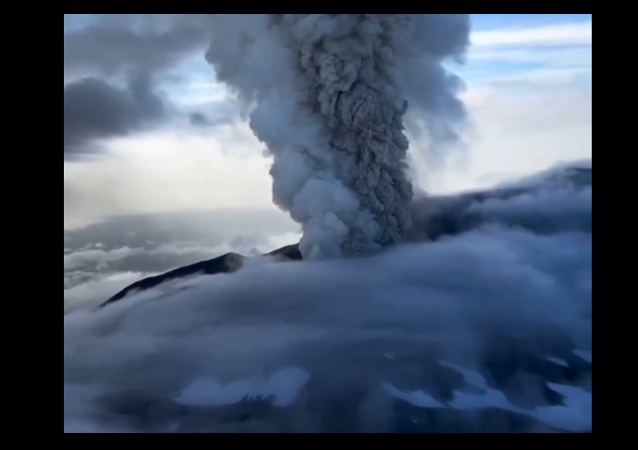
The Krasheninnikov volcano sent ash more than 3.7 miles into the sky, according to staff at the Kronotsky Reserve, where the volcano is located. The eruption came just days after a massive 8.8-magnitude earthquake hit in the region, causing tsunami waves in Japan and Alaska and prompting warnings for Hawaii, North and Central America and Pacific islands south toward New Zealand.
Images released by state media showed dense clouds of ash rising above the volcano.
“The plume is spreading eastward from the volcano toward the Pacific Ocean. There are no populated areas along its path, and no ashfall has been recorded in inhabited localities,” Kamchatka’s emergencies ministry wrote on Telegram during the eruption.
The eruption was accompanied by a 7.0-magnitude earthquake and prompted a tsunami warning for three areas of Kamchatka. The tsunami warning was later lifted by Russia’s Ministry for Emergency Services.
Smithsonian Institution’s Global Volcanism Program lists Krasheninnikov’s last eruption as occurring in 1550 AD, about 475 years ago. However, Russian sources cite 1463–1463 AD. It is thought that last week’s 8.8 earthquake may have triggered the eruption.
“This is the first historically confirmed eruption of Krasheninnikov Volcano in 600 years,” RIA cited Olga Girina, head of the Kamchatka Volcanic Eruption Response Team, as saying.
She added that the eruption may be connected to the earthquake on Wednesday that triggered tsunami warnings as far away as French Polynesia and Chile, and was followed by an eruption of Klyuchevskoy, the most active volcano on the Kamchatka Peninsula.
On the Telegram channel of the Institute of Volcanology and Seismology, Girina said that Krasheninnikov’s last lava effusion took place in 1463 – plus or minus 40 years – and no eruption has been known since.
The Kamchatka branch of Russia’s ministry for emergency services said that an ash plume rising up to 6,000 meters (3.7 miles) has been recorded following the volcano’s eruption. The volcano itself stands at 1,856 meters.
New video shows absolutely stunning footage of Krasheninnikov erupting after 600 years.
On August 2, 2025, it recorded its first-ever eruption, with ash soaring up to 5-6 km high. Scientists believe it may be linked to the recent M8.8 earthquake.
📍 Kamchatka, Russia. pic.twitter.com/1CKiSXbeRM
— Weather Monitor (@WeatherMonitors) August 3, 2025
It is being theorized that last week’s seismic waves may have impacted the magma in a way that woke up the sleeping giant.
The latest volcanic activity on Kamchatka could be related to the quake, according to Harold Tobin, a professor of seismology and geohazards at the University of Washington and director of the Pacific Northwest Seismic Network.
“It is definitely an interesting coincidence… Or not coincidence,” Tobin told NPR.
Tobin doubts the quake alone would have triggered the eruption. But he said if the Krasheninnikov Volcano was near erupting on its own, the quake’s seismic waves could “shake loose the system that then allows it to actually erupt.”
“It wouldn’t have experienced really extreme shaking,” Tobin said. “Nonetheless, seismic waves that are passing through the earth are certainly affecting underground systems like potentially magma that’s in cracks in the rock inside a volcano.”
NEW: Incredible video of The FIRST HISTORICALLY RECORDED ERUPTION of Krasheninnikov Volcano in Kamchatka, Russia.
Scientists think it may have been triggered by the M8.8 earthquake that struck off the coast of Kamchatka, Russia on 30 July 2025, at 11:24:52 local time.… pic.twitter.com/1ZQcZxSs1G
— Volcaholic 🌋 (@volcaholic1) August 3, 2025
Krasheninnikov actually is comprised of two overlapping stratovolcanoes inside the Kronotsky Nature Reserve. The volcano is named after the explorer Stepan Krasheninnikov (a naturalist who explored Siberia in the mid-1700s).
The Pacific Ring of Fire seems to be awfully busy recently. Those living adjacent to it should take a few moments to ensure evacuation plans and emergency supplies are in order.
Donations tax deductible
to the full extent allowed by law.







Comments
CNN to put blame on:
1. Trump
2. Climate change
3. Racism
Ladies and gentlemen, place your bets…
4. The Joooz.
And the cyclists.
“Why the cyclists?”
“Why the Jews?”
I love that old story.
5. Another Russian hoax
Boris! Is new capitalist weapon tested in motherland because of Mendeleev.
Works! Call it Trump Roars Back!
Krasheninnikov was considered dormant so the possibility of eruption always existed. I live near a ton of dormant volcanoes and a caldera about 20 miles south of my house. I don’t anticipate any activity in the next 30 years so it’s really not a great concern.
I can just hear Ivan Krasheninnikovon the phone making an appointment.
“ Krasheninnikov. Yes. Krasheninnikov Common spelling.”
Coming next: Kaiju.
Kaiju Number 8
As long as it’s not Number 9.
agreed. Number 9 is vicious.
Gaia must be very, very angry with us. No doubt it’s because of Trump and racism. 🙄
Hmmmmm.
The ash and smoke from the eruption – perhaps AlGore can tell us the equivalent emissions equal to x number of IC engines driven by y number of people for z number of years.
Would this be considered man made global warming / cooling / climate change because the volcano is named after a human, Stepan Krasheninnikov?
Or, maybe, the two aren’t separate incidents. Maybe the earthquake and eruption were both symptoms of the same event.
Or maybe they were totally unrelated and just coincidental.
Or maybe it was just God clearing His throat.
Or maybe a butterfly flapped its wings on the other side of the world.
Or maybe “scientists” should keep their hypotheses to themselves until they have a chance to research and test them instead of spouting off as if they had any freaking clue what they were talking about to “journalists” desperate for clickbait.
Then maybe people wouldn’t be so skeptical of “the science”.
Or maybe they would still be.
I need to test that theory.
The Earth is in for some global cooling with all that volcanic ash blocking out the sun. That will keep the global warming crowd at bay for a while. They’ll be back though. Just like Freddy Krueger, you can’t keep him down!