


Federal Appeals Court Voids Pa. Law Requiring Mail-In Ballot Dating
The appeals court found the dating requirement did little to ensure election efficiency, reinforce the solemnity of voting, or detect or deter fraud.
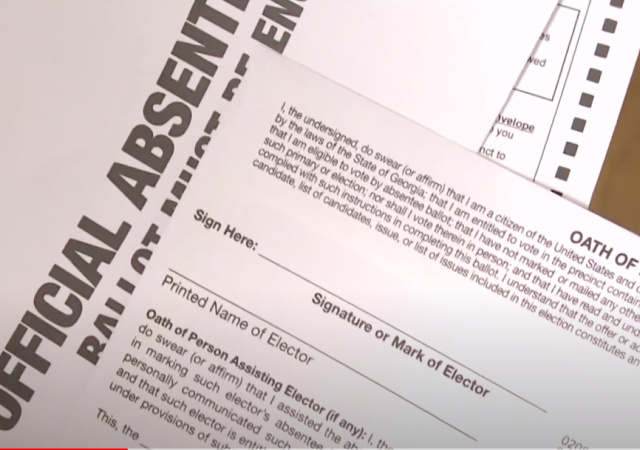
A federal appeals court on Tuesday voided a Pennsylvania law requiring proper dating of mail-in ballots. The law required the rejection of mail-in ballots improperly dated by voters. The Pennsylvania Attorney General, now a Republican, defended the law on appeal after his predecessor, a Democrat, had declined to defend it in a lower court.
Numerous types of dating errors could result in ballot rejection, the appeals court noted:
Pursuant to this “date requirement,” if a return envelope’s date field contains a mistaken additional digit, a stray pen mark, or missing information (including a year) then the ballot contained within that envelope may not be counted. (citations omitted)
The law led to 10,000 discarded ballots in the 2022 General Election. Only 4,500 ballots were discarded in the 2024 General Election after Pennsylvania redesigned the return envelope to reduce the number of discarded ballots.
The U.S. Court of Appeals for the Third Circuit held that while the dating requirement only minimally burdened voters, the consequences of an improperly dated ballot outweighed any purported benefit of the requirement.
The challenge came after the Supreme Court of Pennsylvania interpreted a part of the state election code requiring voters to “fill out, date and sign” their mail-in ballot. The state supreme court held that the dating requirement mandates discarding ballots that are improperly dated.
The state supreme court further held that county election boards are not required to inform affected voters of a ballot rejection due to improper dating. Further, Pennsylvania law bars a voter who received a mail-in ballot from voting in person unless that voter surrenders the mail-in ballot at the polling place.
Thus, the law meant that Pennsylvania voters with an improperly dated mail-in ballot likely had no opportunity to remedy the defect and cast a vote.
A voter whose ballot was rejected during the 2022 General Election challenged the law in the U.S. District Court for the Western District of Pennsylvania. The district court rejected some of her challenges but found the law violated the First and Fourteenth Amendments to the U.S. Constitution.
The state offered three rationales for the dating requirement, which the appeals court rejected:
We . . . examine the three State interests Appellants offer to support the date requirement: (1) facilitating election efficiency; (2) promoting solemnity; and (3) detecting and deterring voter fraud.
The court agreed that “these interests are legitimate” but found them insufficient to support the law.
The court first addressed the efficiency rationale:
[A]s a general proposition, the date requirement does not seem to facilitate orderly election administration in any manner. The date on a return envelope does not inform whether a voter is eligible to cast a ballot. It does not indicate when a voter completed a ballot. And it has no bearing on whether a ballot is timely. If anything, requiring county election boards to check the date field on return envelopes seems to hamper efficiency by foisting an additional responsibility on the boards for no apparent purpose. (citations omitted)
Under Pennsylvania law, a mail-in ballot is timely if received by 8 PM on Election Day.
The court also rejected the solemnity rationale, which the state contended encouraged voters to make more thorough deliberations about their choices. The court found other aspects of the election code more effective in promoting an interest in solemnity:
[T]here are other aspects of the mail-in voting process that promote solemnity, including the process to acquire a mail-in ballot, the steps required to submit a timely ballot, and the fact that the return envelope that accompanies a mail-in ballot features a declaration that a voter must sign. Affixing one’s signature onto a legal document does indeed constitute a solemn act. And under Pennsylvania law, signing the return envelope has legal import and could subject someone to criminal penalties. It is puzzling what incremental solemnity dating a return envelope might possibly add that affixing one’s signature to the document has not already accomplished. (citations and footnote omitted)
Turning to the third rationale, the court found little to link the dating requirement to detecting or deterring fraud:
[W]e are simply unable to discern any connection between dating the declaration on return envelopes and detecting and deterring voter fraud. County election boards have no means of verifying the handwritten dates on return envelopes. And the record shows that county election boards did not view the absence of a date on a return envelope’s declaration or the presence of an incorrect date as a reason to suspect voter fraud.
The state pointed to one criminal conviction for mail-in voter fraud. In that case, a woman filled out and mailed in her deceased mother’s ballot. Pennsylvania’s Statewide Uniform Registry of Electors (SURE) system flagged the ballot because the mother had already been removed from the voter rolls.
“Notably, the SURE system, and not the date on the return envelope, is what alerted the County to the fraud,” the court noted.
The Third Circuit’s opinion:
Donations tax deductible
to the full extent allowed by law.







Comments
If. The good for little Congress can do one thing, it would be to eliminate federal courts and or judgeships since if I am not mistaken they are the ones that created them. Is not the SC the only fed court specifically authorized in the Constitution ? Please correct me if I am wrong
You are wrong. The constitution specifically authorizes both a supreme court and “such inferior Courts as the Congress may from time to time ordain and establish”.
Not only is it obviously impossible for all federal cases to be heard by the supreme court, but the constitution precludes any attempt at doing so, by providing that in most cases the supreme court has only appellate jurisdiction; original jurisdiction in most cases lies with the inferior courts.
It’s obvious those courts are way too inferior or at least the judges are.
I don’t disagree with your broader point. But, there are a TON of cases where a State ‘is a party’ that are first heard in District Courts because Original doesn’t necessarily mean ‘exclusive.’ But, as you point out, it would simply be logistically impossible for the Court to be the trial court in those cases.
With respect to the subject of original jurisdiction, I’ve always found it interesting that Marbury vs Madison was (I believe) litigated entirely before the Supreme Court even though it clearly didn’t qualify as a case that met the original jurisdiction set forth in Article III. But, the Judiciary Act had been passed that intended to expand the Court’s original jurisdiction. Marshall, writing for the majority, said that the Court couldn’t grant the writ Madison was asking for because the basis of the Writ, and the original jurisdiction to hear the case (The Judiciary Act), was unconstitutional.
Original doesn’t necessarily mean ‘exclusive’, so an inferior court can hear a case where the supreme court has original jurisdiction.
But original and appellate are exclusive of each other. So in cases where the supreme court doesn’t have original jurisdiction it can’t hear them until an inferior court has done so first. Which means the constitution requires Congress to establish inferior courts. It doesn’t say how many or what kind, but at least one inferior court must exist.
No, you are wrong. Article III Section 1 only says “may from time to time ordain and establish”. There is nothing whatsoever in the language that REQUIRES Congress to establish even one single inferior court. If that had been the Framers’ intention, why did they not just say so like they did with the Supreme Court?
Yes, the constitution does require Congress to establish inferior courts, because in most cases the supreme court has only appellate jurisdiction. That means there must be a court with original jurisdiction, and the only way that can happen is if Congress establishes one. So it is required to do so.
Congress does not establish the supreme court. The constitution itself establishes it, and Congress has nothing to do with it.
There is a world of difference between ‘may’ and ‘shall’.
As is the standard, you stand on the wrong side of that difference.
As usual, you are wrong. “May” here is not giving Congress permission to establish inferior courts if it wants to. Congress has to establish such courts, because there must be courts to hear cases where the supreme court has no original jurisdiction. This clause simply means “whichever courts Congress happens to establish”. It has to establish some courts; it doesn’t have to establish any particular court. So each court it does establish is contingent on that establishment. That’s all the “may” here means. Look it up in a dictionary.
And, as usual, when called out, your response is, that the truth is whatever the Democrat, in this case, you, says it is.
There is no ‘shall’ establishing the federal court system. No matter what way you ‘living constitutionalists’ seek to pervert it.
The ‘shall’ you so love is what has grown through the practices spawned by your great deceit.
Love Yu, millstone. Bless
IANAL, but I have long understood that under our system of law, it is plainly NOT the role of the court to opine on the efficacy of laws that are passed by the legislature. IOW, it’s none of their business if the law achieves the intended effect. Instead, they’re only asked if the law is constitutionally infirm or in conflict with (in this case) federal statutory law.
A law that doesn’t achieve the effect for which it was passed is arbitrary as it doesn’t serve its purpose, and arbitrary laws are unconstitutional. A law must both have a purpose and it must accomplish its intended effect in order to avoid being arbitrary (and therefore unconstitutional). This, I understand, is the theory. In effect, our statutes are full of purposeless laws and purposeful laws that failed to accomplish their goals.
“Gun free zones,” anyone?
In general this is not true. As a general rule, state legislatures can make whatever laws they like, and they don’t have to make any sense. They’re not limited to enumerated powers (unless their own constitutions say they are), and they have a general police power (which Congress does not).
The rule you cite, that rules out arbitrary and capricious laws, refers to federal regulations. Also federal laws must bear some rational relationship to one of Congress’s enumerated powers.
However election laws are different, for two reasons.
One is the materiality requirement of the Civil Rights Act of 1964, which bans states from enforcing any legal requirement that would prevent someone from voting, if that requirement is “not material in determining” whether the person is qualified to vote.
Originally it was argued that this meant that PA’s dating requirement could not be enforced. However the district court rejected that argument because under 3rd circuit precedent that only applies to laws that restrict who may vote, not to ones that restrict how they must vote. So if PA had a law requiring voter registration forms to be dated, and a person forgot to put the date, it would not be allowed to enforce that law and reject the application, because who cares what date the application was made? It doesn’t affect the person’s qualification to vote, so the state must accept the registration anyway. But here the state is saying, “you can vote, here’s a ballot, but you must date it”, so the materiality clause doesn’t apply.
However there is also something called the Anderson-Burdick doctrine. It says that although there is no constitutional right to vote as such, as soon as a state grants a right to vote the first and fourteenth amendments require that it be administered fairly, and therefore that the state may not impose pointless restrictions on it. Every burden on voting, in any election, must be balanced against the benefit the state gets from it. If it serves a legitimate purpose, well and good, but if it’s just making voting harder for the sake of making it harder then it’s invalid.
And that’s the basis for this decision.
Yep, the constitution says the state legislatures set the rules, not the courts, not the governor, not the Sec of State. Of course the judges think they have final say on all things. That is why the 10th is doomed to obscurity. Can’t have federal judges opining on things not in their domain.
First of all, for constitutional purposes a state “legislature” includes whatever mechanism the state uses to make laws, which includes the governor’s signature, and if the state’s normal legislative procedure includes referendums then they’re covered by “legislature” as well.
Second, every state’s election law, enacted by its legislature, delegates considerable regulatory power to the secretary of state (or some other officer). That makes that person’s rules valid
Well that is an interesting take by the 3rd Circuit. In Alabama absentee ballots are not the norm. Requires a narrow range of reasons if not a Military/Overseas voter. Gotta apply and may be rejected. If approved then voter completes ballot and puts into provided plain envelope. The plain envelope goes into the affidavit envelope which requires voter signature + two witness signatures. Can be returned by US Mail but must arrive NLT NOON on election day or can be returned by hand of the voter to the clerk NLT 1700 the day PRIOR to election day.
And that’s fine. But all such regulations must pass the Anderson-Burdick test. The burden imposed on a voter’s constitutional right must be balanced against the state’s interest in that regulation. So for instance, unless the state can come up with some reason why it can’t accept ballots that arrive at 2:00 PM on election day, it will not be allowed to reject such ballots. It can’t simply say “that’s what the legislature said, so we’re enforcing it”. That’s not good enough, because the legislature itself has no right to impose such restrictions without a good reason.
The plaintiff must show a harm, where is it and relative to what/whom? Ultimately there’s always gonna be a cut off point on a particular time/day so any claim that a harm exists for a voter simply not complying with the cut off time/day is IMO frivolous. The absentee voter is still able to bring their absentee ballot to their polling place on election day, present it, have it voided and cast a normal in person ballot subject to the normal poll closing hours. Compared to a non absentee voter who has only election day to receive, review, complete and turn in their ballot the absentee voter has far more time and opportunity to comply.
The State interest in avoiding opportunities for fraud and/or chaos on election Day in order to maintain public confidence and trust in the election process seems to me insurmountable with a clear, transparent and neutral application of election rules…particularly here with an Alabama Absentee ballot which keep in mind is itself an accommodation privilege granted to a voter and not itself a right. Especially when the opportunity to void the absentee ballot and vote in person exists.
Considering Alabama is home to the SLPC and the election statutes for absentee ballots haven’t been successfully challenged by them or one of their many lefty ideological law fare allies it’s probably a good bet that these election statutes are quite likely to remain in force for the foreseeable future.
Under the Anderson-Budrick doctrine the plaintiff must merely show a burden on voting that is not de minimis. It doesn’t have to be a great burden, just not so small that it can be ignored. Having ones vote thrown away just because one didn’t fill in the date properly, or just because the mailman delivered it an hour late, is inherently a burden on voting; therefore Anderson-Budrick says the state must justify it by showing what benefit it gets from such a law, and that benefit must be balanced against the burden.
That’s just the thing. The PA law requiring the envelope to be dated does nothing to advance any state interest whatsoever. The state couldn’t come up with any reason for it, so it failed Anderson-Budrick balancing.
What state interest does it serve when AL cuts off receipt of postal votes many hours before the poll closes? In what way does that prevent fraud, or boost confidence, or advance any other state interest? If it does, then that must be balanced against the burden placed on the voter; but without finding some interest there’s nothing to balance, so it must fail.
I don’t see how SPLC’s presence in AL makes any difference; if a rule does nothing to prevent fraud, why would SPLC even want to challenge it? SPLC isn’t there to just challenge things at random. It has specific goals, one of which is to help Democrats get elected, so it will only bring challenges that it thinks will advance that goal.
If there were no mail in ballots (except military) this wouldn’t even be an issue.
Indeed. In person voting, with positive ID, would eliminate any question of validity.
That, and purging the rolls of the dead and unqualified. Illegal alien voting should be rewarded with unquestioned expulsion from the country.
Naturally, the Dems are against all of that.
Indeed. But since PA does allow them, it may not impose a burden on using them without a good reason. Even a minimal burden such as this must be balanced against the benefit the state gets from it. It’s not enough to say “That’s what the legislature wrote”.
A notary public is used when you need to verify the authenticity of signatures on important documents, such as contracts, powers of attorney, or real estate transactions. Their role helps prevent fraud and ensures that all parties involved are aware of the document’s contents and are signing willingly
What’s that got to do with the topic? In this case there is no question about the ballot’s authenticity, or the voter’s eligibility; the only defect is that the voter didn’t write the date on the outside envelope. The date does not assist the state in any way whatsoever. The state makes no use of it for any purpose; it simply verifies that it’s there, and then ignores it. So it has no valid reason to reject ballots that omit it. Simply saying “The legislature said so” is not good enough.
Except you cannot use a Notary Public to authenticate a ballot as they charge a fee to authenticate documents and that could (would?) be considered an unconstitutional poll tax under the 24th Amendment that prohibits poll taxes.
The 24th amendment does not prohibit poll taxes. It only prohibits making the right to vote conditional on paying them, or any other tax.
The only reason it specifically mentions a poll tax is because at the time it was passed many states did happen to use that particular tax as a criterion for the franchise, and they commonly administered this requirement in a racist fashion, enforcing it only against black people and not against white people.
You could require absentee ballots to be notarized, either by requiring notaries to do so for free (at least in NY, they’re only allowed to charge $2, which is so close to zero that making free isn’t much of a burden on them), or simply by saying you’re free not to vote absentee. You’re free to choose not to apply for an absentee ballot, and vote in person instead. If you choose to do it this way, there will be costs involved.
As far as I am concerned unless you present yourself in person, provide a government issued identification that matches the roll, and fill out a paper ballot within the 24 hours of Election Day, your vote does not count.
Nothing else protects against fraud, which I believe is far more rampant than currently believed.
As far as I am concerned unless […] your vote does not count. Sorry, you don’t get to decide that. You may think that without those conditions a vote shouldn’t count, but the law says it does count and must be counted.
Churl, he gets to have an opinion.
Which is what he voiced. Not a statement of policy –‘as far as I am concerned’.
You grow too fervent in your zeal to absolve your leftist brethren of all the crimes against the US they revel in.
What a joke. This appellate court is fit for the Soviet Union.
What we really need, though, is the abolition of ALL mail-in balloting. No ballot can be allowed to travel through the us mail and drop-off boxes are jokes that only serve to allow massive cheating.
No more mail-in or drop-off balloting. Any “exception” law (like early voting) must be limited to being an actual “exception” and cannot be used by more than 1 or 2% of the voting population, though I prefer to have no early voting, at all. Get to the poll on election day or wait until the next election to vote. Tough.
It is amazing that any sentient person would ever even think of allowing mail-in balloting. Crazy.
Most western nations have rejected mail-in balloting specifically because of the potential for cheating. Nobody ever had to prove cheating in order for them to make these laws, it’s just common sense. If you permit wide-scale mail-in voting, at best you’re not serious about the integrity of the vote, at worst you’re inviting/enabling fraud.
Or counting on it….
The cheating issue is obvious. But mail-in balloting (any home fill-in balloting) violates every single important characteristic of anonymous, secret balloting. It used to be that no one could really buy votes since it was impossible to know how someone actually voted in the booth. There was no record to check and they couldn’t go in with them. With mail-in balloting (or any fill-in balloting) you can buy votes because you can sit with the voter and watch him fill our his ballot and then watch him put it in the mail/drop-off box. You can buy a vote and be assured it was actually purchased.
Further, the ballot is no longer secret. Even some couples might enjoy the fact that they cannot be in the voting booth with each other and never really know how their spouse or children vote. With fill-in balloting that disappears. The voting takes place in public, as it were.
On top of these serious issues, there is no chain-of-custody with mail-in or drop-off balloting and no way to even establish a legitimate origination of the ballot. Obviously, the only people who want mail-in/drop-off balloting of any sort are people who want to cheat the system.
BTW, interesting factoid about PA voting – the mail-in ballot stupidity in PA had nothing to do with COVID. They passed mail-in balloting idiocy in Sep 2019, before COVID. ANd it was a friggin GOP legislature (backstabbing pieces of sh*t) who introduced and passed it.
I don’t know how you determine that “most” Western countries have rejected it. Which countries do you count as Western for this purpose? Certainly a lot of them do allow it.
I would call a country “western” if is has a democratically-elected government derived either natively (e.g. European countries, the U.S., and Canada) or from historical ties to Europe through former colonization (e.g., India, Brazil) or occupation (e.g., Japan) where the native population subsequently adopted European-style democratic principles.
Also, in context, we’re discussing situations in which all voters are either permitted to vote by mail or in which voting by mail is mandatory. (I don’t think anyone arguing either way here doesn’t believe that at least some voters should be allowed by mail.) We’re discussing the Dem’s attempt to remove the limits and to make voting by mail maximally pervasive.
See the map here:
https://en.wikipedia.org/wiki/Postal_voting
Note that very few countries allow “all voters” to vote by mail (and this does not include the US, as not all States allow all voters to vote by mail), and the description of what limited types of voters are permitted to vote by mail in those countries allow some types voting by mail. Generally voting by mail (either permissive or mandatory) for all voters are in a distinct minority, and world-wide a surprising number of countries don’t allow any mail-in voting at all. Even counting just North America and Europe shows that very few countries have entirely permissive of mandatory voting by mail.
Actually we aren’t. We’re discussing is a proposal for “the abolition of ALL mail-in balloting”, and your claim that “most western nations have rejected mail-in balloting”. That map shows many countries that allow extensive postal voting, even if you need to give a reason.
Oh yeah? Have you read the decision? Do you have any reasoned objection to it? You certainly don’t seem to. Do you disagree that the court was required to apply the Anderson-Burdick test?
With mail in ballots you have a severed chain of custody. Thus they can never be trusted. They should be banned completely. That will solve the problem of bad dates.
This, exactly. There’s a reason why you can’t just mail stuff to a notary public to have it endorsed and instead, you have to sign the document in their presence. Mail-in voting is an invitation to election fraud. I mean, even France – FRANCE – doesn’t allow it.
And yet many countries do.
Even aside from the chain-of-custody, you cannot even confirm the origination of such ballots or determine anything about the circumstances and methods of their being filled out – all of which are integral parts of our electoral processes and are supposed to insure that every vote is anonymous and secret, which these home-filled ballots are not.
The questions before the court should be: does the
law violate the US constitution; does it violate federal law; and/or does it create an unreasonable burden for citizens to cast their votes? Based on what is written above, the answer should have been ‘No’ for each, thus the law should not have been overruled.
The Appeals Court used the “apparent” ineffectiveness of the law to justify throwing it out, based on thousands of disqualified ballots due to incorrect date entries by registered voters.
If the Court was concerned about disqualified ballots, then it could have offered a remedy (or required the state to find a remedy) such as requiring all county voting offices in the state to notify the voter of an incorrect date entry and allow an opportunity to fix it. Apparently that is already done in some counties, but not all.
The fact that the Court threw out the law without considering other options shows that the decision was politically motivated.
The effectiveness of the law should not be considered in the Court decision at all, since that is in the realm of politics and thus is under the purview of voters.
That’s not how it works. The Anderson-Budrick doctrine requires balancing every burden on voting against the benefit the state gets from it. Having established that, even with the new simplified form, a significant number of voters get it wrong, and that the fact is not every county gives them an opportunity to fix it, the state had to come up with some benefit it gets from the law, which the court could then balance against the burden on the voter. The court agreed that the burden here is quite small, and could be justified by quite a small benefit to the state; but the state couldn’t come up with anything. It was reaching at empty air. So what else could the court have done?
The Court here is simply substituting their own personal political opinions for what the elected legislature actually passed into law.
If they want to function as State Senators/Assemblymen, they should resign and run for those positions.
They’re simply making sh!t up.
There is no legal basis for their decision.
If anyone wants to know why mist Americans have nothing but contempt for our Courts, cases like this are a prime example.
No, it is not. It is applying the law to what the legislature passed, and determining whether the legislature had any right to pass it.
That is just outright false. You are entitled to disagree with the court’s judgment; you are not entitled to make shit up about it. The court made nothing up, and had good legal basis for it, which you would know if you bothered to read it. It may be that, considering the same factors, you would have come to a different conclusion. That’s OK. But you can’t deny that this is a reasonable conclusion for it to have reached.
Respectfully, I would disagree here.
The court here invalidated a requirement that the ballot submission be dated. The court reasoned that there has to be a tie to the purpose of the requirement and the requirement.
The underlying question is how a dating requirement helps determine whether a ballot is valid, or the submission is a valid vote.
Compare and contrast a dating requirement with a signature requirement. For examples, signatures create a mechanism for detecting an ineligible or fraudulent submission. How does a date on the envelope do that?
Don’t get me wrong, I don’t like and am opposed to mailin balloting, among for other reasons, vulnerability to fraud, and the privacy of the voter. Here though, it looks to me the court actually did what it was supposed to.
If only to save 1 proper vote from being rejected.
They know mail voting is their best shot at vote fraud.
Or we could just admit mail in voting was pushed during Covid to provide massive opportunities for fraud with the resulting election of Pres Autopen. How about we just ban it in it’s entirety except for specific situations like our military stationed in locations other than their home states, foreign diplomats around the world etc and not allow it for people just too friggen lazy to vote.
Nope. If you’re going to ban mail in voting then there shouldn’t be any exceptions. None. What. So. Ever. All or nothing. If you allow mail-in voting then fine. If you ban it then no exceptions, everyone must go to their polling station in person to complete ballot. Military, foreign diplomats and their families, college students living out of their home states, citizens who are out of the U.S. on election day. All of them without exception. Why should I be forced to travel to a polling station and physically complete a a ballot while others are allowed mail-in ballots.
In theory, absentee voting is necessary to avoid disenfranchising some categories of legal voters.
But to make fraud more difficult (impossible is I’m afraid not an attainable goal) there should definitely be some restrictions.
All VBM to have a (say) 30-day active pre-election day window to allow for mail processing. Perhaps 45 days if overseas. (‘Yes, “overseas” also applies to other countries you can get to by walking, like Canada or Mexico). Post mark date or by other means (say arrival on time for non-postmarked mail from military using free delivery) to ensure timeliness – with no more than a (say) 10-day late post-election window to be still valid and countable.
Overseas US govt, military, civilian contractors, and their accompanied families. A no-brainer. Those who serve certainly deserve to vote.
Other overseas permanent resident civilians – perhaps require them to appear in person at a US embassy or consulate the first time they wish to VBM.
Those planning to temporarily be away from home (traveling or just living elsewhere) during the voting window – must show up in person at a specified local govt office (like county clerk) ahead of time to make arrangements.
Those unable to vote in person due to health reasons – if staying at a care facility or hospital during the voting window require an admin of that facility to sign off that you exist and it’s you who filled out the form. If still living at home you can have a friend or family do that. In either case require the person who signs off to have previously registered in person WITH ID at the same govt offices a voter can go to in person WITH ID to request a mail-in ballot for themselves.
Prosecute any one “farming” elderly or senile votes at care facility for their Party by falsely attesting that the voter voted themselves. Yes, this scheme happens every election now.
The important thing to all these exceptions is that in EVERY case either the voter or the helper or both had to show valid ID. To prove they actually exist, are that person on the ID, are still alive, are at the least not in a coma.
No more Chicago graveyards yielding up their dead to vote, no more Party operatives casting votes for nursing home residents who don’t even know they’re “voting”, no more mass mailings of un-asked-for VBM ballots out there to be filled in by whoever finds them.
Cleaning up the voter registration lists is IMO a better target in the vote by mail jurisdictions. Then try to get the voter registration deadline for participating in State/Local elections pushed back to the day prior to ballots being mailed in those VBM States. That’s two-fer b/c it eliminates late stage voter registration chaos and opportunities for shenanigans close to election and creates a ‘tension or conflict’ for the VBM advocates by linking the last registration day to the day they want to mail ballots…forcing them to choose an early mailing date 45 days/60 days to have more time to ‘harvest’ ballots or a later mailing date to gain time for more registrations. Gotta get rid of same.day registration in any event and it should probably be whatever the residency requirement is to mandate a DL in that State.
Might as well send ballot to everyone in the country.
Democrats sure know how to game the system. (How did “Bette Eakin” know her ballot was not counted?)
Would the Third Circuit be all like What’s-the-big-deal if you filed a lawsuit and misdated the 28 USC 2244 form and said sure, we’ll consider your motion for relief anyway? I think not. Because it ALL about promoting the “solemnity and efficiency” of the Court.
Hopefully all this is moot when mail in voting is abolished
Mail in voting will never be entirely abolished – at the least US military or govt employees serving overseas have a long recognized right to vote by mail.
Lots of back and forth about the wrong issue. Pass a law mandating there be no mail in ballots. Full stop, period. That takes care of this problem and many more. You want an absentee ballot? Fine, go the supervisor of elections office and present a valid ID and pick it up. Watch the demonrats turn into raving lunatics. Shut off the money and then shut off the ability to count until you get the outcome you want.
If the lower federal courts ignore or defy SCOTUS decisions, isn’t that prima facie insubordination? Surely that alone is grounds for impeachment and removal.
What are you talking about? The only SCOTUS decisions involved here are the ones that came up with the Anderson-Budrick doctrine, and the court followed them.
If you’re talking in general, there have been no instances of outright defiance; there have been some where SCOTUS had to clarify its meaning.