


Appeals Court Rules Numerous Trump Tariffs Are Illegal
“we discern no clear congressional authorization by IEEPA for tariffs of the magnitude of the Reciprocal Tariffs and Trafficking Tariffs.”
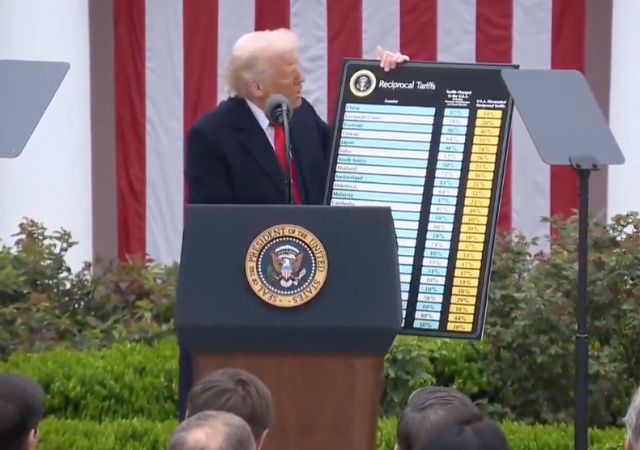
The Court of Appeals for the Federal Circuit (7-4) has ruled that Donald Trump’s tariffs lacked statutory authority, affirming the findings of the lower court but vacating the lower court’s universal injunction and remanding for further consideration as to the scope of the injunction in light of the Supreme Court’s recent ruling as to universal injunctions.
(The Federal Circuit has jurisdiction over disputes involving international trade, among other things.) The ruling will not take effect until October 14 per the court order, to give time for the inevitable appeal to the Supreme Court.
The Court limited its ruling to the five sweeping tariffs imposed by Trump, and does not address subsequent additional tariffs since those were not part of the challenge.
From the Opinion:
The Government appeals a decision of the Court of International Trade setting aside five Executive Orders that imposed tariffs of unlimited duration on nearly all goods from nearly every country in the world, holding that the tariffs were not authorized by the International Emergency Economic Powers Act (IEEPA), 50 U.S.C. § 1701 et seq. Because we agree that IEEPA’s grant of presidential authority to “regulate” imports does not authorize the tariffs imposed by the Executive Orders, we affirm.
***
We are not addressing whether the President’s actions should have been taken as a matter of policy. Nor are we deciding whether IEEPA authorizes any tariffs at all. Rather, the only issue we resolve on appeal is whether the Trafficking Tariffs and Reciprocal Tariffs imposed by the Challenged Executive Orders are authorized by IEEPA. We conclude they are not….
Upon declaring an emergency under IEEPA, a President may, in relevant part, “investigate, block during the pendency of an investigation, regulate, direct and compel, nullify, void, prevent or prohibit” the “importation or exportation of . . . any property in which any foreign country or a national thereof has any interest.”. 50 U.S.C. § 1702(a)(1)(B). “Regulate” must be read in the context of these other verbs,14 none of which involve monetary actions or suggest the power to tax or impose tariffs.15 ….
Since IEEPA was promulgated almost fifty years ago, past presidents have invoked IEEPA frequently. But not once before has a President asserted his authority under IEEPA to impose tariffs on imports or adjust the rates thereof. Rather, presidents have typically invoked IEEPA to restrict financial transactions with specific countries or entities that the President has determined pose an acute threat to the country’s interests….
For the reasons discussed above, we discern no clear congressional authorization by IEEPA for tariffs of the magnitude of the Reciprocal Tariffs and Trafficking Tariffs….
Given these considerations, we conclude Congress, in enacting IEEPA, did not give the President wide-ranging authority to impose tariffs of the nature of the Trafficking and Reciprocal Tariffs simply by the use of the term “regulate . . . importation.”
***
We affirm the CIT’s holding that the Trafficking and Reciprocal Tariffs imposed by the Challenged Executive Orders exceed the authority delegated to the President by IEEPA’s text. We also affirm the CIT’s grant of declaratory relief that the orders are “invalid as contrary to law.” V.O.S. Selections, 772 F. Supp. 3d at 1383–84. We vacate the CIT’s grant of a permanent injunction universally enjoining the enforcement of the Trafficking and Reciprocal Tariffs and remand for the CIT to reevaluate the propriety of granting injunctive relief and the proper scope of such relief, after considering all four eBay factors and the Supreme Court’s holding in CASA.
Four Judges dissented (starting at page 62):
This court today affirms the holdings on jurisdiction, standing, and unlawfulness, while vacating the CIT’s injunction and remanding for reconsideration of the remedy. Maj. Op. at 24–25, 42–44. We agree with the majority’s decision on jurisdiction and standing and on the need for reconsideration of the remedy if the tariffs are unlawful. But we disagree with the majority’s conclusion on the issue of the tariffs’ legality. We conclude that plaintiffs have not justified summary judgment in their favor on either statutory or constitutional grounds.
Regarding statutory authority: Plaintiffs have not shown on summary judgment that either group of tariffs fails to meet the preconditions IEEPA sets for the exercise of the presidential authorities that IEEPA grants—requiring that measures adopted be imposed to deal with an unusual and extraordinary threat, having foreign sources, to the national security or foreign policy or economy of the United States, the threat declared as a national emergency (lasting one year unless renewed). The majority does not disagree. Rather, the majority concludes that the particular tariffs at issue are not among the tools IEEPA makes available through the authorization to “regulate . . . importation” of goods, IEEPA § 203(a)(1)(B) [50 U.S.C. § 1702(a)(1)(B)], even when all the required preconditions are met. Maj. Op. at 37–38. We think otherwise. IEEPA’s language, as confirmed by its history, authorizes tariffs to regulate importation—a conclusion that the majority does not squarely reject, but Judge Cunningham and those who join her opinion do. And IEEPA’s language does not contain the additional limits on which the majority opinion today relies as the sole basis for its illegality holding.
***
For the foregoing reasons, we respectfully dissent from the majority’s affirmance of the CIT’s summary judgment that the reciprocal and trafficking tariffs are unlawful.
The Court withheld the issuance of a Mandate, which would send the case back down to the lower court to carry out the ruling, until October 14, to give the government time to apply for relief in SCOTUS.
MORE TO FOLLOW
🚨 BREAKING: Following a court decision striking them down, President Trump says his tariffs "ARE STILL IN EFFECT."
"Today a Highly Partisan Appeals Court incorrectly said that our Tariffs should be removed, but they know the United States of America will win in the end."
The… pic.twitter.com/upazHBUnUC
— Eric Daugherty (@EricLDaugh) August 29, 2025
Article One gives Congress tariff powers. Over the last century, Congress gave the President “emergency powers” to implement tariffs. What we’ve seen is, and the Appeals Court is saying, the President’s actions are tariff POLICY changes, not emergency actions. https://t.co/hZMtH2TgCr
— Rep. Don Bacon 🇺🇸✈️🏍️⭐️🎖️ (@RepDonBacon) August 29, 2025
Donations tax deductible
to the full extent allowed by law.






Comments
Ignore the activist judges, we’ve seen too much of this garbage
Republicans in Congress should pass a tariff authorization law prior to Oct 14th
That would have to pass the senate and survive a filibuster.
Another Leftist Federal court has ruled against the duly elected President of the United States in a patently partisan manner.
I’ve had it. Just as the medical “profession” destroyed it’s credibility during the Covid Fraud, the judicial “profession” is destroying it credibility by constantly opposing President Trump without cause or, for that matter, legal jurisdiction. As far as I am concerned, all federal courts are most cordially invited to go pound sand.
SCOTUS will have to take this one up quickly.
sure
local = mamdami johnson omar aoc etc etc
the locals are somehow winning elections where anti maga is in full force
how are they able to do this??
Fraud. Ballot harvesting, ballot stuffing, “ranked choice” voting, vote-by-mail…
It seems like Trump is well-positioned for SCOTUS. This particular Circuit Court is overwhelming Democrat, to say the least. And, the selection of Judges who heard this case was 7 Dems to 4 GOP. But, there was some ideological inconsistency with one Republican joining the largely Dem majority and – surprisingly – an Obama appointee actually writing the Dissenting opinion, joining three Republicans in the process. Even if there’s some cross-over on SCOTUS, Trump should prevail…I think.
Where were they with wide open borders and a dictator selling us out.
Approving it.
They want America to fail
“Want” is too passive a word. They are actively working toward that end.
According to the court, the law apparently allows the president to “restrict financial transactions with specific countries or entities that the President has determined pose an acute threat to the country’s interests….”
Regulation may involve “any property in which any foreign country or a national thereof has any interest.”
Isn’t that exactly what the tariffs are doing in this case, to then be worked into a trade agreement?
Just because Congress has tariff powers does not mean the president has none.
These judges apparently are blind to what makes an emergency when it comes to international emergency economics, yet they usurp the right to determine themselves, although it is clearly delegated elsewhere.
Judicial tyranny fueled by lawfare.
An ‘emergency’ is when a Democrat wants to do something, ‘not an emergency’ is when a Republican wants to do something.
I have to agree with you on this. If the Act gives the President authority to “regulate . . . importation” of goods, IEEPA § 203(a)(1)(B) [50 U.S.C. § 1702(a)(1)(B)]” it’s hard to fathom how imposing tariffs doesn’t meet this as that is exactly what they do. The court, it seems, is saying that a President has no authority to impose tariffs ignoring the history of Presidents doing just that going back to before The Chicken Tax of Lyndon Johnson. Suddenly Congress can bind the hands of a President if it feels like it. While The Constitution gives Congress the authority to levy tariffs, they long ago ceded that power to the President. I’m not sure how this is going to shake out.
At least the court recognized the lower court had no authority to impose a universal injunction and gave the administration ample time to appeal it’s decision.
There is no history of any president ever claiming that IEEPA gives him power to impose tariffs. On the contrary, as the decision points out, “Since IEEPA was promulgated almost fifty years ago, past presidents have invoked IEEPA frequently. But not once before has a President asserted his authority under IEEPA to impose tariffs on imports or adjust the rates thereof.”
Johnson did not cite IEEPA. He cited “Section 252(c) of the Trade Expansion Act of 1962 (19 U.S.C. 1882(c and Section 350(a) (6 of the Tariff Act of 1930, as amended (19 U.S.C. 1351(a) (6))”, to amend the USA tariff schedules, and to suspend trade concessions previously granted to the European countries.
Congress can’t do that. It can authorize the president to exercise its powers in specific and limited manners, but it can’t cede a power to the president, or even delegate a power to him without limiting the delegation by an intelligible principle.
But not once before has a President asserted his authority under IEEPA to impose tariffs
I would argue that a great part of that is due to those Presidents not wanting tariffs to be imposed in any fashion. The “Free Trade” thing has been around a long time.
(That is, the idea that America should never do anything to manipulate OUR side of the trade arrangement.)
I wonder if this is a ‘justiciable’ issue — seems to be a political issue, and the courts traditionally stay away from those. Congress has the power to make tariffs, and presidents have the power and latitude to enforce/not enforce them. Congress grants the President some of that power and latitude (the ‘intelligible principle’). If the President uses the power in a way the Congress doesn’t like the Congress can step up.
so?
A dangerously stupid ruling. One that offends not only the President’s authority but also Congress, which delegated broad authority to the President. And a ruling that, as noted by Rubio and Bessent, amounts to a “dangerous diplomatic embarrassment” that harms US foreign policy.
The whole point is that it didn’t. Actually Congress can’t delegate “broad” power to the president; every delegation must be limited by an intelligible principle. Here he’s claiming that the act delegates a tariff power to him, but it’s not mentioned in the act, and in the 50 years it’s existed no president has ever claimed it gave him such a power.
fwiw – I think the major question doctrine kicks in , or some variation of the major question doctrine.
It will kick in only to the extent it will be one of issues called out as error by the S.Ct. The MQD has no application here with respect to a clear delegation of broad power directly to the president in the national security/foreign policy domains. This isn’t a question of a grant of ambiguous authority to an agency with respect to some domestic issue.
Well Milhouse, I guess MY whole point is that the appellate court HAS gravely erred. They have misconstrued the statutory language in the context of national security/foreign policy and mistakenly relied on inapplicable doctrines like the major questions and non-delegation doctrine. Listening to foreign news reports only substantiates the warnings of Rubio and Bessent.
Commissar Judges strike again
The rules are what they say they are, nothing more and nothing less.
President Trump needs to tell them to screw off and let them bring up a constitution crisis. They won’t stop because there is no penalty for the Judge to force them to stop. No Commissar Judge will get tossed out no matter how many non constitution laws the want to break.
I’m not a lawyer, let alone a constitutional lawyer.
With that disclaimer and zero research, let me throw a couple of logs on the debate fire.
1. “But not once before has a President asserted his authority under IEEPA to impose tariffs.” The fact that a President has never used his authority previously does not prevent him from using it for a first time.
2. “Upon declaring an emergency under IEEPA, a President may, in relevant part, “investigate, block during the pendency of an investigation, regulate, direct and compel, nullify, void, prevent or prohibit” the “importation or exportation of . . . any property in which any foreign country or a national thereof has any interest.”
a. The courts have no power to second-guess what constitutes an emergency if the President declare one.
b. The court has no power to decide how much investigation is enough, or how long such might take.
The court needs to order congress to edit the legislation to read; “Upon declaring an emergency under IEEPA, a President, with approvial of each federal judge may…”
These judges need to be criminally charged.