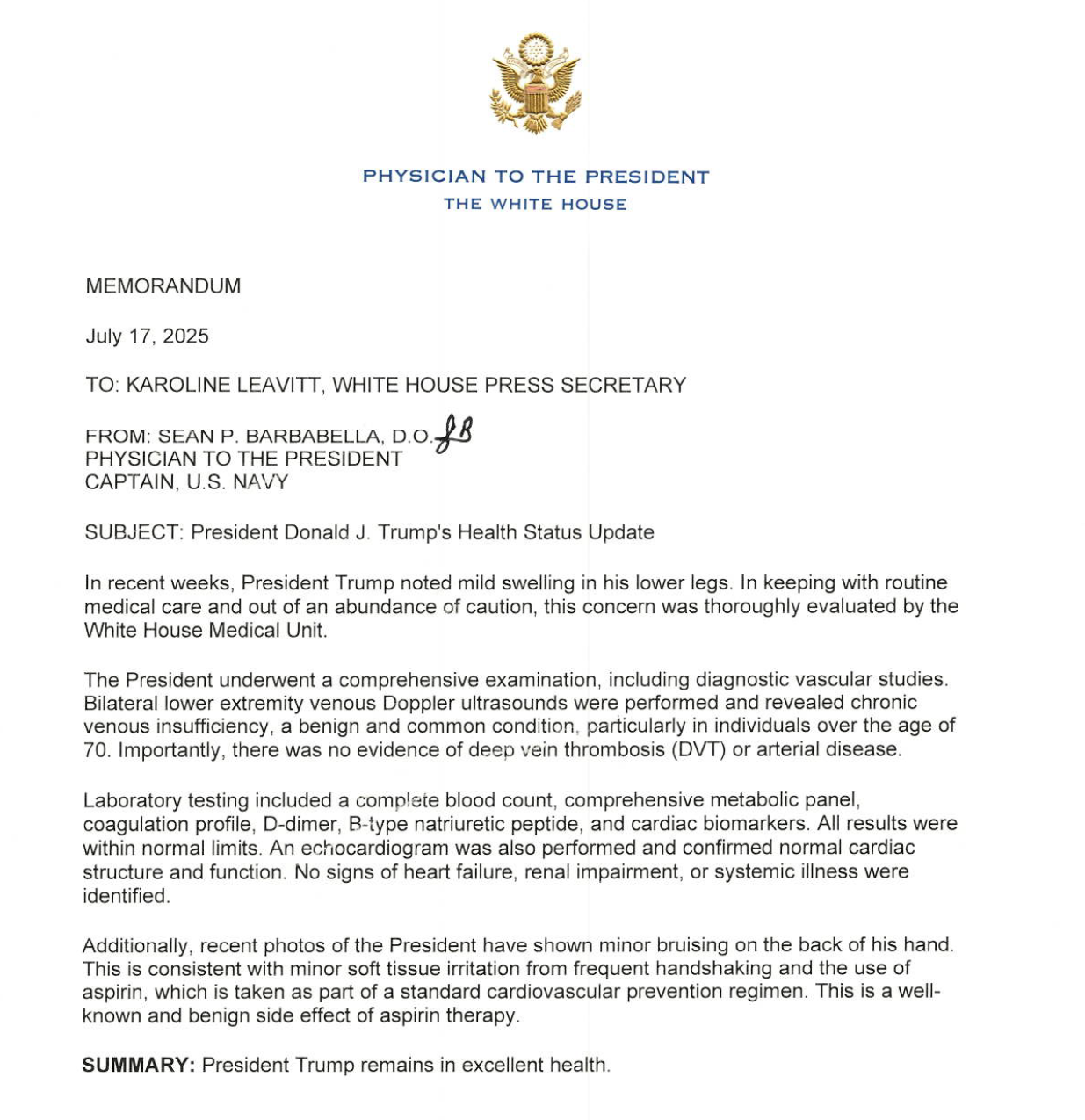
Press Secretary Karoline Leavitt announced that President Donald Trump underwent an examination due to bruising on his hands and swollen legs.
Chronic venous insufficiency explains the swollen legs, while shaking hands and aspirin contributed to the bruised hands.
A venous disease affects the veins.
On another note, I know that many in the media have been speculating about bruising on the President’s hand and also swelling in the President’s legs. So, in the effort of transparency, the President wanted me to share a note from his physician with all of you today. In recent weeks, President Trump noted mild swelling in his lower legs.In keeping with routine medical care and out of an abundance of caution, this concern was thoroughly evaluated by the White House Medical Unit. The President underwent a comprehensive examination, including diagnostic vascular studies. Bilateral lower extremity venous Doppler ultrasounds were performed and revealed chronic venous insufficiency, a benign and common condition, particularly in individuals over the age of 70.Importantly, there was no evidence of deep vein thrombosis or arterial disease. Laboratory testing included a complete blood count, comprehensive metabolic panel, coagulation profile, D-dimer, B-type natriotic peptide, and cardiac biomarkers. All results were within normal limits.An echocardiogram was also performed and confirmed normal cardiac structure and function. No signs of heart failure, renal impairment, or systemic illness were identified. Additionally, recent photos of the President have shown minor bruising on the back of his hand.This is consistent with minor soft tissue irritation from frequent handshaking and the use of aspirin, which is taken as part of a standard cardiovascular prevention regimen. This is a well-known and benign side effect of aspirin therapy, and the President remains in excellent health, which I think all of you witness on a daily basis here. So the President wanted me to share that note with all of you.I’m happy to take further questions on it. We will provide the memorandum from the President’s position to all of you, as we always do, and we’ll get to questions here.
Chronic venous insufficiency is “very common,” especially in those over 50.
CVI happens when the veins in the legs get damaged:
As a result, these veins can’t manage blood flow as well as they should, and it’s harder for blood in your legs to return to your heart. CVI causes blood to pool in your leg veins, leading to high pressure in those veins.
CVI can happen due to damage in any of your leg veins. These include your:
The symptoms can be mild. However, CVI could cause complications later in life.
CLICK HERE FOR FULL VERSION OF THIS STORY