


Swarm of Hundreds of Small Earthquakes Shakes Washington’s Iconic Mt. Rainier
The current seismic activity appears to be related to the movement of heated water under the volcano’s surface.
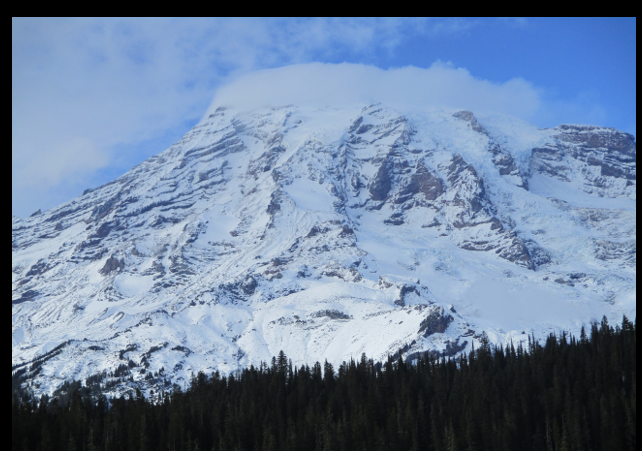
The last time I reported on the Cascade Volcanic Arc, I was focused on Mt. Adams. This slumbering volcano had experienced an unusual round of seismic activity that lasted into the beginning of this year.
Subsequently, two of the area’s Congressional representatives sent a letter to the United States Geological Survey (USGS) requesting additional studies of the region. Additionally, emergency plans for the Pacific Northwest were being reviewed and updated.
These moves may prove to be most timely. Swarms of hundreds of small earthquakes have just been recorded around the Cascade Range’s iconic Mt. Rainier.
Mount Rainier was experiencing “the most significant seismic activity” at the volcano in more than 15 years as an “earthquake swarm” hit the site starting on Tuesday, according to the U.S. Geological Survey’s Cascades Volcano Observatory.
The swarm — hundreds of small earthquakes hitting the same area in quick succession — started around 1:30 a.m. local time Tuesday and was continuing into Wednesday, data showed.
But there was no cause for concern, according to the Cascades Volcano Observatory, which monitors volcanoes across Washington, Oregon and Idaho. Some of the earthquakes were too small to even locate.
“Earthquakes are too small to be felt at the surface and will likely continue for several days,” the observatory said in a news release Tuesday. “There would be no damage caused by such small events.”
At the present time, Cascades Volcanic Observatory indicates there is no evidence suggesting that the swarm is heralding a potential eruption. The seismic activity appears to be related to the movement of heated water under the volcano’s surface.
According to CVO, there is no indication of magmatic movement or surface deformation. No changes have been observed in infrasound signals or volcanic gas emissions. As a result, the Volcano Alert Level remains at Green (Normal), and the Aviation Color Code is also Green.
Hydrothermal activity, rather than magmatic intrusion, is believed to be the primary driver of the swarm. Such swarms occur once or twice annually beneath Mount Rainier.
The nature of this seismic activity, therefore, is similar to that which occurred during a 2009 swarm.
“The last large swarm at Mount Rainier in 2009 had a maximum magnitude of M2.3 and lasted three days. The 2009 swarm had over 1,000 earthquakes, of which the PNSN officially located 120 earthquakes,” the USGS said. “Past swarms have been attributed to circulation of fluids interacting with preexisting faults.”
There is even more good news. Mt. Adams and its more infamous partner, Mt. St. Helens, are also quiet at the present time.
All volcanoes in the Cascade Range of Washington and Oregon are at normal background activity levels. These include Mount Baker, Glacier Peak, Mount Rainier, Mount St. Helens, and Mount Adams in Washington State and Mount Hood, Mount Jefferson, Three Sisters, Newberry, and Crater Lake in Oregon.
Seismicity continues beneath Mt. Rainier, WA, at lower rates than yesterday. Plots show map of located swarm quakes (orange) with all quakes since 2020 (blue), and recent quake numbers/magnitudes over time.
Update: https://t.co/wCMsQ9mxka
More info at https://t.co/55M2hieFvs pic.twitter.com/VpuT8rXWL9
— USGS Volcanoes🌋 (@USGSVolcanoes) July 9, 2025
For those of you who might be interested, the Cascade Mountain Range formed by the oceanic plate (the Juan de Fuca Plate) sliding beneath the lighter continental plate (North American Plate). The geologic stresses occurring in the region are enormous, and it is far more likely to pose a significant regional problem for the country (sooner) than the Yellowstone Supervolcano.
But, for now, all is quiet along the West Coast — at least in terms of geology.
 DONATE
Donations tax deductible
to the full extent allowed by law.








Comments
Cue Carole King: “I feel the earth … move … under my feet …”
.
Clearly Trump’s fault, either that or racism. (s)
Not the Jews?
True… Washington in a most peaceful day goes from blue to red.
Whew…
My nephew just bought a house in Orting.
aka- if that thing blows…. everyone in the Orting valley dies.
The chances are greater that there will be catastrophic mudflows; the last eruption a mere 600 years ago had mud flows reaching to the Sound 100 feet deep. In fact, I believe all of the South Sound urban zone is sitting on ancient mudflows .
But don’t worry; if the Cascadia Subduction Zone releases, the devastation will be so enormous a volcano or two won’t hardly matter.
But, how, then, will they predict the weather?? I was a government guest (most expenses paid) at Fort Lewis in 1967 and Mt Rainier was the tell-tale: If you could see the mountain, it was going to rain; if you couldn’t see the mountain, it was raining. Good times. Yes siree.
Seattle-ites don’t tan, they just rust. A great T-shirt… “Seattle Rain Festival…. July1st to June 30th. That said… when I got to Seattle it was a respite of sunshine…. Kodiak… and especially Ketchikan make Seattle look like a desert. Forget annual rainfall in inches… you need feet.
Mt Rainier is composed of really crappy rock, some from accumulations of volcanic “ejecta” and the rest from the slow internal rotting from sulfuric gases and steam. It currently rests well above the critical angle for a slide to occur, and more than likely these quakes are simply internal structures shifting around where gravitational forces are overcoming the friction holding things together. Think of Rainier as a HUGE pile of pick-up sticks. Somewhere deep a large rock under stress cracked (microquakes are just a rock cracking 99.9% of the time. That then led to an adjacent rock shifting and cracking, and another, …, until the system once agin establishes a new temporary stability. These quakes are all on the order of magnitude of a big truck rumbling by. We are also entering the summer thaw cycle where “glacial glue” as a binding force is decreasing. It isn’t a matter of if Rainier will slide again, it is when.
What is different now is that these mountains are fitted with hundreds of 24/7 instruments which now pick up events that were previously unnoticed. Lack of evidence (the past) is not the same as evidence of lack.
Cascadia will happen in the next hundred years, and might even happen before I hit send here. I don’t worry about Yellowstone for two reasons. 1) We have about 50,000 years wait. 2) I will be dead one way or another, so not my problem. The worst geologic events are the ones that you survive.