


Harvard May Win The Funding Lawsuit, But Lose The War With Trump
“the Harvards of the world, the Cornells and the Columbias and all the other places, they may win the battle over a particular grant, but there’s no judge that’s going to be able to order the Trump administration to give new funding.”
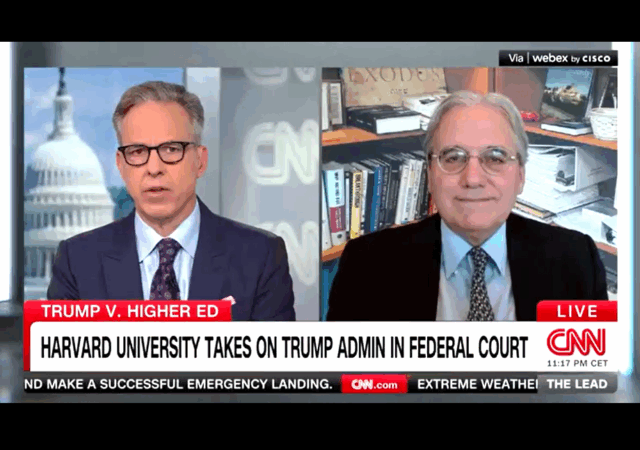
I appeared on The Lead with Jake Tapper to talk about the trial in Harvard’s suit against the Trump administration over $2 billion in funding cuts.
It’s the second time I’ve been on his show. I’m happy to get exposure to a new (for me) audience.
Transcript auto-generated, may contain transcription errors, lightly edited for transcript clarity)
Tapper:
Joining us to discuss is William Jacobson, a law professor at Cornell University and a Harvard Law School graduate. Professor Jacobson, the Trump administration, as you know, terminated $2.4 billion in federal funding for Harvard, impacting more than 950 ongoing research projects towards things such as cancer prevention, Parkinson’s research. Today the judge appeared to be favorable towards Harvard, and he [sic] questioned what the relationship between cutting funding for cancer research and ending antisemitism on campus was. Do you think Harvard has a legitimate argument here?
WAJ:
Well, they’ve got a legitimate argument. I just don’t know if it’s going to prevail. The Trump administration is arguing that in the fine print of the contracts, with the grants, that they have the right to terminate contracts when they no longer align with administration’s priorities. So the question’s going to be, do they have that legal right to do it? So yes, Harvard has arguments. They can say them with a straight face, but I don’t know if they’re ultimately gonna prevail. The Judge seems to be leaning that way from all the reports that I’ve seen, that she’s basically saying this is some sort of pretext, you’re not really doing that. You’re just punishing them, a violation of First Amendment sort of argument.
Tapper:
Do you think that Harvard sacrificed its independence by accepting the federal grants in the first place?
WAJ:
Well, they certainly did, and that’s what a lot of schools don’t seem to want to accept, that when you take federal money, it comes with strings attached. One of those strings is you have to comply with the civil rights laws, and if you don’t, you can lose your funding. But also there’s contracts that give you the grant and you have to comply with the terms of the contracts. And again, the Trump administration is claiming that the language in the contracts, that maybe the schools didn’t read that carefully, gives them the right to terminate it. So yes, you give up your independence when you take federal money. Everybody knows that, Harvard’s coming to grips with that,
Tapper:
Even if Harvard succeeds in this case. And that’s a big if, because obviously I’m sure it will be appealed, if Harvard does win this first round, could this sacrifice future federal funding, do you think?
WAJ:
Yes. That’s something that’s not really talked about enough, is that all of these fights are taking place over current funding money and contracts and grants that have already been given. And I think there’s a certain sympathetic aspect that certainly I feel for universities where you take money, you build up overhead, you build up infrastructure, and then the government wants to take it away.
But that’s very different from future funding. And I think the Harvards of the world, the Cornells and the Columbias and all the other places, they may win the battle over a particular grant, but there’s no judge that’s going to be able to order the Trump administration to give new funding. And these schools may find when the current funding runs out, even if they manage to keep it, that they’re not going to get more funding. And Trump has already announced, Trump administration’s already announced no new funding for these schools. So they’ve got weigh that risk against a possible short-term win in court.
Tapper:
President Trump’s attacking the federal judge on Truth Social saying, quote, the Harvard case was just tried in Massachusetts before an Obama appointed judge. She’s a total disaster. Which I say, even before hearing her ruling, when she rules against us, we will immediately appeal and win unquote. Ultimately, this is going end up in front of the US Supreme Court, don’t you think?
WAJ:
It probably will, depends what the basis for the judge’s decision is. This is the same judge, and I don’t mean to disparage her, it’s just an interesting historical note, this is the same judge who ruled in favor of Harvard in the affirmative action case and eventually was reversed by the Supreme Court. So I think by all press accounts of people who’ve been in the courtroom, she seems to be leaning their way. But I think this is not necessarily a win for Harvard, and it might end up in the Supreme Court as to the terms and conditions under which an administration can pull funding.
Tapper:
Interesting. Professor William Jacobson at Cornell. Thanks so much. Appreciate it. Always good having you.
WAJ:
Thank you.
Donations tax deductible
to the full extent allowed by law.





Comments
Good interview.
Cancel all international students (no visas), stop all federal funding for non STEM.
Why should the taxpayer fund someone else’s college degree, of any sort? Those kids can pay their own loan back, they’ll be making good money.
I agree. Stop these loans and watch the tuition prices drop like a rock.
Not sure the tuition will drop all that fast – but IF the business of a Uni is actually education instead of feathering the nests for those Uni grads who want a well-paying non-business non-teaching job….
Why do so many Uni’s have more admin slots than teaching slots – and why do so many pay admins higher salaries?
Even if you dropped all the DEI and “Equity” and other admin slots that you don’t need IF YOU JUST FOLLOW THE DON’T DISCRIMINATE LAWS ON THE BOOKS – I suspect you still don’t need more admins than actual teachers. In what other “industry” do the managers need to outnumber the workers?
Administration expands to the funding available in any organization.
For every system there’s a type of person adapted to thrive on it or in it. Only bankruptcy serves as a check.
It will. The entire system is supported on the ability of the students to borrow infinity dollars backed by the US Government. Without the US Government backing those loans with the ability to garnish wages of the students, the entire system collapses.
Eh, I can see the argument that it is in the national interest to fund technical education. We already complain about the need to import engineers, technicians, doctors, etc. due to demand outstripping supply. And yes, there are arguments that importing these personnel is a rigged game to get cheap labor. I don’t believe that it accounts for all of the demand for STEM grads.
I do wonder if there are legal barriers to a private company (Tesla, Boeing, LockMart, etc.) offering scholarships with a work commitment? Ironclad rules, where you must work for the company for several years upon graduation or be required to pay the money back.
This used to be done at the Master.s level. Not sure if it still is. Some of this could be tax related – what a business can write off.
You can thank Obama for federalizing the student loan industry.
STEM fields have been infected with DEI and anti-semitism too. Zero out their funding completely until they come back to following the law.
the next gop is going to have to take the kamala harris stance when asked what they would do different than trump
not a thing…this time it could actually WIN ANOTHER ONE FOR MAGA
Harvard is counting on continued support from the elitist establishment that will inevitably bounce them back from the temporary setbacks of the Trump Era. Unfortunately for them, their political bedfellows are taking a decidedly Marxist trajectory that will reward them for destroying the institutions of the ruling class, which is exactly what Harvard aspires to remain. This should be interesting.
Good interview Professor! It is the downstream funding that will be cutoff no matter what this judge decides. Federal monies have corrupted the college system. It is the direct cause for the bloated administrations and the runaway tuitions. Stop all federal funding. Student loans, Pell grants, research grants, etc..
Nice long segment on NTD News this morning, Professor. They asked good questions and allowed you to go into some detail. 👏🏼
1. I found it disturbing that the judge harped on “How does cutting research funding help tamp down antisemitism?” and either did not understand or was purposely denying that incentives and conditions matter and that money is fungible. Doing good in one area does not generate a free pass to violate other rules.
2. The judge’s approach to the First Amendment is also potentially flawed: if the contract includes adherence to government priorities and one of those (at least when Democrats beholden to their leftist base are not in charge) is not fostering antisemitism, then is enforcing that contractual provision a denial of a university’s First Amendment “right” to promote antisemitism?
3. Don’t be so sure that a federal judge will not order the government to continue to make grants at their historical levels. I believe that that is what the judge in the Planned Parenthood case is doing in declaring OBBBA’s funding restrictions unconstitutional. And as WAJ noted, even with no contractual rights locked in, grant recipients invest in infrastructure, and the first Obamacare case held that the federal government could not “addict” states to funding and then threaten to cut that funding unless states agreed to sign up for a new program.
Yes, it is. It violates the Unconstitutional Conditions doctrine. The government is not allowed to condition any benefit or contract on the recipient waiving a constitutional right, unless the restriction is reasonably necessary for the effective performance of the contract. That’s why the judge would want the government to explain exactly how Harvard’s allowing antisemitism on campus hinders the research that the contract is funding. A good answer might be that Jewish researchers would be intimidated from working there.
I don’t believe this interpretation of the doctrine would apply so broadly as may be suggested. A District Court sure but probably not at SCOTUS given recent decisions involving discrimination including at Harvard. It seems utterly at odds with the requirements to comply with the Civil Rights act(s). Wouldn’t the proponents of such a broad view also have to support a prohibition on infringement another 1A right ‘freedom of association’. Are the proponents of this view also gonna work to overturn Brown v Board and endorse a return to ‘separate but equal’?
Unconstitutional Conditions doctrine
“No judge is going to be able to force the Trump Administration to make further grants.” That was a lol moment.
Boasburg says Hold My Beer.
Tapper failed to mention the Legal Insurrection Foundation, introductions everywhere else include that, I guess Tapper and / or the producers don’t want others to know that it exists.
STEM degrees — any degree — is already supported by industry. Lots of companies have college funding opportunities. My MS degree in Computer Engineering was mostly paid for by my employer. Lots of hard-working people have taken advantage of this. Also there is a big tax incentive: anybody can pay for education of another and not face a tax penalty.
The US Army has programs for other special purposes, notably translators. You get a free ride at school if you can do the work to be a field interpreter. A good program, and not easy .
Tuition prices will not drop until two other Federally-created problems are addressed. First, the value of a degree — to corporations — was radically inflated by the Griggs v. Duke Power decision in 1971. Differentiation of intelligence can be done at a college without risk, but no longer can it be done by a company without risk. Second, and more complex, is the 1978 change that made it possible to use HELOCs for funding education of children without a penalty. OK, so the mortgage industry is used to prop up high tuitions. This led to the blow up of the collateralized mortgage industry through one terrible mistake by one guy.
The pioneering work in slicing up mortgage bonds was done by one guy, and he assumed that financial risk was a continuous, differentiable function. As was required to used the Gaussian technique he used to do the risk modeling. But financial behavior is not continuous: there are both deadbeats and fraudsters. The eventual result was discontinuities in the performance of the software: the model failed and a few firms went into the trash heap.
Trump has created a few EOs to address some of this. But Congress must fix the law to make it possible to do underwriting that reflects reality of human behavior. Getting the Federal mortgage market divorced from the Federal student market would help quite a bit too.
You’d need to curtail use of borrowed money across the board that lacked a specific non educational purpose to achieve the goal to disentangle them from tuition. IOW your have to require loans be used for only a specific purpose auto finance, mortgage. Then there’s the education loans themselves which some borrowers use to finance a higher lifestyle in Univ v strictly for books, tuition, dorm room, dining card/cafeteria meal plan. How about the use of credit cards to finance books, tuition, room, board?