


Good.
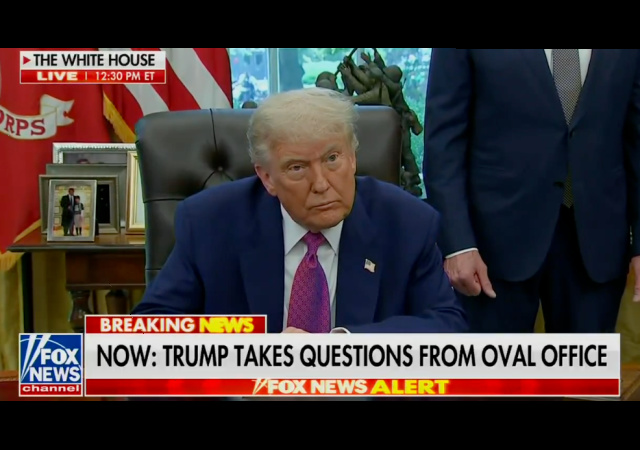
President Donald Trump spoke to the media about FEMA:
So we want to wean off of FEMA and we want to bring it down to the state level, a little bit like education. We’re moving it back to the states so the governors can handle. That’s why they’re governors now. If they can’t handle it they shouldn’t be governor.
And, but these governors can handle it, and they’ll work in conjunction with other governors. They’ll give each other a hand.
But the FEMA thing has not been a very successful experiment. Very expensive, and it doesn’t get the job done. You saw what happened in North Carolina under the past administration, and when we got in, we did a great job for North Carolina. Brought it back, but it was a disaster, FEMA.
And it has not worked out well. It’s extremely expensive.
Trump: "The FEMA thing has not been a very successful experiment. Very, very expensive, and it doesn't get the job done." pic.twitter.com/305nZz8Pvi
— The Post Millennial (@TPostMillennial) June 10, 2025
It makes me mad whenever Oklahoma has a destructive tornado and the state asks for federal help.
Everyone knows Oklahoma is a hotspot for tornadoes. The government should establish a fund specifically for tornado relief. It infuriates me that the Oklahoma government does not budget.
Unless the natural disaster is unprecedented, such as Hurricane Helene, the federal government should not intervene.
Even then, it should be minimal.
President Calvin Coolidge (the only decent president we’ve had besides George Washington) received criticism for his response to the 1927 Mississippi flood:
On April 22, 1927, President Calvin Coolidge issued a proclamation to the nation. He declared, “The Government is giving such aid as lies within its powers …. But the burden of caring for the homeless rests upon the agency designated by Government charter to provide relief in disaster — the American National Red Cross.” He made no mention of emergency appropriations. Rather, Coolidge, as President of the United States and the Red Cross, asked for the public to donate $5 million [$55.9 million in 2005 dollars] to the Red Cross. Additionally, the President created a quasi governmental commission to assist the Red Cross in the relief effort.
Coolidge relented a little bit, but not enough to where a state would depend solely on the government after a natural disaster.
Coolidge knew helping too much would lead other states to expect the federal government to step in.
Also, taxes. Why should people not affected by the disaster pay for the recovery? They shouldn’t:
Another concern was taxes. When Coolidge was a boy, he attended a town meeting with his father in their hamlet of Plymouth Notch, Vermont. Some locals proposed to raise the tax rate to reduce the town’s debt, which had grown after a disastrous freshet. Young Calvin noticed that his father did not vote to increase the tax rate. When he asked why, the elder Coolidge explained that he “did not wish to place so large a burden on those who were less able” to pay.
The lesson stuck with Calvin Coolidge. As president, he rejected recovery-intended tax increases, believing them to be “unfair” to taxpayers. Only the affected should bear the burden of expenses, Coolidge concluded.
Stop relying on the federal government.
My gosh, I wish Trump would just go Javier Milei and take a chainsaw to everything.
Donations tax deductible
to the full extent allowed by law.






Comments
At. least this will keep things like using voting patterns to determine how much and how fast assistance is given to a disaster area.
Or,on second thought, it will bring it down to state level. Still bad but…
That’s why they’re governors now. If they can’t handle it they shouldn’t be governor.
That’s why they’re governors now. If they can’t handle it they shouldn’t be governor.
That’s why they’re governors now. If they can’t handle it they shouldn’t be governor.
I hear the yodels echoing off the California hills…
the more the locals are in charge
the more that the government must answer to them
then,,in a fair ruling,,when the socialists demand their skin of the top
a court would rule that that violates the laws
the laws that will be changed once the ball gets rolling and the locals take back over…cause if not,,,then its business as usual and the usa bk which its not if…but when
At the federal level, the government should be like a general contracting consultant, pointing to where needed assets are that can be deployed. It should be a repository of information on all types of disasters so it could give guidance on particular issues. Extraordinary problems can be helped with federal funding along with their consulting. As was shown in the Palisades fire, local governments will talk a good game, but not bend much to federal advice. Local impediments can’t be fixed or shouldn’t be fixed with federal money.
any “extraordinary problems” can be handled by local tax approved bpnd packages and / private bailouts
no need to make exceptions and keep the corruption going
correction: bond packages
It’s not the best risk spreading strategy. Some states wind up under-insured, in effect. But the bureaucracy defeat is a plus.
I mostly agree. Put the State Government in the driver’s seat with their own Emergency management apparatus running the operation and with minimal assistance from the Feds in things the Feds have but the State may not. The Feds should only be a backstop to those efforts with maybe a checkbook for a simple.straight forward disaster relief assistance payment to meet immediate needs say a one time $300 to $500 each. The Feds can offer logistical support to assist with helicopters and vessels for search/rescue operations and to throw some MRE at them and help move supplies into the area to assist the State. States can, as they do now, coordinate most of th assistance among themselves for NG assets and hosting displaced people in evacuations or Medical support. The States should be doing 80% to 90% of the lift themselves with Feds stepping in to provide some cash assistance, helping in search/rescue and some logistics support upon request but with the expectation that the responsibility for execution and funding of emergency management events is on the State.
without FEMA money spread around, the Senators of the new nonreciepient states would not vote for FEMA budget. At All.
Maybe a voluntary insurance co-op for the likely states?
Look, the short term premise of FEMA was shot down when they did not get the FEMA trailers back after Katrina (the only ones they have gotten back even now are worn out or trashed to be unuseable), nor did the state or even HUD buy those trailers from FEMA.
Maybe have the Army Corps of Engineers provide group tents and warm food to cities or MREs to rural victims but nothing that can’t be packed up and pulled out when enough time has been given.
National disasters cross state boundaries. That is a recipe for federal involvement. The fact that FEMA sucks has more to do with the implementation than the concept. Frankly most states can’t afford to stock what they need for a natural disaster, The few that do can’t afford it because they waste their tax levies on stuff that will buy votes and not on preparedness.
Setting priorities to do what is essential v what is fun/nice to have is not important but demonstrates which States are prudent and which are fools. Far past time to stop bailing folks out of the consequences of their own bad decisions. I suppose if a ‘grasshopper’ State sings their sob story and their leadership is willing to put the State into a sort of receivership of the Fed Gov’t until their budgetary foolishness gets fixed by slashing over generous pensions, draconian cuts to eliminate all wast fraud abuse (defined as anything outside explicit core govt functions) then sure, bail them out..Think Illinois would go for it? How about CA? Nah, they would demand to be saved by the prudent sending $ to the same foolish leadership so they can squander it.
It’s more an issue of priorities than affordability. An analogy: Why should I have to pay to have your roof repaired when you’ve prioiritized frivolities over necessities?
If your state is in Tornado Alley or is known for being prone to flooding because of hurricanes or whatever, maybe your state should focus on putting money in an emergency fund designated for that purpose, instead of funding sanctuary cities or feeding, housing, and educating illegal aliens, or supplying slush funds and graft to corrupt politicians, or any of a hundred ways states blow taxpayer money.
The real problem is that whenever politicians see a bunch of money sitting untapped in an account somewhere, their fingers start itching and they just HAVE to rob that taxpayer piggybank.
And that is why money sitting at the state or federal level is a problem. Look, the state can probably handle a river flooding or a tornado. All states probably have a EMA. Mass does. Once the disaster though becomes bigger and crosses state boundaries than it becomes a bigger problem a state may not have resources for. We see this cross state activity all the time with power losses. Massive power loss. It’s not left up to the state’s lineman to correct. Lineman will come from all over the region and farther to help. Same thing locally with fires. If the fire is big enough fireman from surrounding municipalities with assist. States aren’t islands and we shouldn’t ask them to behave as such.
Good idea. Good luck with that too.
Katrina shows the state’s will crap the bed.
Three years ago the National Forest Service set New Mexico on fire, causing the largest wildfire in recorded history. FEMA was put in charge of compensating the victims and it’s been an absolute shit show. It took the city of Las Vegas two years to receive funding to replace their water treatment facility that was destroyed by burn scar runoff.
FEMA, in its current form is a Clinton invention. Bush one faced a series of natural disasters that he decided to take on (probably due to press/political pressure) and largely was ineffective by being responsive versus proactive. When Clinton came in he centralized disaster response and revamped FEMA to what it is now.
So what Trump is proposing is a return to what it was before the first Bush administration. Hopefully he succeeds so we don’t have any more “heck of a job, Brownie.” moments (ala Bush II).
I believe there is still a place for a federal response and assistance in large scale disasters that impact multiple states.