


The Energy Trifecta: Nuclear, Fossil Fuels…and Geothermal Energy
The Geothermal Energy Opportunity (GEO) Act has recently been introduced in congress to help clear the regulatory burdens hindering the development of this potentially important resource.
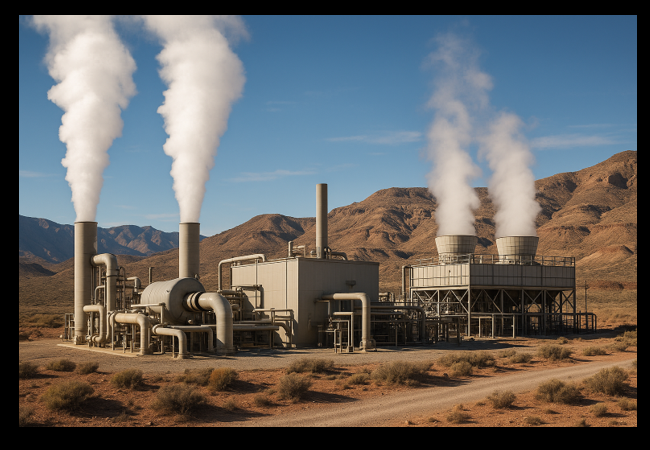
The U.S. stands at a pivotal crossroads in its energy future. As artificial intelligence (AI) accelerates its transformation of industries and daily life, the nation’s appetite for electricity is surging to unprecedented levels.
AI data centers are already consuming about 4% of U.S. electricity, with projections indicating this could rise to 12–15% by 2030. The explosive growth of AI, from large language models to autonomous vehicles, is placing strains on the power grid.
Based on some recent discussions I have had with friends and my geologist husband, I assert that geothermal energy deserves urgent and serious consideration alongside fossil fuels and nuclear power as the perfect “trifecta” for America’s energy strategy. Unlike intermittent renewables, geothermal offers stable, 24/7 baseload power… reliability that is essential for supporting the always-on demands of AI-driven data centers, our critical infrastructure, and the electricity needs of U.S. consumers.
Also, and most importantly, it leverages existing American expertise in drilling and subsurface engineering, providing a pathway for oil and gas workers use their talents to expand our nation’s energy options.
There have been some critical breakthroughs in recent years that make utilizing geothermal energy more effective and efficient. There have been significant advances in enhanced geothermal systems (EGS), which enable geothermal energy production in areas previously deemed unsuitable due to a lack of natural permeability or water resources. A DOE-funded project conducted by the University of Utah demonstrates the enormous potential for developing this particular energy source.
A major University of Utah-led geothermal research project, funded by the U.S. Department of Energy (DOE), achieved a critical breakthrough in April after hydraulically stimulating and circulating water through heated rock formations a mile and a half beneath its drill site in the Utah desert and bringing hot water to the surface. The test results are seen as an important step forward in the search for new ways to use Earth’s subsurface heat to produce hot water for generating emissions-free electricity. The successful well stimulations and a nine-hour circulation test were the fruits of years of planning and data analysis at the Utah FORGE facility near Milford, 175 miles southwest of Salt Lake City.
As highlighted in the recent Issues & Insights article, new geothermal projects are coming online with greater efficiency and lower costs, thanks to innovations such as closed-loop systems and enhanced geothermal systems.
These common drilling techniques should enable geothermal developers to reach “hot spots” located deeper below the surface than thought possible just a few years ago. They could also expand the map for geothermal development far beyond the Western states.
Small wonder that investor interest in geothermal energy has surged in recent years, with more than $1 billion raised since 2022. Tech companies on the hunt for suppliers of baseload electricity to power their data centers see the potential of geothermal energy. Amazon, Google, Microsoft, and Meta – all heavyweights in the booming AI/data center sector – have all inked contracts with geothermal developers.
…Geothermal’s potential to join fossil fuels and nuclear energy in powering America’s economy in the years to come far exceeds anything weather-dependent wind and solar could ever match. With the House version of the budget reconciliation bill accelerating the phase-out of the subsidies that prop them up, these once-coddled industries are scrambling to stay relevant.
Congrats to @QuaiseEnergy on the completion of their first geothermal drilling demonstration on a full-scale oil rig developed at @MIT. This technique can drill up to 12 miles, surpassing conventional geothermal wells that typically don't exceed ~2 miles.https://t.co/QlWV0gkQrB
— ARPA-E (@ARPAE) June 27, 2025
As the article notes, bureaucratic bungling has been the biggest hurdle for geothermal energy to overcome. Therefore, Rep. Celeste Maloy (R-UT) has introduced the Geothermal Energy Opportunity Act (GEO Act, H.R. 301), which aims to expedite the federal permitting process for geothermal energy projects.
She is also pairing it with another piece of legislation to help peel back the layers of regulatory tape.
…[T]he permitting process for geothermal energy production itself needs to be shortened, Garfield said, calling out the National Environmental Policy Act, or NEPA, a 1970 law that requires the federal government to conduct an environmental review before moving forward with infrastructure projects.
{Deputy Director of the Utah Office of Energy Development Jake] Garfield said offering geothermal projects certain exemptions under NEPA would help the industry — like what’s being proposed by Maloy through her Geothermal Energy Opportunity Act, which requires the U.S. Department of Interior to process a geothermal drilling permit within 60 days.
Maloy is also sponsoring the Streamlining Thermal Energy through Advanced Mechanisms Act, which gives the geothermal industry the same flexibility as the oil and gas industry, cutting some of the regulations when pursuing a project on public land that’s already been studied or disturbed by industry.
With governments and private investors increasingly recognizing the potential of geothermal energy, I believe the sector is poised for significant growth in the coming years. As an added bonus, geothermal plants are not known to kill whales or bald eagles.
Image by perplexity.ai.
Donations tax deductible
to the full extent allowed by law.






Comments
Just a side note….. news reports that Iran is at Fordow digging. The news sources say that this means little damage. I would counter that they are trying to recover the enriched U-235 now deeply buried.
I would hope that Iran keeps digging to a point that it is easier for a bunker busting bomb to more throroughly destroy the facility
The article I read said that they were filling the holes, not digging. They were using large excavators (back hoe) to do the work. At one location, they had already filled two of the holes and were finishing the third.
There are already heat pumps on the market that use the earth as a heat sink/heat source instead of air. This looks like a drastically upscaled application. If the environmentalist wackos will stay out of the way, it might just work.
.
I had a house built 8 years ago, and considered everything including a geothermal heat pump. I had studied geothermal while I was a financial analyst and was something of a believer until I took a close look. The capital cost was at least twice as much, and there are significant issues with both the heat exchangers and the grid buried beneath the soil.
I can give details if anyone here cares. Bottom line: Nope.
Oh, and something else: Air source heat pumps have come a long way in the last 20 years or so. Given the competition, I’d say that ground-source heat pumps have very limited applicability.
This is an entirely different technology.
Very interested… Will be building soon and retrofitting other properties. Will be looking at geothermal for hvac, water heating, and pool temp regulation.
gibble, the mechanics of air-source and ground-source are different, but the idea is exactly the same. Anyone considering ground-source should compare it to air-source.
Okay, midge, here goes. The issues::
1. The heat exchangers for ground-source are much more expensive than air-source heat pumps, which are essentially two-way air conditioners. They are finicky and repairs are expensive, and in any case I would check all of this BEFORE installing ground-source. Maybe things have changed in the last decade.
Ground source works by burying a grid of pipes, typically PVC, in a maze-like trench about six feet deep. You pump anti-freeze through the pipes. In cold weather, heat is extracted from the ground. In hot weather, it’s extracted from your dwelling and returned to the ground.
2. After the trenches are refilled once the pipes are placed, the soil in the trenches will settle, and there will be air gaps. This will degrade the performance of your system.
3. If you live in a place with really cold winters, the extraction of heat from the ground can cause the soil around your grid to get very cold and even freeze as winter goes on. This will degrade the performance of your system. Same in the opposite direction if you live in a very hot place. I’d be wary of a ground-source heat pump in Fargo or Phoenix. Could it be that the trenches just have to be a lot deeper?
4. Some people (raising hand) wonder if they can run that pipe full of anti-freeze down a well. The short answer is no. It is much, much more complicated than you think. I remember looking at that and then laughing at myself.
5. You will run that anti-freeze through a pump pretty much all the time. I could be wrong about that one (it’s been 9 years since I studied this), but in any case it’s going to be a use of electricity. Thus, your heating and cooling will never be “free.” There is an efficiency calculation used to judge heat pumps; it’s devilishly complex, and I say that as a real nerd. For a ground source pump to make sense, it has to be VERY efficient relative to air source.
6. Air source heat pumps used to be dogmeat. This is no longer true; they’ve come a long way. We have an air-source pump. Works great down to freezing, then switch to backup propane. If I’d gotten a larger heat pump, there might not been a need. Depends on the cost of propant/gas/oil vs. electricity.
7. With respect to points 2 & 3 & 5 above, if your heat pump isn’t heating enough in winter, your system will have a backup traditional open coil. Ka-ching! to the electric company. Hoo=wee, open coil will hurt!
8. One way that a ground-source heat pump would shine is if your property has a stream that flows year-round, and the state or county would allow you to run those pipes through the stream. Then in a straight trench to the house. Good luck.
9. Another option to consider for heat is radiant in the floor. This is cheapest and most effective and really comfortable, but there are downsides. One is that radiant takes forever to heat up, so if you leave on vacation in winter, or are out of the house during the day, beware of this before turning the heat down. Secondly, radiant is heat only; a/c has to be separate and additional.
Now for water.
Your choice is a traditional water tank versus on demand. Traditional tanks use more energy, but on-demand will have a delay whose length depends on how far away this or that faucet is from the heat source. We have on-demand, and are accustomed to waiting for 30 or 45 seconds in some parts of the house.
Swimming pool.
I don’t have a clue, and I refuse to make shit up.
Sorry if I am dousing the hopes for geothermal energy.
Based on my understanding of the technology, there seems to significantly more advocate hype than actual promise.
I personally dont see how the technology can be improved to a point to make this viable. The system needs to be a closed looped system, otherwise the fluids are going to pick up the salt and other hazardous chemicals in the formations. fwiw, the salt water in the oil and gas formations is about 10x more toxic than ocean water.
Just my two cents.
Iceland says you are wrong.
both Iceland and new zealand have the geography to make it work, and work quite well.
This proposal is to drill down 15k-20k any where, and harvest the earths heat in a manner somewhat akin to oil and gas drilling.
Where the geography is good, then geothermal should work well, Its just that its niche that is very limited by geography.
Iceland has 1/900th of the U.S. population, generates 1/250th of the electricity we do, and is surrounded by a set of unique geological features that aren’t even remotely as common here as they are there. Make sense, would you?
Okay movie time:
Crack in the World
https://www.imdb.com/title/tt0059065/
What could happen (in SF) if we drill deep enough. A fun 1065 movie.
For the record I like the idea geothermal. Iceland uses it extensively but it makes a lot of sense there because of their geology. Is it really possible to use it in the US? What’s the expense.
1965 movie. My kingdom for Paula’s edit button.
Texas should build several new nuclear reactors and can do so at existing sites
Blackrock Desert, Nevada.
Lots of hot springs along the edge of the playa.
https://wiki.blackrockdesert.org/wiki/Geothermal
Calistoga Power Plant.
https://www.gridinfo.com/plant/calistoga-power-plant/50066
Let’s just say that geothermal has a long way to go, It generated 0.4% of the nation’s electricity last year.
https://www.eia.gov/totalenergy/data/monthly/pdf/sec7_5.pdf
Random – I think you missed the subtext of the article. There hasn’t been a lot of use of geothermal energy in the U.S. because of the difficulties in getting through the administrative hurdles.
However there are some quite substantial geothermal generation plants in operation, some for a long time, including one in California. What I’m reading suggests low pollution levels and costs roughly on par with coal.
It might make a good constant generation base to supplement solar etal.
https://www.climatecare.com/blog/the-worlds-10-biggest-geothermal-energy-plants/
I could be convinced by facts, but I doubt geothermal will ever be anything more than a curiosity in the United States.
part of our core energy agenda should be
transfer huge amounts of waste from our shores aka blmplo
Wait for the anti-fracking nuts to hear about this. They’ll have heart attacks.
A few years ago an earnest young person came knocking on my door asking me to sign a petition against fracking. They had obviously been prepared for possible refusals, and had answers ready for those who expressed reluctance to get involved, for those who said they didn’t know enough, etc. But when I said I would not sign because I’m for fracking, the look on their face was precious. It was as if I’d said I was from Mars. It never occurred to them in their wildest dreams that someone could actually be for fracking.
It’s a good thing we didn’t discuss the RKBA.
I enjoy screwing with door-knockers too, both the political and the religious types!
Geothermal is clearly the best. Just listen to what Al Gore says about it:
With temperatures that incredibly high there’s no need to look at anything else. That sort of heat could power 10,000 Earths, with room to spare!
For a good time, “what is the status of cornell university’s geothermal project”:
https://www.perplexity.ai/search/what-is-the-status-of-cornell-.iNnQnqsRIKmC23.Gu3.ZQ
The demonstration was four inch diameter hole drilled ten inches deep. To reach the useful heat source requires that they drill two to twelve miles deep.
There’s much more development that still needs to be done.
Geothermal is only practical when the heat source is relatively close to the surface, so that the required heat can be found relatively close to the surface. Such areas (e.g. Yellowstone) already have obvious geothermal features. But the features aren’t usually as obvious, with even small hot springs being indicative of near-surface heat sources.