


Supreme Court Rules For Trump In “Birthright Citizenship” Case
“These injunctions—known as “universal injunctions”—likely exceed the equitable authority that Congress has granted to federal courts…. The applications do not raise—and thus we do not address—the question whether the Executive Order violates the Citizenship Clause or Nationality Act.”
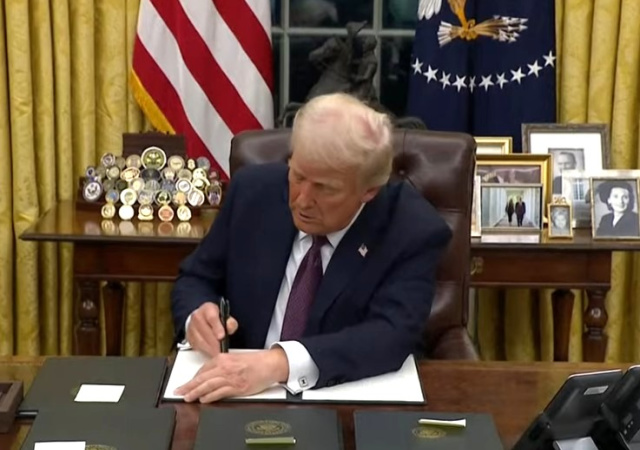
The Supreme Court has issued its Opinion in what is being called the “Birthright Citizen” case, ruling that universal injunctions were likely unauthorized while avoiding the merits of whether birthright citizenship was required under the 14th Amendment.
As I discussed before, it probably was better called the “Nationwide Injunction” case because that’s what most of the oral argument was about – in the context of a District Court judge issuing a nationwide injunction against Trump’s Birthright Citizenship Trump’s Executive Order instructing federal departments not to recognize birthright citizenship:
Sec. 2. Policy. (a) It is the policy of the United States that no department or agency of the United States government shall issue documents recognizing United States citizenship, or accept documents issued by State, local, or other governments or authorities purporting to recognize United States citizenship, to persons: (1) when that person’s mother was unlawfully present in the United States and the person’s father was not a United States citizen or lawful permanent resident at the time of said person’s birth, or (2) when that person’s mother’s presence in the United States was lawful but temporary, and the person’s father was not a United States citizen or lawful permanent resident at the time of said person’s birth.
(b) Subsection (a) of this section shall apply only to persons who are born within the United States after 30 days from the date of this order.
(c) Nothing in this order shall be construed to affect the entitlement of other individuals, including children of lawful permanent residents, to obtain documentation of their United States citizenship.
The Supreme Court ruled 6-3 in an Opinion written by Justice Barrett focused on the universal injunction aspect:
The United States has filed three emergency applications challenging the scope of a federal court’s authority to enjoin Government officials from enforcing an executive order. Traditionally, courts issued injunctions prohibiting executive officials from enforcing a challenged law or policy only against the plaintiffs in the lawsuit. The injunctions before us today reflect a more recent development: district courts asserting the power to prohibit enforcement of a law or policy against anyone. These injunctions—known as “universal injunctions”—likely exceed the equitable authority that Congress has granted to federal courts.1 We therefore grant the Government’s applications to partially stay the injunctions entered below….
The Government has now filed three nearly identical applications seeking to partially stay the universal preliminary injunctions and limit them to the parties. See Application for Partial Stay of Injunction in No. 24A884; Application for Partial Stay of Injunction in No. 24A885; Application for Partial Stay of Injunction in No. 24A886.3 The applications do not raise—and thus we do not address—the question whether the Executive Order violates the Citizenship Clause or Nationality Act. The issue before us is one of remedy: whether, under the Judiciary Act of 1789, federal courts have equitable authority to issue universal injunctions.
The Supreme Court handed the trump administration what it really wanted – a restriction on district courts issuing universal injunctions. Those type of injunctions, which allow a single federal district court judge to impose a ruling on the entire nation, have plagued both the first and second Trump administrations. The ‘birthright citizenship’ executive order was just a means of getting the case to the Supreme Court, and the Trump administration did not even seek a substantive ruling. This case will have wide-reaching implications for the lawfare attacks on Trump policies, and will help Trump implement his agenda.
MORE TO FOLLOW
Three was some sniping between Barrett and Sotomayor. From Barrett’s opinion:
8The principal dissent faults us for failing to identify a single foundingera case in which this Court held that universal injunctions exceed a federal court’s equitable authority. See post, at 29 (opinion of SOTOMAYOR, J.). But this absence only bolsters our case. That this Court had no occasion to reject the universal injunction as inconsistent with traditional equity practice merely demonstrates that no party even bothered to ask for such a sweeping remedy—because no court would have entertained the request. Cf. Grupo Mexicano, 527 U. S., at 332 (“[E]quitable powers conferred by the Judiciary Act of 1789 did not include the power to create remedies previously unknown to equity jurisprudence”).
Barrett reserved her primary ire for Justice Jackson, practically calling her ignorant:
Rhetoric aside, JUSTICE JACKSON’s position is difficult to pin down. She might be arguing that universal injunctions are appropriate—even required—whenever the defendant is part of the Executive Branch. See, e.g., post, at 3, 10–12, 16–18. If so, her position goes far beyond the mainstream defense of universal injunctions. See, e.g., Frost, 93 N. Y. U. L. Rev., at 1069 (“Nationwide injunctions come with significant costs and should never be the default remedy in cases challenging federal executive action”). As best we can tell, though, her argument is more extreme still, because its logic does not depend on the entry of a universal injunction: JUSTICE JACKSON appears to believe that the reasoning behind any court order demands “universal adherence,” at least where the Executive is concerned. Post, at 2 (dissenting opinion). In her law-declaring vision of the judicial function, a district court’s opinion is not just persuasive, but has the legal force of a judgment. But see Haaland v. Brackeen, 599 U. S. 255, 294 (2023) (“It is a federal court’s judgment, not its opinion, that remedies an injury”). Once a single district court deems executive conduct unlawful, it has stated what the law requires. And the Executive must conform to that view, ceasing its enforcement of the law against anyone, anywhere.17 23
We will not dwell on JUSTICE JACKSON’s argument, which is at odds with more than two centuries’ worth of precedent, not to mention the Constitution itself. We observe only this: JUSTICE JACKSON decries an imperial Executive while embracing an imperial Judiciary. [Emphasis added]
We can expect more district court ligitation, as SCOTUS said the district courts should fashion narrower remedies, with specifying what those remedies should be:
The lower courts should determine whether a narrower injunction is appropriate; we therefore leave it to them to consider these and any related arguments….
The upshot: As with most disputed issues, there are arguments on both sides. But as with most questions of law, the policy pros and cons are beside the point. Under our well-established precedent, the equitable relief available in the federal courts is that “traditionally accorded by courts of equity” at the time of our founding. Grupo Mexicano, 527 U. S., at 319. Nothing like a universal injunction was available at the founding, or for that matter, for more than a century thereafter. Thus, under the Judiciary Act, federal courts lack authority to issue them….
The Government’s applications to partially stay the preliminary injunctions are granted, but only to the extent that the injunctions are broader than necessary to provide complete relief to each plaintiff with standing to sue. The lower courts shall move expeditiously to ensure that, with respect to each plaintiff, the injunctions comport with this rule and otherwise comply with principles of equity. The injunctions are also stayed to the extent that they prohibit executive agencies from developing and issuing public guidance about the Executive’s plans to implement the Executive Order. Consistent with the Solicitor General’s representation, §2 of the Executive Order shall not take effect until 30 days after the date of this opinion. See Tr. of Oral Arg. 55.
Justice Thomas in his concurring opinion, joined by Gorsuch, recognized that the district courts will probably try to get around the ruling:
I write separately to emphasize the majority’s guidance regarding how courts should tailor remedies specific to the parties. Courts must not distort “the rule that injunctive relief should be no more burdensome to the defendant than necessary to provide complete relief to the plaintiffs.” Califano v. Yamasaki, 442 U. S. 682, 702 (1979). Otherwise, they risk replicating the problems of universal injunctions under the guise of granting complete relief….
For good reason, the Court today puts an end to the “increasingly common” practice of federal courts issuing universal injunctions. Hawaii, 585 U. S., at 713 (THOMAS, J., concurring). The Court also makes clear that the completerelief principle provides a ceiling on federal courts’ authority, which must be applied alongside other “principles of equity” and our holding that universal injunctions are impermissible. Ante, at 26. Lower courts should carefully heed this Court’s guidance and cabin their grants of injunctive relief in light of historical equitable limits. If they cannot do so, this Court will continue to be “dutybound” to intervene. Hawaii, 585 U. S., at 721 (THOMAS, J., concurring).
Justice Alito, joined by Thomas, sounded a similar warning:
Putting the kibosh on universal injunctions does nothing to disrupt Rule 23’s requirements. Of course, Rule 23 may permit the certification of nationwide classes in some discrete scenarios. But district courts should not view today’s decision as an invitation to certify nationwide classes without scrupulous adherence to the rigors of Rule 23. Otherwise, the universal injunction will return from the grave under the guise of “nationwide class relief,” and today’s decision will be of little more than minor academic interest.
Lax enforcement of the requirements for third-party standing and class certification would create a potentially significant loophole to today’s decision. Federal courts should thus be vigilant against such potential abuses of these tools. I do not understand the Court’s decision to reflect any disagreement with these concerns, so I join its decision in full.
Sotomayor viewed this as an end run around ruling on the birthright citizenship merits (and she’s right!):
Children born in the United States and subject to its laws are United States citizens. That has been the legal rule since the founding, and it was the English rule well before then. This Court once attempted to repudiate it, holding in Dred Scott v. Sandford, 19 How. 393 (1857), that the children of enslaved black Americans were not citizens. To remedy that grievous error, the States passed in 1866 and Congress ratified in 1868 the Fourteenth Amendment’s Citizenship Clause, which enshrined birthright citizenship in the Constitution. There it has remained, accepted and respected by Congress, by the Executive, and by this Court. Until today.
It is now the President who attempts, in an Executive Order (Order or Citizenship Order), to repudiate birthright citizenship. Every court to evaluate the Order has deemed it patently unconstitutional and, for that reason, has enjoined the Federal Government from enforcing it. Undeterred, the Government now asks this Court to grant emergency relief, insisting it will suffer irreparable harm unless it can deprive at least some children born in the United States of citizenship. See Protecting the Meaning and Value of American Citizenship, Exec. Order No. 14160, 90 Fed. Reg. 8849 (2025). The Government does not ask for complete stays of the injunctions, as it ordinarily does before this Court. Why? The answer is obvious: To get such relief, the Government would have to show that the Order is likely constitutional, an impossible task in light of the Constitution’s text, history, this Court’s precedents, federal law, and Executive Branch practice. So the Government instead tries its hand at a different game. It asks this Court to hold that, no matter how illegal a law or policy, courts can never simply tell the Executive to stop enforcing it against anyone. Instead, the Government says, it should be able to apply the Citizenship Order (whose legality it does not defend) to everyone except the plaintiffs who filed this lawsuit.
The gamesmanship in this request is apparent and the Government makes no attempt to hide it. Yet, shamefully, this Court plays along. A majority of this Court decides that these applications, of all cases, provide the appropriate occasion to resolve the question of universal injunctions and end the centuries-old practice once and for all. In its rush to do so the Court disregards basic principles of equity as well as the long history of injunctive relief granted to nonparties.
Justice Jackson – the sky is falling!
I agree with every word of JUSTICE SOTOMAYOR’s dissent. I write separately to emphasize a key conceptual point: The Court’s decision to permit the Executive to violate the Constitution with respect to anyone who has not yet sued is an existential threat to the rule of law. It is important to recognize that the Executive’s bid to vanquish so-called “universal injunctions” is, at bottom, a request for this Court’s permission to engage in unlawful behavior. When the Government says “do not allow the lower courts to enjoin executive action universally as a remedy for unconstitutional conduct,” what it is actually saying is that the Executive wants to continue doing something that a court has determined violates the Constitution— please allow this. That is some solicitation.
With its ruling today, the majority largely grants the Government’s wish. But, in my view, if this country is going to persist as a Nation of laws and not men, the Judiciary has no choice but to deny it.
Thanks to our B-2 pilots the closest our country got to nuclear war this week was Amy Coney Barrett absolutely NUKING Ketanji Brown Jackson in her opinion pic.twitter.com/1rMfH8RfMy
— Arynne Wexler (@ArynneWexler) June 27, 2025
A huge rulling by the Supreme Court, smacking down the ridiculous process of nationwide injunctions. Under our system, everyone has to follow the law–including judges! pic.twitter.com/S3Os7RpV6F
— JD Vance (@JDVance) June 27, 2025
The FACT that six Justices were OK with signing onto an opinion where Justice Barrett took a personal shot at Justice Jackson is a VERY STRONG indication that Jackson has alienated her colleagues and there is a growing lack of respect for her work.
Justices circulate Memos…
— Shipwreckedcrew (@shipwreckedcrew) June 27, 2025
This line from Barrett:
"JUSTICE JACKSON, however, chooses a startling line of attack that is tethered neither to these sources nor, frankly, to any doctrine whatsoever."
My gosh, Amy. That poor lady has a family! https://t.co/iQGjoVOeta
— Matt Whitlock (@mattdizwhitlock) June 27, 2025
Donations tax deductible
to the full extent allowed by law.






Comments
As usual SCOTUS punts on the biggest question, and fails to state that the framers of the 14th Amendment in no way intended to extend US citizenship to every brat born in the US to foreign parents. In fact, those framers intended exactly the opposite.
Which makes sense as that wasn’t really the issue in question here. To my knowledge, zero people have been denied citizenship via being born in this country. Yet. This injunction was intended to stop such things before it happened.
Yeah, birthright citizenship is the bigger question. But we’ll probably get to that one in due course.
It is disappointing that this allows all previous birthright scammers to stay.
They didn’t punt. It wasn’t the argument that was made before the court. They ruled on the case that was brought to them.
On “the bigger question”, Trump is absolutely wrong.
It doesn’t even matter what the amendment’s framers intended. A law’s meaning does not depend in any way on what its drafters intended to do. A law’s meaning must be objectively determinable, and it means exactly what its language says, as it would have been understood at the time it was enacted.
But in this case we don’t even have to go there, because the drafters absolutely did intend exactly what you falsely claim they didn’t. They wrote what they meant and they meant what they wrote. And everyone understood exactly what the amendment did. It did indeed “extend US citizenship to every brat born in the US to foreign parents”, and it was meant to do that, and those who didn’t want that to happen voted against it and lost.
But that wasn’t the issue before the court, so of course the court didn’t rule on it. If and when it ever comes there, I have no doubt that the decision will go against Trump, at least 8-1 if not 9-0.
Trump’s case is correct because we have been ignoring the clause “and subject to the jurisdiction thereof”. Travelers under passport are subject to the jurisdiction of their home country, and only under US jurisdiction in accordance to international agreement. Illegal aliens are outlaws living outside of US jurisdiction. Meer presence in the US does not remove you from your home countries jurisdiction. For example: a US citizen studying oversees in the 60’s could still be drafted and if he failed to show up, he faced criminal prosecution. If his location removed him from US jurisdiction, President Carter’s pardon of draft dodgers would not have been needed. Trump is following the 14th Amendment as written.
No, we have not been ignoring that clause, you and your entire dishonest band of liars have been lying about it, and deliberately forcing a meaning on it that the words cannot sustain and never have. No one honestly believes your crap. Not even you.
Bullshit. That is a f***ing lie, and you know it. Every person in the USA is subject to its jurisdiction, except accredited diplomats and their families, and invading armies. And, until the 1920s, those Indians who chose not to pay taxes and not to be be subject to US law.
If someone is not under US jurisdiction then he cannot be arrested, cannot be sued or prosecuted, cannot be summoned to court. He can shoot someone in broad daylight on Fifth Avenue and the police can’t touch him. That is what it means to be outside a country’s jurisdiction. The very fact that illegal aliens can be arrested, tried, imprisoned, and deported proves that they are under US jurisdiction.
US citizens abroad are subject to the jurisdictions of wherever they are. If they break the local law and are arrested the US consulate can do nothing to ease their legal predicament. All it can do is visit them, make sure they have a lawyer, bring them care packages, put money in their canteen account, and that sort of thing.
The USA claims universal jurisdiction over its citizens and permanent residents, no matter where they happen to be. Other countries don’t recognize that. But as far as the USA is concerned if a US citizen is in China he is subject to both jurisdictions and must obey both sets of laws. He can be arrested by the Chinese, and when he returns to the USA he can be arrested for things he did in China.
Will Judge Murphy in Boston issue an injunction against this Supreme Court ruling?
An unnecessary waste of paper as SCOTUS has already allowed judges to ignore it
No, some traffic court judge in Topeka will.
The Dems have succeeded in destroying the credibility of the Judiciary.
Actually, the judiary did that all by itself
Sure….Judge Murphy has set a precedent of citing a dissenting opinion from a higher court as justification for making a ruling.
So, unless a decision from the Supreme Court is unanimous it’s not binding on his court.
That is not a precedent at all. Judges do it all the time, and it’s completely legitimate. Dissents often point out the limits on the majority’s decision, and it’s normal and expected for judges to cite that. Especially when there is no majority ruling they could cite instead.
In this case the dissent correctly noted that the stay only applies to the order that was before the court. How could it apply to anything else. The majority read this and none of them bothered to contradict it, because it’s obviously true.
Despite Stephen Miller’s ranting and raving, Murphy did NOT defy the Supreme Court. Miller is a liar, and anyone who repeats his lies is just not paying attention. SCOTUS stayed one order Murphy had made. It did not stay any other orders, because none of his other orders were before it. That is all.
Translation by Paula:
“Only the Supreme Court is Supreme”
Justice Jackson is a Supremely Stupid Jerk!
DEI posterchild replacing the wise latina.
Okay, so it’ll probably cut down on some of the universal injunctions. But, I wouldn’t even count that just yet. It’s not like the Communists have any real respect for our laws and traditions.
Her edict doesn’t go into effect for 30 days so that gives every federal judge time to issue unlimited nation wide injunctions
the leftyrino marriage is strong
they know they have to step up and write the laws
they wont
and as the country becomes more non citizens
but citizens who are being given the right to vote and ..ummmm…peacefully protest
the odds of common sense are flying out the window and within maybe our lifetime you can become potus without having been born here
Democrats are quick to use the homily “” when it suits their ends. They are also quick to ignore the gravement of decisions such as Bruen when they disagree.,’
The immortal words of the perpetually outraged Palestine Chuck Schumer echo in my mind: “Kavanaugh you’ve unleased the whirlwind.” Words that were followed by an assassination attempt.
Do they seek “rule of law’ or “mob rule”?
Homily “rule of law”
“gravement”?! Did you mean “gravamen”? If so I’m not sure how that word applies. A decision can’t have a gravamen.
Well, I find that I agree with the progressive “No Kings” being applied. lol
The Trump administration just sued every federal district court judge in Maryland. Is there any sort of precedent for something like this? And does LI have any opinion on this lawsuit?
Not a lawyer but I don’t think that this will happen as the judiciary , particularly SCOTUS will not allow themselves to be liable for their actions
No one’s asking for them to be liable for anything. The suit is against a standing order the district court adopted, that automatically issues a temporary injunction against the government in certain cases as soon as they’re filed, without a judge even being involved.
The government says this is beyond the court’s power, but it can’t go straight to the appeals court without first suing in the district court, so it has sued in that same court that issued the order, to have it overturned. The defendants are the judges who issued the order. Naturally all those judges must recuse themselves, since they’re the defendants, and another judge must brought in to consider it. If they refuse then the government has something that it can appeal to the fourth circuit.
I have to pull my jaw of the floor. Seems ACB has moved a lot – is the criticism getting to her?
In her dissent, KBJ sounds like an activist. Her dissent, as reported at Breitbart:
”The Court’s decision to permit the Executive to violate the Constitution with respect to anyone who has not yet sued is an existential threat to the rule of law.”
That statement from KBJ makes no sense to me. What does she think the Supreme Court does? It rules on suits. The Supreme Court does not “permit the Executive to do anything”, it rules on the facts of the cases placed before it, with little regard to personalities. I’m also under the impression that it’s Congress that writes the laws. Does KBJ need a remedial course on the function of the Supreme Court?
If birthright citizenship was set in stone by Supreme Court decisions affirming the 14th Amendment give automatic citizenship to anyone born on US soil, then the minority would be screaming the District Courts were enforcing black letter law. Even Thomas and Alito would be forced to agree.
But that is not what 14A states, and the minority knows it. The touchstone is whether the parents have permanent residence and have pledged allegiance only to the United States. And the children of freed slaves met that provision perfectly.
That is exactly what the 14A states, and you know it. Birthright citizenship is set in stone, but that’s not the issue here. The issue here is an injunction that’s completely unnecessary and goes far beyond the case or controversy before the issuing court.
There are very few people who have standing to challenge this executive order. I’m surprised there are any, but I suppose it’s inevitable that the order would affect someone. Those few are entitled to sue, and to get an injunction protecting them while the case is being heard. Other people, who have no standing because the order doesn’t affect them, have no business sticking their noses in and are not entitled to an injunction “protecting” them from the order, no matter how flagrantly illegal it is.
Barrett took liberal Justice Ketanji Brown Jackson to task for the arguments in her dissenting opinion and apparent lack of interest in the specifics of the scope of judicial authority.
“The principal dissent focuses on conventional legal terrain, like the Judiciary Act of 1789 and our cases on equity. JUSTICE JACKSON, however, chooses a startling line of attack that is tethered neither to these sources nor, frankly, to any doctrine whatsoever,” Barrett said.
“We will not dwell on JUSTICE JACKSON’s argument, which is at odds with more than two centuries’ worth of precedent, not to mention the Constitution itself. We observe only this: JUSTICE JACKSON decries an imperial Executive while embracing an imperial Judiciary,” Barrett added.
Amy has, for today at least, redeemed herself. Spending 20-30% of her opinion “correcting” Justice Brown will make for chilly times in the women’s lounge at SCOTUS. It is reminiscent of a 1st year law school class-Amy was the professor who called on an unprepared student who spent time studying the NYT editorial page rather than the class assignment. Ketanji was the unprepared, yet opinionated 1st year student called on for the first time.
KBJ is clearly a lightweight. Out of her league. Over her head. I wonder what the other justices say about her in private. Clearly ACB had enough of her and I’m surprised how she very publicly excoriated her.
“ The Supreme Court ruled 6-3” should be carved onto my eyelids at this point
Who were the three dissen….
Oh, you know what? Never mind.
Alecto (endless anger), Megaera (jealous rage), and Tisiphone (vengeful destruction).
Federal judges rush to ignore SCOTUS ruling in 3…2…1…
And this is when Trump can finally play the Jackson card: “Enforce it.”
(Oh right — the OTHER Jackson.)
https://x.com/julie_kelly2/status/1938664192346833273
“. Lower courts should carefully heed this Court’s guidance and cabin their grants of injunctive relief in light of historical equitable limits. If they cannot do so, this Court will continue to be “dutybound” to intervene.”
As every parent has said at one point “Don’t make me go down there . . .”
All good and well but I am frustrated that the “parliamentarian rule” in the Senate has just snatched away the HPA and SHORT Act from the OBBB.
How many times have we, the Citizens, been sold beach front property in Arizona?
You knew it was never going to happen.
When it comes to government bait and switch, gun owners are the perennial patsies.
How are those budget measures? It’s the parliamentarian’s job to police the rule, and she does it to both sides, whenever someone tries to sneak something in to a reconciliation bill that has no right to be there.
Remember that reconciliation is a special accommodation that circumvents the normal rules, and is specifically designed only for budget measures. Sneaking something else in invalidates the whole arrangement, and the minority would be well within its rights to filibuster the whole bill.
For the same reasons the HPA and SHORT act got put in there in the first place. The Leftists brayed endlessly “Oh, this isn’t a ban. It’s a tax on these horrid, terrible, awful, weapons that should be banned but we can’t do that so we’ll just tax the (censored) out of them.” Now that removing that tax is a budget issue which fits under reconciliation, the same suspects are braying “Oh, it’s not a tax! Honest!”
https://www.judiciary.senate.gov/press/rep/releases/what-theyve-said-democrats-flip-flop-on-injunctions-to-suit-partisan-aims
Supreme Court Justice Elena Kagan:
“It just can’t be right that one district judge can stop a nationwide policy in its tracks and leave it stopped for the years it takes to go through the normal process,”
Kagan said on September 14, 2022.
I seem to remember that it was only three or so months ago that Prof. Jacobson was ranting that the Supreme Court had ducked its responsibility to reign in district court injunctions. And now here we are: the Supreme Court is forced to curtail District Court injunctions. Either the Supreme Court expected far better from the District Courts, or reality hit them in the head with what were easily foreseen consequences. Not sure either is comforting. Not sure this delayed ruling will actually discourage an empowered district court. Pretty sure that John Robert’s reputation remains damaged.
I view it as patience. It not something SCOTUS would want to do, unless absolutely necessary. But the line has to be drawn somewhere, and 3-4 months seems reasonable to me.
Perhaps it is judicious restraint.
I was surprised the DOJ chose this case to present the general question of universal injunctions, because the underlying question of the legality of Trump’s order is very much in question. I thought that might prejudice a majority of the court against the injunction question, but that did not occur fortunately.
Sotomayor’s dissent (signed by all 3 dissenters) does use that argument that the question is obvious and the DOJ is just engaged in gamesmanship, but I do NOT think the question is obvious. If it were obvious, Wong Kim Ark would have been written more broadly.
But I thought the question would be presented on a question where Trump strongly expected to prevail on the merits and was critical of Bondi. I admit I was wrong and congratulate Pam Bondi on a big big win.
Judicial Supremacy was never supposed to be a thing.
Jefferson knew it would be. A “thing of wax.”
It never ceases to amaze me how brilliant the Founders were. It seems they anticipated just about every excess government was going to implement and tried to guard against it. Their writings show this over and over.
I am a long-time fan of Supreme Court opinions for 50+ years, from my teenage days when I found a university library where I could read them going way back.
This one was challenging. Lots of technical issues. Not being a lawyer, I found myself struggling to follow the Court’s opinion, but I hung in there. Thus far, I have only read the main opinion and not the dissents yet. Coney Barrett wrote forcefully and logically, even if I couldn’t fully grasp the details of the references.
From prior opinions lately, I have formed a view that Sotomayor is an idiot, and this time it looks like Jackson is a true radical. That much said, I will read their dissents with as open a mind as I can muster, but it seems like the Court’s liberals have really descended.
I am a strong believer in the idea that for the eagle to fly, it needs a left wing and a right wing, but it sure looks like the left wing is far weaker than it once was. I will read carefully, and hope that the liberal dissents aren’t as weak as they appear to be.
I encourage you to read the concurrences, they’re all good and all different. And Sotomayor has suddenly written well, now that KBJ is producing the apparently obligatory pure leftwing screed.
I also like reading SCOTUS opinions. I’ve never been bored by the writing. If you want to read a shocking one (and a case that we urgently need reversed) read Plyler v. Doe. That’s why we taxpayers have to provide free everything for anyone who shows up in a school or hospital, all because of a case of one disabled kid who was a US citizen trying to get a Free and Appropriate Public Education.
Reverse Plyler v. Doe, and lots of the illegal immigration pressure suddenly stops, and school districts can go back to educating their own population.
Also check out Milliken (I think 1973). It reversed most of Brown v. Board of Education. But the left loves to keep citing Brown v. Board as a “landmark” decision, but Milliken chopped down the landmark to a local attraction.
It said yes busing is still needed for racial balance but only within a school district! That why ever since then when house-shopping, there have been “good districts” and “bad districts” to be aware of.
“Children born in the United States and subject to its laws are United States citizens. That has been the legal rule since the founding”
Nope and that shows exactly why the 3 dunces are not judges but poorly educated activists in robes.
Yes, it is and it has been. And if that issue ever makes it to the supreme court I would be surprised to see more than one vote for your position, and not surprised to see no votes at all for it.
Why did she change “subject to the jurisdiction thereof” (14th Amendment) to “subject to its laws”? Lawyers know that words matter, and her switching of words wasn’t an accident.
They mean effectively the same thing. Someone subject to a jurisdiction must keep its laws. Someone not subject to a jurisdiction need take no notice of them.
That angle on “subject to the jurisdiction” baffles me. In short, a couple where neither of them can: Vote, hold office, be drafted, serve on a jury, etc… can simply by being inside the US give birth to a child who instantly gains all of those same rights. Tada!
Do you deny that the couple are subject to US jurisdiction? That they must obey they law, pay all applicable taxes, can be arrested if they don’t, can be sued in a US court or compelled to appear as witnesses? You can’t deny that. Then the constitution says explicitly that their child, who is also born under US jurisdiction, is a citizen.
That has been the law of pretty much every country in the New World for centuries, and it was traditionally the law of the UK, which only recently abandoned it along with such other common law traditions as the freedom of speech, the right of self-defense, and the right against self-incrimination.
No they don’t Milhouse. Stop it.
Jackson:
Jackson makes what seems to be a good point, except for one gigantic hole in her argument: We’re not talking about “something that a court has determined violates the Constitution”. We’re talking about something that is alleged to violate the constitution, and a court thinks the allegation is probably correct, but has not yet determined that. Does it still make sense that the court can prevent the government from doing it to people who are not parties before it?
Think about it this way: Suppose the case that triggered this has already been heard, and the court has finally and fully ruled for the plaintiffs and against the government. Can it then enjoin the government from doing that thing to anyone, anywhere? Of course not. There is no longer a case before it, and it has no power over the government. It has determined that the law is such, and the government would be unwise to try to do that thing to someone in the same district, but nothing prevents it from trying its luck in another district, let alone another circuit. So how can the fact that the court has not yet determined this make its case stronger? If it can’t enjoin something that it has already decided is illegal, how can it enjoin something it hasn’t yet decided, and might eventually decide is legal? The purpose of an injunction is to preserve the parties from irreparable damage, not to protect anyone else. So I think Jackson’s argument fails.
As Kavanaugh points out in his concurrence, and as is obvious, SCOTUS doesn’t even take rulings on the merits from lower courts at face value. It redecides the questions it grants cert to. So it should give not a moment of consideration to the preliminary estimates of three district judges that CASA managed to find to support universal injunctions.
The thinness of that basis is WHY we need to stop the overuse of universal injunctions.
Sotomayor:
Her frustration is valid; it must be frustrating for a judge to see the government violating the law and not be able to do anything about it. But that’s the nature of the judiciary. The only meaningful restraint on the judiciary is that it can’t act sua sponte. A judge can see flagrantly illegal conduct every day, but until someone with standing brings it before him he must sit on his hands and do nothing. That is a fundamental principle, and it’s what stops the judiciary from becoming a dictatorship.
Here someone has brought the case before a court, and presumably that person has standing (though I’m not sure how), so the judge can finally do something about it — but only for that plaintiff. As regards any other violations, that have not yet been brought to him, his position is no worse than it was before. The fact that one person has brought a case doesn’t automatically give him power over all those other cases.
I find her argument, that Trump is violating the law, to be misleading. That has not been decided. All that’s been done at the lower court level is to make a very preliminary estimate (in three handpicked districts) that it’s likely illegal. Sotomayor can go on and on about how it’s obviously illegal, but it’s not obvious.
Birthright citizenship (except for former slaves and their families) was not widely recognized in the decades immediately following the Civil War. Wong Kim Ark then recognized it, but for parents who were always in legal status. The underlying question in this case has never been decided and is not obvious.
I would decide it as saying there is no birthright citizenship for such babies, because at a policy level it creates a lot of problems including pressure to get across the border and give birth here, which can then bring the whole family in with eventual legal status, making a joke of our immigration process, exactly as we see — the courts should not make it impossible for the executive to do his job of controlling immigration.
Hardly any other country in the world has birthright citizenship, and for good reasons. All those Muslim and African immigrants who flooded into Europe are on temporary status and can be ordered to leave if the government ever gets that resolve — and Germany is getting that resolve now.
It is completely obvious, but that is not the point.
That is not true. Of course there were occasional instances when people ignored the constitution; there always are. But those instances were corrected as they came up.
That is a dishonest and disgusting basis for deciding any legal question. It is not a judge’s business whether something is good or bad policy; a judge must say what the law actually says, not what he thinks it would be a good idea for it to say. You are parroting the judicial left here.
That is not true either. Jus soli is the rule in almost all of North and South America. And it was the English tradition that the USA inherited, in contrast to continental Europe, which was mostly jus sanguinis. The UK only abandoned jus soli in 1981.
If Sotomayor is right, universal injunctions could still be common when large entities such as states seek them. From Sotomayor’s dissent at 34:
“Perhaps that is why the majority leaves open the possibility that the District Courts, in these cases, could have
granted at least respondent States a nationwide injunction
consistent with the notion of “complete relief.” The majority
recognizes, correctly, that the Massachusetts District Court
“decided that a universal injunction was necessary to provide the States themselves with complete relief.” Ante, at
18.9 And the majority does not dispute the basis for those
decisions: “Children often move across state lines or are
born outside their parents’ State of residence,” and “th[is]
cross-border flow” would make an injunction protecting
only children born in the party States “unworkable.” Ante,
18. ”
From reading most of the majority opinion and concurrences, I do not recall that this point is contradicted there. I must say also that now that KBJ has taken on the writing of amateurish leftist screeds masquerading as legal argument, the wise latina has moved on (at least in this case) and is putting up some actual legally compelling stuff. Some of her dissent is misleading and is called out by the majority, after all she’s an advocate (let’s be honest), but this one seems to stand up as a legal argument.
This is much ado about nothing. The larger point is ‘THE MORON’S’ Make America White Again crusade . Birthright citizenship is still in effect.