


Supreme Court Rejects Mexico Lawsuit Against U.S. Gun Companies
Mexico should sue Obama and Eric Holder over Operation Fast and Furious. That’s a case the country would win.
So many unanimous decisions! At least the three I’ve read.
The Supreme Court ruled 9-0 that Mexico cannot sue American gun companies.
Mexico alleged seven American gun companies “aided and abetted unlawful gun sales that routed firearms to Mexican drug cartels.”
Weird. How come Mexico never sued former President Barack Obama and former Attorney General Eric Holder!? You know…Operation Fast & Furious.
Mexico based its case on the theory that the seven gun companies did not “exercise ‘reasonable care’ to prevent trafficking of their guns into Mexico.” Therefore, the country placed the responsibility of the “harms arising there from the weapons’ misuse.”
*cough*Obama*cough*Holder*cough*
Mexico believed its theory fit the Protection of Lawful Commerce in Arms Act (PLCAA) exception portion, which states someone can sue a manufacturer or seller who “’knowingly violated a State or Federal statute applicable to the sale or marketing’ of firearms, and the ‘violation was a proximate cause of the harm for which relief is sought.’”
*cough*Obama*cough*Holder*cough*
The country presented three arguments:
- (1) supply firearms to retail dealers whom they know illegally sell to Mexican gun traffickers;
- (2) have failed to impose the kind of controls on their distribution networks that would prevent illegal sales to Mexican traffickers; and
- (3) make “design and marketing decisions” intended to stimulate cartel members’ demand for their products
“Because Mexico relies exclusively on an aiding-and-abetting theory, that means plausibly alleging that the manufacturers have aided and abetted gun dealers’ firearms offenses (such as sales to straw purchasers), so as to proximately cause harm to Mexico,” wrote Justice Elena Kagan. “We need not address the proximate cause question, because we find that Mexico has not plausibly alleged aiding and abetting on the manufacturers’ part.”
As Kagan notes, “plausibly” is not the same as “probably.” The difference between those in law is the level of certainty or likelihood.
“Plausibly” demands the plaintiff show “more than a sheer possibility that a defendant has acted unlawfully.”
“We have little doubt that, as the complaint asserts, some such sales take place—and that the manufacturers know they do,” stated Kagan. “But still, Mexico has not adequately pleaded what it needs to: that the manufacturers ‘participate in’ those sales ‘as in something that [they] wish[] to bring about,’ and ‘seek by [their] action to make’ succeed.”
Aiding-and-abetting claims set a high burden for plaintiffs.
SCOTUS found that Mexico never had a specific example of where the dealers allegedly participated in criminal action:
It does not say, for example, that a given manufacturer aided a given firearms dealer, at a particular time and place, in selling guns to a given Mexican trafficker not legally permitted to buy them under a specified statute. Instead, the complaint levels a more general accusation: that all the manufacturers assist some number of unidentified rogue gun dealers in making a host of firearms sales in violation of various legal bars. The systemic nature of that charge is not necessarily fatal. But as noted earlier, it cannot help but heighten Mexico’s burden. See supra, at 8. To survive, the charge must be backed by plausible allegations of “pervasive, systemic, and culpable assistance.” Twitter, 598 U. S., at 502.
Mexico’s allegations are vague and general in nature. The cases the country relied on had specific names and offenders. Also, Mexico did not provide evidence that the manufacturers “attend to the conduct of individual gun dealers, two levels down.”
SCOTUS also shot down (no pun intended) Mexico’s accusations that the manufacturers have not done enough to regulate practices, such as “bans on bulk sales or sales from homes.”
“Such ‘omissions’ and ‘inactions,’ especially in an already highly regulated industry, are rarely the stuff of aiding-and-abetting liability,” said Kagan. “And nothing special in Mexico’s allegations makes them so. A manufacturer of goods is not an accomplice to every unaffiliated retailer whom it fails to make follow the law.”
This one made me laugh.
SCOTUS also said Mexico didn’t satisfy the burden for its argument over the manufacturers’ “design and marketing decisions.”
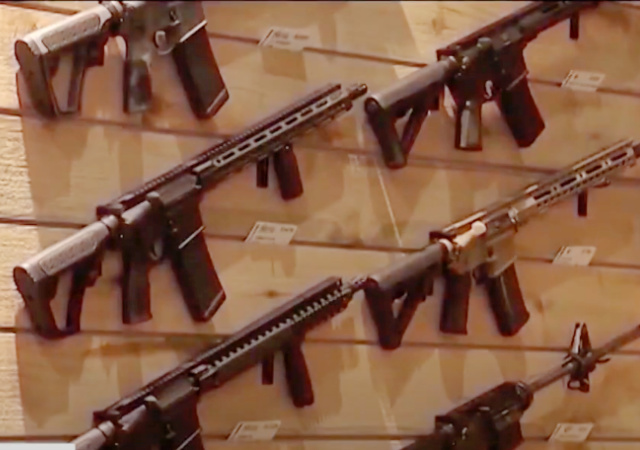
Kagan reminded Mexico that guns are available to everyone, even pointing out that the AR-15 is the most popular rifle in America.
Oh, man: “The manufacturers cannot be charged with assisting in criminal acts just because Mexican cartel members like those guns too.”
It gets better:
The same is true of firearms with Spanish-language names or graphics alluding to Mexican history. See supra, at 6. Those guns may be “coveted by the cartels,” as Mexico alleges; but they also may appeal, as the manufacturers rejoin, to “millions of law-abiding Hispanic Americans.” Tr. of Oral Arg 80; Reply Brief 20. That leaves only the allegation that the manufacturers have not attempted to make guns with nondefaceable serial numbers. See supra, at 6. But the failure to improve gun design in that way (which federal law does not require) cannot in the end show that the manufacturers have “join[ed] both mind and hand” with lawbreakers in the way needed to aid and abet. Direct Sales, 319 U. S., at 713.
Justice Ketanji Brown Jackson with a fabulous observation: “Tellingly, that failure [not showing statutory violations] exposes Mexico’s lawsuit as precisely what Congress passed PLCAA to prevent.”
Donations tax deductible
to the full extent allowed by law.





Comments
states that are suing gun makers for causing violence:
California
Colorado
Connecticut
Delaware
District of Columbia
Hawaii
Maine
Maryland
Massachusetts
Michigan
Minnesota
New Jersey
Nevada
Oregon
Rhode Island
Vermont
Would be interesting to see how those state crime stats relate to other states
true
but also states get to decide how they report their stats
also of note: they love to include suicides under “homicide” gun violence etc
put it this way
just read the news the news that lefty tries to suppress and its still enough to know that per capita the lefty is the maggot
Generally those states have lower crime rates than do states with more liberal gun laws. But the correlation is coincidental, not causal.
Or perhaps it is causal, but in the other direction: people in states with higher crime rates are more likely to feel the need to defend themselves, and are therefore less likely to vote for restrictions on their right to do so.
The real answer emerges when one looks at the relative demographics, both between those states and within them, and correlates that to the crime rates.
I would challenge in part you on how gun crimes are prosecuted with decreased charges and plea deals to lesser charges for the populations that commit the most crimes… protected minorities. If tomorrow all blacks in American woke up somewhere else in the world, violent crime would drop to low EU levels. That is very sad state of affairs.
“The real answer emerges when one looks at the relative demographics, both between those states and within them, and correlates that to the crime rates.”
I recommend gunfacts.info. You can get pretty much all the data you need there. SOme of it is already assembled into direct answers to questions like yours, some of it has to be assembled from graphs in multiple articles, depending on your question.
Will they sue car makers for road rage? Yeah, that’ll work! (NOT).
.
as I recall kia was sued b/c their cars were the most stolen
kia and Hyundia
“KIA”
I’ve often wondered if the company ever considered what that means in America.
check this out:
October 25, 2024 — A Hyundai and Kia theft settlement has been granted final approval after dozens of Hyundai and Kia theft class action lawsuits were filed after teens began stealing the vehicles in 2021 in what was called the “Kia Challenge.”
The teenage criminals break a window, tear apart the steering column, remove the ignition lock and start the vehicle with a standard USB cable. Criminals recorded their crimes and posted the videos online and “challenged” other people to do the same.
The lawsuits allege Hyundai and Kia didn’t equip 2011-2022 vehicles with engine immobilizers, something not required in the U.S.
The National Highway Traffic Safety Administration investigated the vehicles and determined there were no defects or problems with the vehicles.
Federal safety investigators found the cause of the thefts to be teen criminals damaging and stealing the vehicles, while cities where those teens lived blamed Hyundai and Kia for “safety defects.”
But much of the lawfare was organized on the municipal level, with leftist s*holes like Chicago themselves suing the automakers for being “easy to steal.”
1. It seems to me that Mexico’s three complaints were actually law enforcement failures. Manufacturers of all goods are responsible for following all laws in the manufacture and distribution of their goods. But once they reach the wholesaler or retailer, responsibility for those goods is out of their hands. Certainly any criminality associated with any articles of manufacture is a LE responsibility to detect, prevent, and prosecute.
2. This is not merely an important 2nd Amendment win. This is a national security win. The sale of civilian small arms keeps American small arms producers in business. It fosters innovation and assures there is an existing workforce experienced with firearms design and manufacture. Should the country ever need to go on a war footing and begin immediate, large-scale manufacture of small arms, the industry will be prepared for the demand. Anything that reduces that capability (e.g., putting firearms manufacturers out of business with liability suits) is damaging to the strategic interests of the United States.
Imagine a future misuse (possibly by terrorists) of American high-tech weaponry. Could a foreign state sue the manufacturers of those weapons and put them out of business? If this were possible, this would be an obvious threat to national security. The same goes for small arms production. The country’s ability to manufacture small arms must be protected.
Excellent points.
good post
Anything that reduces that capability (e.g., putting firearms manufacturers out of business with liability suits) is damaging to the strategic interests of the United States.
^^^lefty agenda^^^^^
It’s not even law enforcement failures. Not only do manufacturers not control dealers, or even do any business with them, but there’s scant evidence that the kind of “rogue dealers” the suit alleged actually exist. Certainly they don’t exist in any significant numbers.
The key fallacy of those pursuing this line of argument is that they pretend criminals typically buy their guns from licensed dealers, and thus restrictions on sales by those dealers can affect the criminals’ ability to obtain the tools of their trade. But that’s just not true. There’s plenty of evidence that criminals rarely buy their guns from dealers; they either steal them, or buy them on the street from those who steal them. And no amount of regulation on dealers can affect that.
Awash in billions of dollars, the cartels have to line up one at a time to buy a firearm from an FFL? Please Mexico, you are a failed narco-state doing the bidding of the Dems in hopes of loosening up the border when Trump leaves.
Remember “Fast and Furious”? I earnestly believe that BHO, Holder and other leaders were OK being complicit in the murder of hundreds of innocent (and criminal) Mexican nationals…. believing that the murder of hundreds would lead to bans that would save thousands. The wedge the Left uses is the “assault weapon” which Josh Sugarmann of Handgun Control (later headed by Jake Tapper) said was intentionally confusing to get the first ban going. What does the Left see as the 2A protected firearm? A single shot rifle without sights that cannot be concealed and hard to carry and difficult to get a hold of. To use the false statement that truly applies here….”safe, legal and rare”.
Milhouse…. Sarah Brady was asked if the waiting period or being turned down by FBI background check would stop a bank robber? She said “yes”.
Sarah Brady was a stone cold liar.
“Josh Sugarmann of Handgun Control (later headed by Jake Tapper)”
Ugh! Getcher program! You can’t tell the villians widout yer program!
Josh Sugarmann started out with the National Council to Ban Handguns (a spinoff from the Board of Church and Society of the United Methodist Church run by Michael Beard, now called the Coalition to Stop Gun Violence because the old name was a total non-starter). He now runs the Violence Policy Project. Neither of those is a Brady property.
Tapper never headed HCI/Brady, he was their PR flack/professional liar. I believe it may have been his very first job.
“There’s plenty of evidence that criminals rarely buy their guns from dealers”
For one thing, they all have to undergo a federal background check. If the fibbies say the guy is eligible, it’s not the dealer’s fault for selling to him.
Although all true, I was giving Mexico the benefit of the doubt for the sake of argument. Even if the presumptions underlying their claims are true, they tried to pin the tail on the wrong donkey.
The recent Colorado “burning man” assailant was denied a firearm purchase due to the background check. Had he stolen a gun the results would be far worse.
It could have been worse if he’d driven his car through them at high speed like what happens in Canada, Europe, and China. It could have been worse if he’d bought two machetes from Harbor Freight and gone swinging. It could have been worse if he’d bought some commonly available chemicals from Home Depot and made a bomb. Don’t blame the tool, blame the person.
He wasn’t denied a purchase. He never tried to purchase, because he knew he couldn’t legally do so. And he seems not to have known how to go about purchasing one on the street. No criminal connections. But he’s not your typical criminal.
So who is goung to apologize to the Remington stockholders?
I’m glad this piece noted the plausible v probable difference i.e. the plausible standard is more onerous than merely probable. Worse, I though it mean merely possible so I was way off on that definition!
No, you have that backwards. “Probable” is a higher standard than merely “plausible”. “Probable” means what you claim is actually likely to be true. “Plausible” merely means it might be true, but probably isn’t. “Possible” is even less than that; it merely means there’s no law of physics that prevents it from happening, but we all know it isn’t.
“The possibility exists, the probability does not.”
Howard Cosell.
Good article but “shot down” isn’t a pun.
It’s a modest joke.
An example of a pun – double one actually follows.
A man by the name of F. Huehl came unknowingly upon a previously unknown painting by Monet.
An unscrupulous art dealer found out about the find and realizing that Huehl had no idea of its value, offered him an obscenely low price. Huehl happily accepted the offer.
Asked later how he’d gotten away with the deal, the dealer just said, “F. Huehl and his Monet are soon parted.”