


Florida Doctor Uses Robot to Remotely Perform Surgery on Patient in Angola
The surgery conducted by Dr. Vipul Patel is part of a clinical trial approved by the U.S. FDA and marks a groundbreaking advancement in remote surgical technology.
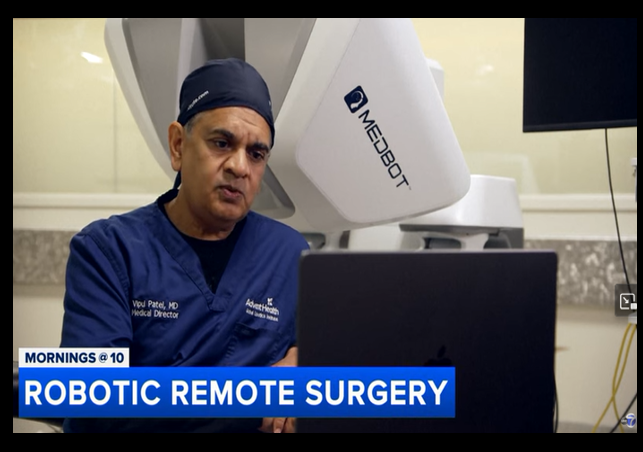
Once confined to the realm of science fiction, robotic remote surgery has crossed the threshold into reality, transforming the way surgeons operate and patients receive care worldwide.
What began as visionary experiments in telepresence during the 1980s, with teams like those at Stanford Research Institute pioneering dexterous manipulators for microsurgery, has evolved into a sophisticated field where a surgeon in a Florida medical center can perform delicate operations on patients a continent away, in Angola, Africa.
The procedure was conducted as part of a clinical trial approved by the U.S. Food and Drug Administration (FDA), marking a groundbreaking advancement in remote surgical technology.
Vipul Patel, the medical director of the Global Robotic Institute at Orlando’s Advent Health, recently performed a prostatectomy, which removes part or all of the prostate, on Fernando da Silva of Angola, ABC News reported in an exclusive story from medical correspondent Dr. Darien Sutton on Tuesday.
Da Silva, 67, was diagnosed with prostate cancer in March, and in June, Patel cut out the cancer using transcontinental robotic telesurgery. The surgery was a success, according to ABC News.
Prostate cancer is very prevalent in Africa, Patel told the network, adding, “In the past, they really haven’t monitored it well or they haven’t had treatments.”
Dr. Patel and his team had spent two years preparing for the operation, traveling globally to identify the right technologies and develop robust contingency plans. This technique has numerous possible applications in the U.S., including the potential use in ambulances to initiate life-saving operations before arriving at hospitals.
While surgeons are often near the patient they are operating on, Patel and his team were eager to test whether the surgery could be done long distance using fiber optic cables.
“I think the humanitarian implications are enormous,” Patel said. “Internationally, obviously, there’s so many underserved areas of the world.”
Patel also pointed out that rural areas within the U.S. could benefit by helping surgeons learn new procedures from a distance or helping patients from a distance if complications arise during surgery.
“Emergency room physicians will have technology that can be remotely accessible to surgeons, maybe even in the ambulance, where people can get remote interventions if they can’t make it to the hospital,” Patel said.
Robotic surgery techniques are rapidly evolving. Interestingly, recent studies suggest that robotic-assisted surgery enhances patient outcomes, shortens hospital stays, and reduces surgeon fatigue.
Emerging trials indicate that robotic-assisted surgery improves patient outcomes, reduces hospitalization length and decreases surgical fatigue. Here’s a deeper look into the pros of robotic surgery:
1. Improved patient outcomes: Robotic-assisted surgery reduces both intraoperative and postoperative complications.
For example, data from 18 randomized controlled trials shows that compared to open radical prostatectomy, robotic-assisted radical prostatectomy yields fewer biochemical recurrences and short-term improvements in quality of recovery and pain (up to six weeks postoperatively).
2. Reduced hospitalization: Robotic surgery often leads to shorter hospital stays than traditional open surgery. This extends to reduced hospitalization costs.
A trial involving 29 surgeons across nine UK hospitals found that patients who received robot-assisted surgery stayed in the hospital for an average of eight days—two days fewer than traditional open surgery. The study also indicated that robotic-assisted surgery achieved a 52% reduction in readmission rates.
3. Decreased surgical fatigue: Fatigue closely correlates with surgical errors.
Robotic surgical systems help reduce fatigue among surgeons through ergonomic enhancements, minimal instrument movement restrictions, comfortable seating and stable visualization.
Powered by advances in robotics, real-time imaging, and high-speed networks like 5G, remote robotic surgery has the potential to enable world-class expertise to be delivered instantaneously, marking a paradigm shift in medicine and opening new possibilities for treatments to people — even in the remotest corners of the the world.
Donations tax deductible
to the full extent allowed by law.







Comments
Buffering will have to be added to risks on the informed consent form.
All the Democrat Karens will decry Vital isn’t wearing a mask.
Amazing!
When Robert Heinlein was getting going with his futurist novels back in the 40s he wrote a short novel, titled “Waldo”, about long distance robotic surgery. It’s often combined in a book with another short novel, “Magic, Inc.” The concept was unimaginable eighty years ago (except for Heinlein) but here we are now. There is a reason that remote manipulators like those used with windowed cabinets to isolate hazardous substances from people are called waldoes.
Heinlein is still one of my favorite writers.
.
Up next: Larry Niven’s autodocs.
Alternate headline:
Florida Man Uses Robot to Remotely Perform Surgery on Patient in Angola
Get your stereotype right there.
So doctors don’t have to go to Africa anymore? Wise choice
I am a medical doctor and I have been discussing this case with my colleagues here in the hospital.
The main problem is if the surgeon runs into complications that require going to an open procedure.
Severe bleeding would make it impossible to see anything with the robotic viewing scope.
Here in the U.S. the surgeon walks away from the robot viewing scope station and walks 10 feet to the o r table and opens the patient and ties off the bleeding arteries or veins.
What is the plan in Angola?
I’m betting there’s a team at the remote location to take care of anything unforeseen. For instance, remote anesthesia isn’t possible, so there must be an anesthesiologist on-site. There’s probably at least an MD and a nurse or two. You, as a conscientious doctor, would insist on such precautions if you had performed this surgery.
Obviously, this surgery wasn’t unusual or within the realm of only a few specialists. Pretty sure there are surgeons in Africa who could have done this procedure. This was a test, a proof of concept. In the future, it will be used by doctors who specialize in very esoteric and delicate procedures on remote patients who would otherwise not have access to such specialists.
I’m wondering about the legal implications of this. If a surgery goes wrong, is the lawsuit in the location of the patient or the surgeon? That can affect a number of things, such as a surgical suite being set up in Mexico for US surgeons to remotely operate on patients without being subject to US regulations, or for US surgeons to take a few months in Canada to do surgery in other countries, etc…
My wife is a Family Practice doc. If she does a “telehealth” meeting with a patient in another state, she can be sued in EITHER state. This makes another layer of malpractice insurance required.
Another layer of patient care expense that a doctor’s office must cover with no commensurate compensation. Another of those “free services” that are never “free” ~ someone pays for everything.
You should probably watch the video. It deals with problems like this.
dei will still f k it up
I would hate to see the effects lag can have on a surgery
so why didnt they do a remote procedure on an american??
lawsuits?? regs????fear that it was a surgery on a trans child??????? and not a prostatectomy
what was the “internet” connection?
and can I get that set up for my home!
That’s not a Robot, it’s a Waldo.