

U.S. Supreme Court Declines Hearing on University ‘Bias Response Teams’
“Only two justices (Alito and Thomas) indicated their desire to hear this case.”
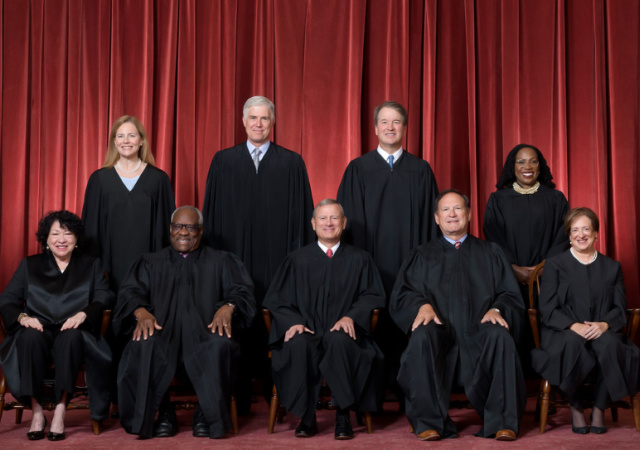
It’s a shame that they turned this down. At least two justices were on board. It’s an important free speech issue.
From the Volokh Conspiracy blog at Reason:
Supreme Court Refuses to Consider Whether University “Bias-Response Teams” Chill Speech
The Supreme Court does not hear many cases these days. It is very stingy in granting certiorari, even in cases that present clear circuit splits. This morning’s Order List provides a good example, as the Court denied certiorari in Speech First v. Whitten, which presented the question whether university “bias-response teams” objectively chill students’ speech under the First Amendment (and, as a consequence, whether there is Article III standing to challenge them).
Only two justices (Alito and Thomas) indicated their desire to hear this case. One, Justice Thomas, wrote a dissent from the cert denial. It begins:
More than 450 of our Nation’s colleges and universities have “bias response teams.” These teams “encourag[e] students to report one another for expressions of ‘bias,'” and then review and act upon reports. Speech First, Inc. v. Sands, 601 U. S. ___, ___–___ (2024) (THOMAS, J., dissenting) (slip op., at 1–2). In reviewing First Amendment challenges to bias response teams, the Courts of Appeals have split as to whether they “objectively chill” student speech for purposes of Article III standing. I would grant certiorari to resolve that important split.
Why didn’t Justice Alito join Justice Thomas’ dissent? We don’t know, but one possibility is that Justice Thomas tipped his hand as how he is inclined to see the merits:
This case presents an opportunity to resolve an important Circuit split. Three Circuits, when evaluating similar facts, have rejected the Seventh Circuit’s view and found that bias response policies “objectively chill” student speech. . . . If this case had proceeded in those Circuits, then Speech First likely would have been able to establish Article III standing. For example, the Sixth Circuit has recognized that a bias response team’s “ability to make referrals . . . is a real consequence that objectively chills speech,” and that this “lurk[ing]” referral power causes even optional meeting invitations to “carry an implicit threat of consequence should a student decline the invitation.” . . . It makes no difference, on the Sixth Circuit’s view, if the bias response team itself “lacks any formal disciplinary power.”
Donations tax deductible
to the full extent allowed by law.