During a weekend interview with President Donald Trump, Fox News host Maria Bartiromo asked whether he believed the U.S. was heading into a recession. He responded, “I hate to predict things like that. There is a period of transition because what we’re doing is very big.”
His reply followed a remark from his joint address to Congress last week, where he acknowledged the possibility of a “little disturbance” in the economy as his administration implemented tariffs. “Tariffs are about making America rich again,” he stated. “There will be a little disturbance, but we’re OK with that. It won’t be much.”
Trump’s response to Bartiromo rattled investors, sending an already skittish stock market into another swoon.
Treasury Secretary Scott Bessent offered the most reasoned explanation so far for the turbulence that has shaken the financial markets in recent weeks during a Friday appearance on CNBC’s Squawk Box. He explained that the U.S. is currently transitioning from an economy driven by the public sector into a private sector economy.
“The market and the economy have become hooked, become addicted, to excessive government spending, and there’s going to be a detox period,” he said. Bessent said there will be a “natural adjustment” and that he is “confident, if we have the right policies, it will be a very smooth transition.”
The full interview can be viewed here.
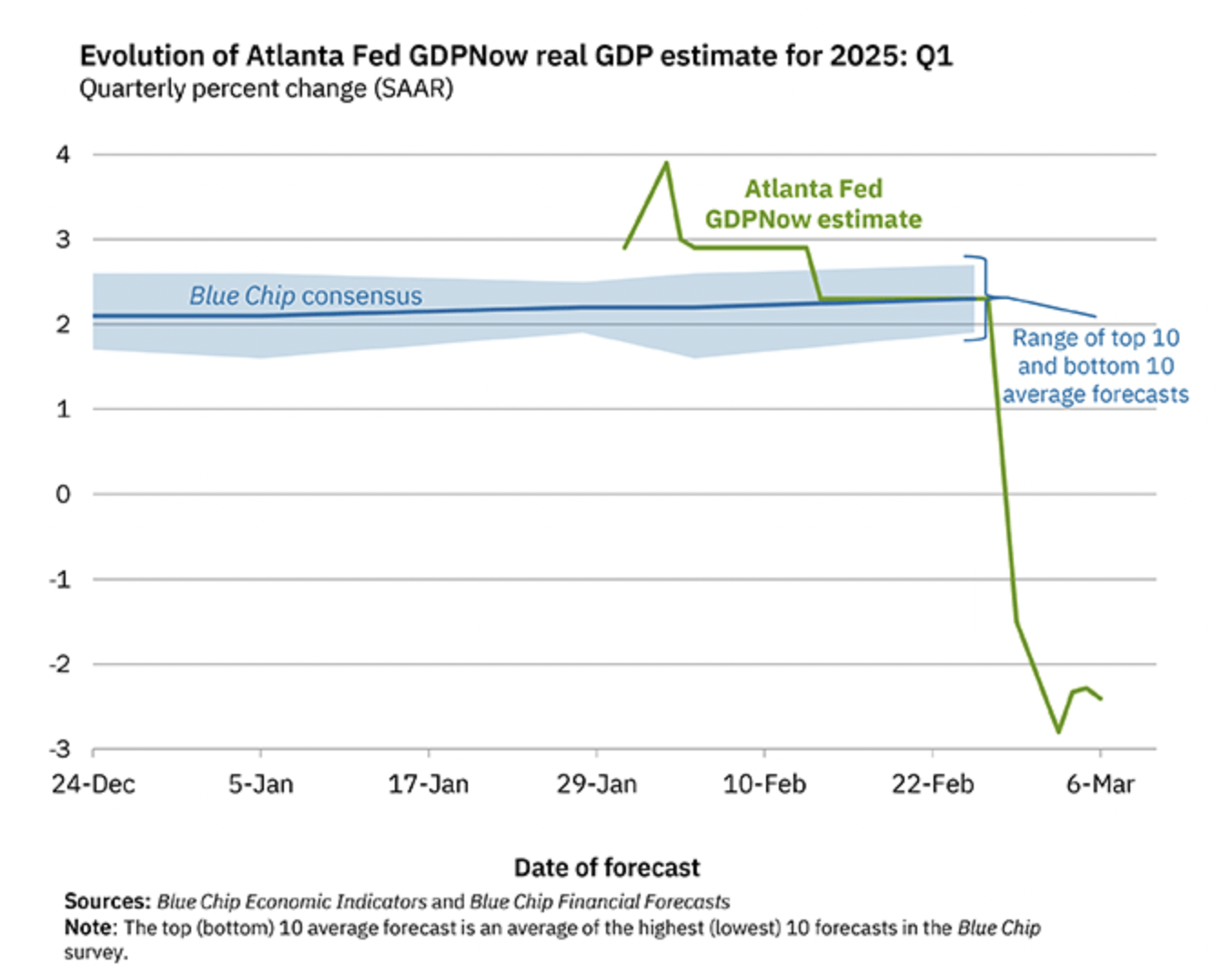
But the stock market isn’t the only indicator pointing to a possible recession. The Federal Reserve Bank of Atlanta tracks quarterly GDP. The bank’s website explains that because their “official estimates” of GDP data “are released with a delay,” they publish a separate indicator called GDPNow or a “nowcast,” which provides a more timely estimate of economic activity.
The Atlanta Fed’s latest estimate, issued on March 6, shows first quarter GDP at -2.4%, a contraction of the economy. While alarming, it’s worth noting that GDPNow is a volatile index. For example, it stood at +2.3% on February 26 and dropped to -1.5% on February 28. The index fell after unfavorable reports on advanced manufacturing, fourth quarter GDP, advanced economic indicators such as personal income and outlays were factored into the model on February 27.
According to the website:
The GDPNow model estimate for real GDP growth (seasonally adjusted annual rate) in the first quarter of 2025 is -2.4 percent on March 6, up from -2.8 percent on March 3. After recent releases from the Institute for Supply Management, the US Bureau of Economic Analysis, and the US Census Bureau, the nowcasts of first-quarter real personal consumption expenditures growth and real gross private domestic investment growth increased from 0.0 percent and 2.5 percent, respectively, to 0.4 percent and 4.8 percent, while the nowcast of the contribution of net exports to first-quarter real GDP growth fell from -3.57 percentage points to -3.84 percentage points.
Perhaps the biggest contributing factor to the stock market’s recent turmoil is the uncertainty over Trump’s tariffs and, in particular, the way they keep changing.
For example, last Tuesday, Trump’s 25% tariffs on imports from Canada and Mexico and 10% on imports from China went into effect. On Thursday, however, Trump paused the tariffs on “goods compliant with the U.S.-Mexico-Canada Agreement (USMCA)” until April 2.
Commerce Secretary Howard Lutnick has insisted on multiple occasions over the past week that the U.S. is not heading into a recession.
Speaking to Fox News’s Laura Ingraham on Friday night, Lutnick said, “On April 2nd, he [Trump] is going to come out … with his reciprocal tariffs which basically say how you treat us is how we will treat you.”
And once U.S. businesses know what to expect from the Trump economy, and how to respond to the new normal, stability will return.
Lutnick also dismissed the notion that the tariffs were inflationary. He mentioned that both India and China charge “huge” tariffs … “50, 60, 70% tariffs” and that has not led to inflation for either nation.
Although I have searched all over the internet for confirmation without success, last week, Fox News contributor Mark Thiessen, who is very reliable, said that last year, the U.S. paid $370 billion in tariffs to foreign countries and received only $70 billion. On Monday, Fox News host Martha MacCallum repeated similar numbers.
If these numbers are true, is it any wonder why Trump is trying to balance the scales?
Finally, the Bureau of Labor Statistics reported on Friday that 151,000 new jobs were added to the U.S. economy in February vs. expectations of 160,000. The unemployment rate ticked up to 4.1% from 4.0% in January.
While the federal government cut 10,000 jobs, state and local governments added 1,000 and 20,000 jobs, respectively.
Meanwhile, the manufacturing sector added 10,000 jobs, a figure that was higher than expected.
While it is impossible to predict whether or not the U.S. will enter a recession in 2025, the uncertainty surrounding Trump’s tariffs seems overblown. In any case, the confusion over the tariffs should be cleared up following his administration’s April 2 assessment.
Surely, none of us are pining for the return of former President Joe Biden’s dismal stewardship of the economy. Let’s give Trump, Bessent and Lutnick, all of whom have built successful businesses in the real world and understand the economy far better than Biden’s stable of academics, a chance.
As they keep telling us, you have to break stuff to get it right.
I, for one, have confidence they’ll get it right.
Elizabeth writes commentary for The Washington Examiner. She is an academy fellow at The Heritage Foundation and a member of the Editorial Board at The Sixteenth Council, a London think tank. Please follow Elizabeth on X or LinkedIn.
CLICK HERE FOR FULL VERSION OF THIS STORY