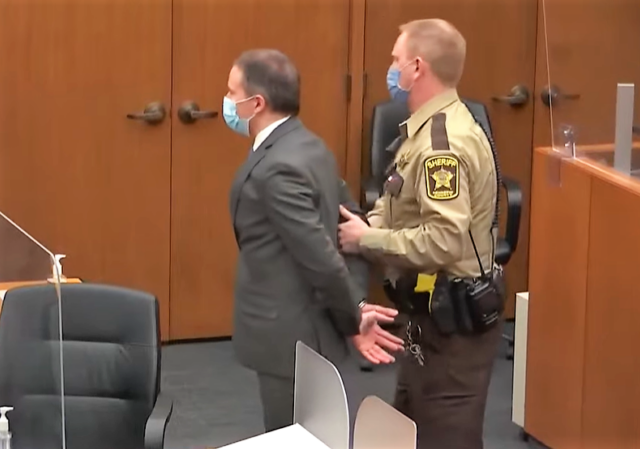
Derek Chauvin was convicted of Second Degree Murder, Third Degree Murder, and Second Degree Manslaughter in the death of George Floyd. He was sentenced to 22.5 years in prison on the highest count.
The Third Degree Murder charge was legally controversial, because traditionally in Minnesota that applied only to generalized depraved indifference to life, such as firing a weapon towards a crowd, but not where a specific person was targeted. During the Chauvin trial, the trial judge dismissed the Third Degree Murder charge, but was reversed by the interim-level appeals court. That caused problems during jury selection, as Third Degree Murder was reinstated during jury selection.
Mohamed Noor was convicted in the death of Australian Justine Ruszczyk Damond, in a particularly outrageous use of police deadly force. There were no riots over the killing of Justine Damond. We did not have a national conversation. Protests did not fill the streets and campuses.
A Minnesota Supreme Court ruling in the case of Noor likely will cause the Third Degree Murder conviction against Chauvin to be vacated. The court ruled, as to Noor:
This case comes to us following the tragic death of Justine Ruszczyk on July 15, 2017. Ruszczyk had called police that night out of concern for a woman she heard screaming behind her home. When Ruszczyk approached the police vehicle that came in response to her call, appellant Mohamed Mohamed Noor fired his service weapon at her from the passenger seat. Noor’s bullet struck Ruszczyk in the abdomen and sadly, she died at the scene.A jury acquitted Noor of second-degree intentional murder, Minn. Stat. § 609.19, subd. 1(1) (2020) but found him guilty of third-degree depraved-mind murder, Minn. Stat. 3 § 609.195(a) (2020), and second-degree manslaughter, Minn. Stat. § 609.205(1) (2020).He appealed, arguing that his conviction of depraved-mind murder could not stand because his actions were directed at Ruszczyk. A divided panel of the court of appeals affirmed his conviction. State v. Noor, 955 N.W.2d 644, 664 (Minn. App. 2021).The issue before us on appeal is not whether Noor is criminally responsible for Ruszczyk’s death; he is, and his conviction of second-degree manslaughter stands. The issue before us is whether in addition to second-degree manslaughter, Noor can also be convicted of depraved-mind murder. Because conduct that is directed with particularity at the person who is killed cannot evince “a depraved mind, without regard for human life,” Minn. Stat. § 609.195(a), and because the only reasonable inference that can be drawn from the circumstances proved is that Noor directed his single shot with particularity at Ruszczyk, we conclude that he cannot. Accordingly, we reverse Noor’s conviction of depraved-mind murder and remand the case to the district court for Noor to be sentenced on the second-degree manslaughter conviction
This could be important in the Chauvin case. In it’s most direct implication, the Third Degree Murder conviction against Chauvin now must be vacated.
That still leaves the higher Second Degree Murder charge, under which he was sentenced to 22.5 years. But that charge always has been legally suspect to me. It’s essentially a felony murder charge, which requires an unjustified killing in the course of committing another felony. But here, the other felony was the same act of assault that caused the death of Floyd, so effectively every unlawful killing becomes Second Degree Murder. Apparently, Minnesota law does not require a separate felony unlike most states, but I wonder if the Minnesota Supreme Court will revisit that.
So for this to make a difference in Chauvin’s length of sentence, the Minnesota Supreme Court would have to reverse his Second Degree Murder charge, the Third Degree Murder now is legally defective, which would leave 2nd Degree Manslaughter, for which 4 years is the presumptive sentence. Admittedly, that’s a longshot for Chauvin.
I also wonder whether the jury having been presented with a legally defective Third Degree Murder charge, and the trial having been conducted on that basis, could taint the entirely of the conviction. And of course, Chauvin has many challenges to trial court rulings, the bizarre civil settlement that arguably tainted the jury pool, actual juror bias, and threats against the jury from public figures during the case. Any one of which could result in a reversal. Again, a long shot.
And another longer shot, Chauvin faces federal civil rights charges along with other officers. He would have to beat those charges.
But at this stage, the only shots Chauvin have are longshots.
CLICK HERE FOR FULL VERSION OF THIS STORY