


Monarch Butterfly Populations Rebound as U.S. Honeybee Colony Counts Rise
“Two new reports from WWF-Mexico and its partners found that colonies covered 7.24 acres of forest in the 2025-2026 season. That’s an increase of 4.42 acres compared to last season.”
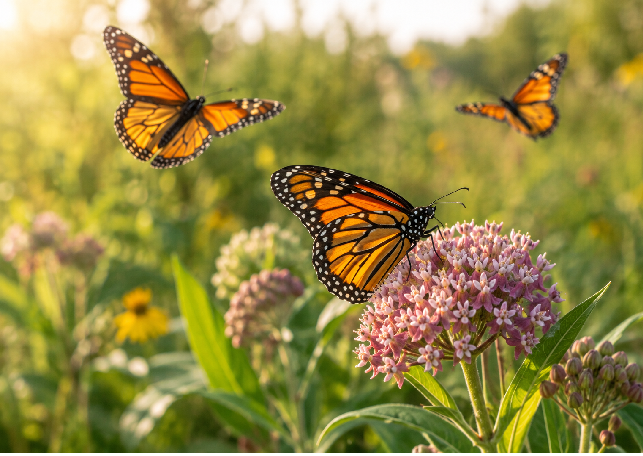
Somebody alert the mainstream media: Mother Nature has interrupted their regularly scheduled environmental doom-and-gloom broadcast with a little good news.
Monarch butterflies are fluttering into the headlines this autumn, as new reports indicate a 64% increase in their population.
The World Wildlife Fund reported in March that “two new reports, both released by WWF-Mexico and its partners, estimate a 64% increase in species population and a significant decrease in forest degradation within their critical winter habitat.”
The Xerces Society for Invertebrate Conservation , a nonprofit organization based in Portland, Oregon says, “In the 1990s, nearly 700 million monarchs made the epic flight each fall from the northern plains of the U.S. and Canada to sites in the oyamel fir forests north of Mexico City, and more than one million monarchs overwintered in forested groves on the California Coast.
Now, researchers and citizen scientists estimate that only a fraction of the population remains, monarchs have declined by more than 80% since the 1990s from central Mexico, and by more than 95% since the 1980s in coastal California.”
Apparently, butterfly colonies have spread significantly.
Every year, eastern monarch butterflies make the 2,800-mile journey from Canada and the United States to the forests of the Monarch Butterfly Biosphere Reserve in Mexico for winter hibernation.
Two new reports from WWF-Mexico and its partners found that colonies covered 7.24 acres of forest in the 2025-2026 season. That’s an increase of 4.42 acres compared to last season. The figure is based on an annual survey of the forest used by overwintering colonies in Mexico that WWF uses to track population trends.
One reason for the uptick is that people are planting butterfly-friendly plants in their local gardens.
The number of monarchs that reach Mexico every autumn is determined by how the population fared over the previous three breeding generations and the success of their migration to Mexico. Thus, their numbers are driven by recruitment (the number of eggs laid and survival to adulthood) and survival during the annual migration.
Recruitment and survival are affected by the availability of quality habitat (i.e., milkweed for breeding and nectar sources, particularly during migration), weather conditions, and the presence of lethal agents such as environmental toxins and insecticides, and natural enemies like predators, diseases, and parasites. Land conversion, climate change, and pesticide use can all affect monarch numbers.
It’s challenging to quantify changes in habitat availability on a year-to-year basis, but we know that people throughout the monarchs’ breeding and migratory range are restoring habitat: in yards, workplaces, schools, and churches; along roadsides, utility rights-of-ways, and railroads; and on open land. All of this is positive.
But that’s not the only good news. The buzz is that U.S. honeybee colonies entered 2026 at higher numbers.
According to the USDA’s National Agricultural Statistics Service, operations managing five or more colonies began the year with 2.81 million colonies, up 6 percent from the previous year.
Operators added more colonies than they lost during both quarters. Renovation also remained common as beekeepers requeened colonies or introduced new bees through nucleus colonies and packages.
Varroa mites remained the leading health stressor, affecting more than one-fifth of colonies early in the year and more than one-quarter during spring. Colony Collapse Disorder losses declined from the previous year.
The expanding colony count offers some reassurance for pollination-dependent crops, but maintaining those numbers requires significant labor and expense. Producers will watch mite pressure, forage conditions, weather, and replacement costs through the remainder of the season.
The monarch rebound and rising honeybee colony counts are welcome reminders that environmental headlines need not always come wrapped in doom, even during the Halloween season.
All of us who garden, as well as hard-working beekeepers, have something worth celebrating and inspiration to keep up our very successful efforts.
Donations tax deductible
to the full extent allowed by law.






Comments
Wow, that really is a rebound. I wonder if my acquaintance in CT is still raising them. He would be happy with this.
We live along the southern part of the Monarch migration highway. Some years ago one of our neighbors who is a dreamer who honestly believes that small acts can change the world organized a drive to make our neighborhood into officially designated “butterfly habitat.” Each spring at any and all neighborhood festival she is there with a small group educating people and giving out butterfly friendly plants packs to everyone with one hand free. My wife who loves her garden helps out as do other neighbors. Of course, although I’m a cynic, I’m not a critic of someone trying to make our neighborhood a better place. So I help, watching with the quiet bemusement I have for a girl pretending to beca nurse helping a puppy with a sore paw. Happily, people love the idea of butterfly gardens and over time we really have seen a pleasant increase in butterflies. Naturally I had no idea that this crazy scheme was really helping, but I just sent her an email including the information about the Monarch population surge and telling her she should be proud of her contribution. Once again the cynic in me is humbled, and frankly I’m glad of that.
(Note: I didn’t send her a link to this article because I don’t want her to see this comment).
Love this idea
So Hodge must be your real name!
That’s correct. I’ve seen more monarch butterflies than migrating birds this year in CT.
I was lucky to see the Purple Martins in Round Rock
Tens of thousands stop here getting ready to fly south for the winter
It was quite a nightly sight. Took
My
Granddaughters. Had them do a news reel for it. It was so cute o sent it to the local
News stations in Austin. They didn’t use it, their loss!!!
Same for me in NJ. I kept saying this is the most I have seen in years!!
I’m really pleased to hear the bees are doing well.
When I was a kid, my friend were all so afraid of bees, and they’d try to shoo them away, getting stung for their trouble.
Me? I just observed them and if one landed on my arm or hand I didn’t panic. I let them do their exploring, then they’d fly away.
Bees are cool!
Until one lands unnoticed on your pool noodle just before you jam it into saddle position. Ask me how I know.
Our water dogs enjoy trying to snap bugs out of the air. We refer to them as “sky raisins.” We call bees “jalapeno sky raisins.”
I concur, and I was allergic to all insect toxins as a kid. (Try living in fire ant country in that state.) I hated wasps and hornets, but would happily be around bees – just don’t piss them off.
okay……
Too funny… as I was reading this post I got a notice from my ‘Hummingbird camera’ that a new visitor had come by. It was a Monarch Butterfly.
Fewer Monarchs in my central Florida yard this year. There’s also some controversy over which varieties of milkweed are good or bad.