


Hackers Hijack French Supermarket Fridges, Spoiling Food Nationwide
Additionally, Dutch supermarket giant Ahold Delhaize took systems offline after cyberattack disrupted websites, apps, and online ordering.
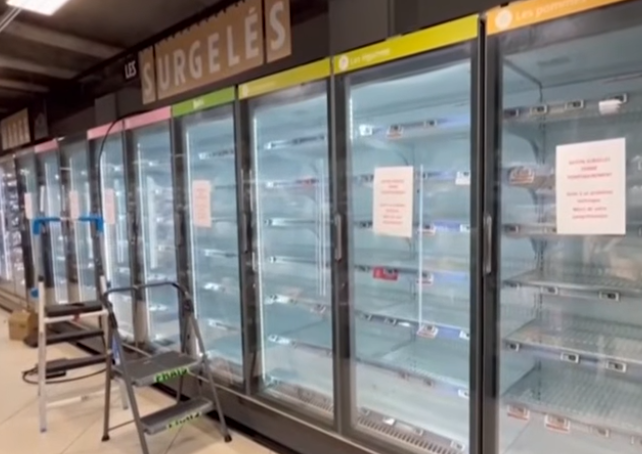
France may take its food seriously, but hackers have found a decidedly unsavory way to interfere with its cuisine: Turning up supermarket refrigerator temperatures and leaving spoiled food and reported fires in their wake.
Hundreds of stores across major French grocery chains were affected, a chilling reminder of what can happen when appliances go digital and cybercriminals control cold storage.
Major French supermarket chains on Monday said they were hit by a cyberattack that caused their refrigerators to shoot up in temperature in hundreds of stores, forcing spoiled food to be thrown away and raising concerns about food security.
Top retailers E. Leclerc, Intermarché and Cooperative U confirmed to AFP they suffered a cyberattack that Cooperative U’s chief executive described as “unprecedented.”
“Food security requires more attention at all levels,” said the EU’s food and agriculture commissioner Christophe Hansen on X, condemning the attack and saying such “exploitation of food” was now a “reality.”
At least 300 shops of Intermarché or its Netto brand were targeted, along with over 100 Cooperative U outlets, and several E. Leclerc stores, the retailers told AFP in separate statements.
Hackers Attacked French Stores' Refrigeration Systems, Causing Mass Spoilage of Foodhttps://t.co/mwzxroFQWQ pic.twitter.com/i2jBUoRsyB
— Amy Curtis (@RantyAmyCurtis) October 13, 2026
In addition to the loss of produce and merchandise, the Paris prosecutor’s office also reported fires.
#Now
Hackers turned French supermarket freezers into ovens, heating some to 50°C (122°F). About 700 stores affected, tons of food destroyed, fires reported. Authorities investigate attacks on refrigeration controllers. https://t.co/EEhfRxSN9S— Mexico Times (@mexicotimes) October 13, 2026
It appears the refrigeration system was running on outdated firmware (software that tells hardware how to operate). I will simply point out that most markets didn’t have this a few years ago…before the “Internet of Things”.
The investigation identified a possible link to vulnerabilities in refrigeration control systems from Danish manufacturer Danfoss. France’s National Cybersecurity Agency (ANSSI) was tasked with investigating the attack by order of Prime Minister Sébastien Lecornu.
Danfoss acknowledged incidents involving its equipment and stated that the affected units were operating with outdated firmware. The manufacturer said it already recommended that customers install the latest versions and replace old systems.
The security history of this equipment adds a relevant detail to the episode. In March and August 2025, Danfoss itself published alerts about vulnerabilities in the AK-SM 8xxA controller family, including flaws that could allow bypassing authentication mechanisms and executing commands remotely.
The fixes were made available in software versions 4.2 and 4.3.1. Later, in August 2026, Claroty researchers documented these vulnerabilities and demonstrated that thousands of management interfaces for this type of equipment were accessible over the internet.
50°C. Inside a supermarket freezer.
Hackers pushed refrigeration systems to that temperature for six hours across roughly 150 stores in France. Food had to be discarded. Danfoss says the affected equipment ran outdated firmware.https://t.co/Veq39d28VV
— Radar Digital (@radardigital_ai) October 13, 2026
Losses are estimated in the tens of millions of euros.
Cooperative U CEO Dominique Schelcher said his supermarket group had also been targeted.“Targeting equipment essential to the preservation of fresh products and to the food supply of the French people is of extreme gravity and is unprecedented,” he wrote on X.Food retailers E.Leclerc and Auchan did not respond to requests for comment.There was no immediate estimate of industry-wide losses, but Intermarche CEO Thierry Cotillard told BFM TV the “unprecedented” attack would represent losses amounting to “tens of millions of euros nationwide in a single day.”Christel Delberghe, director general at European retail association Eurocommerce, said, “This incident underlines the importance of resilience across the entire supply chain.”
No group has claimed responsibility for the cyberattack. Meanwhile, a Dutch supermarket chain is also dealing with a digital security incident.
French investigators on Tuesday were hunting the hackers who seized control of cooling units at hundreds of supermarkets in a cyberattack that underlined the vulnerabilities of connected systems, with no group publicly claiming responsibility.
The investigation comes as Dutch supermarket company Ahold Delhaize, grapples with a separate cybersecurity incident that disrupted online services, although Dutch authorities said they saw no connection between the two events.
The absence of a claim of responsibility by hacktivists or a ransom demand by cybercriminals has puzzled French investigators, according to a source with knowledge of the probe. Typically, such groups tend to quickly seek to monetise their hacks or claim credit for them for political ends.
Dutch supermarket group Ahold Delhaize reported the cybersecurity incident on Monday and took some network systems offline as a precaution. The shutdown disrupted websites, apps, online ordering and deliveries across several brands in Europe and the U.S., although physical stores remained open. The company said it was beginning a controlled restart of certain systems and working with external cybersecurity experts, with no evidence so far that customer or employee data had been stolen.
Ahold Delhaize USA, the parent company of Stop & Shop, Food Lion and Hannaford, confirmed a cybersecurity issue forced it to take systems offline this week — knocking out websites and mobile apps across the grocery chains.
The company said it took "precautionary measures,… pic.twitter.com/eZKZ6EwBaO
— FOX Business (@FoxBusiness) October 13, 2026
The promise of “smart” refrigeration loses some of its appeal when hackers can turn your favorite frozen food into very expensive compost.
Whatever investigators uncover, this episode reminds us that connecting essential equipment to the internet demands more than enthusiasm for the latest digital upgrade.
Supermarkets should make sure their cybersecurity is at least as robust as their cold storage and remember that food security is a national security priority.
Donations tax deductible
to the full extent allowed by law.






Comments
Coming soon to a city near you.
Be prepared.
Stop n Shop in my town had a cyber related refrigeration breakdown this summer. The story did not make it into the news.
Kroger and WalMart have independent systems that monitor their refrigerated cases. Kroger’s uses independent thermometers; WalMart’s (based on what I heard from a developer) uses the controller’s sensor.
I know the Kroger system will alert on a stuck defrost cycle, which this would mimic. I also know Kroger has saved entire store’s worth of food from spoiling after mechanical failures thanks to their system alerting the store and their refrigeration techs. The techs are even able to diagnose the problem from their location and have the parts for the repair ready before they head to the store.
It’s in a city near you right now if your on the east coast. Wife runs the transportation department at a DC for a subsidiary of Ahold Delhaize. All DC’s on the east coast from FL to ME have had their transportation computer systems shut since Sunday. They can build and ship the load by hand which is what they are doing but it’s much slower and some products have delayed shipping times.
I can’t think of a single reason – beyond basic laziness – why any appliance should be connected to the internet. That being said, the cost of this incident will be much higher than just the spoiled food. The coolers will need to be inspected for damage and possibly repaired, controllers and software updated, coolers thoroughly cleaned and disinfected, run for several hours to be brought back down to operating temperature before being restocked, the cost of production and transport for the restocking… man-hours, utilities, parts…
I bought a heat pump this last summer… I was TOLD AFTER installation the only way to control it and set day/night temps was through an online account.
I was pissed beyond belief and 17k later… stuck with it.
If you can prove that, I would think a lawyer would have a field day – fraud by misrepresentation.
Only “fraud by misrepresentation” if the seller said it could be done manually without an online account. And then you’d better hope They didn’t sign the usual, “The written agreement is the only agreement and any verbal representations from either the seller or installer do not have legal force.” clause that is very common in any agreements these days.
eot
I got one of those after my new metal roof was installed. The salesman promised me a 50 year warranty against leakage. The paperwork promised 20 years and contained that clause. I don’t particularly care because I’m old enough to be gone before the warranty, but it’s still unethical.
Caveat Emptor. Buyer beware. It’s up to the buyer to make sure what they are purchasing is fit for purpose and is what they actually want and or need. Not up to the seller to answer unasked questions.
tar and feathers is less expensive than a lawyer and works 100% of the time
I may be wrong, but that sounds like complete nonsense. Fit a locally controlled thermostat to the unit and see what happens.
It most likely is complete nonsense but fit that “locally controlled thermostat to the unit” and watch your warranty disappear faster than . . . well, I don’t really know but your warranty would be voided mighty fast that’s for sure. Just saying.
eot
Unless there is something in the manufacturer’s warranty stating that internet connectivity is REQUIRED, their attempt to deny coverage would fall flat.
(I have ecoBee thermostats (2, two systems), and while they CAN be connected to ecoBee’s servers, I have full automation running under local control.)
Nope. The other fun little clause that usually ends up in any warranty:
Warranty void if labels removed from sealed system or repair work/additions added to system by unauthorized service personnel.
eot
You didn’t actually read the specifications, manual, and other information about this heat pump system before you dropped 17K on it?
Wife and I went to a new minor league team game in a brand new stadium last year. The only way to pay for a ticket was with an online account. No money taken at the stadium. We even had to go through metal detectors to enter the stadium. Everything was cashless but I didn’t get an explanation as to why I needed to hand over my drivers license, create an account and give them my email. I never got spam from them but I was beyond angry and only the wife’s insistence we see the game since we drove all that way kept me there.
Our local minor league park is the same. Can’t even buy a bottle of water with cash. Ridiculous.
And in France, it would not be question of savings or efficiency. You’d have a union in store supervisor, and his supervisor and his supervisor and corporate oversight and their oversight and and government oversight and the interest servicer staff (also unionized) and their supervisors and more government oversight and the contractors (also unionized) and their supervisors and more government oversight.
That sounds like the old British car industry. And look what it got them.
If they’re that bad they wouldn’t have bothered with Danfoss controllers or networking them.
You’re right. They’re not that bad. They’re much worse.
Savoir faire is everywhere
All across America supermarkets, COSTO, Sam’s, BJ’s, Walgreen’s, etc.. use internet interface to monitor temps in freezer and refrigerator nationwide
I used to work private security. On one account, one of my night-shift tasks was to manually monitor and control the air conditioning for the server room…
Kroger’s temperature monitoring system for frozen and refrigerated food also has sensors in the server room in each store and in the pharmacy (and pharmacy refrigeration).
Going from bad to worse in France. Rioters declare “l’etat c’est nous!”
Hope the froggie communist dummies starve themselves, attempting to subjugate others.
‘The internet of things’ confirms the internet has made everything worse.
No, it’s a reminder to corporations worldwide what can happen when they cheap out and don’t upgrade their infrastructure to the latest mechanical and software versions as I’ve read that the corporations hit were utilizing obsolete, end-of-life controllers and software to control their freezers that were no longer being updated and they never received the update that would have prevented hackers from getting into their systems.
They never applied the update. The goofy thing is they could have done the update remotely.
No. they never applied the update because they couldn’t apply the update that contained the fix to their EOLed, obsolete controllers.
EOL/obsolete doesn’t take as long as it used to.
And one of the “benefits” of the Internet is that we are now exposed to many more criminals than we used to be.
That’s actually only relevant because they weren’t doing all of the right things to secure such an important system.
It’s also only relevant because the company responsible for building that system and its over-the-internet control system didn’t build it securely to start with. (At least it probably wasn’t a buffer overflow issue; don’t get me started.)
This is just one more confirmation that the IoT (“Internet of Things”) is not only insanely stupid, it is hugely dangerous.
In this particular instance no one died, no planes crashed, and there was no release of hazardous materials. It simply cost a few millions of dollars and wasted large quantities of food.
There is exactly ZERO reason to connect the temperature controls for a freezer or refrigeration system to the internet. In most cases a simple thermostat takes care of the control; if more sophisticated control is needed a PID controller (NOT connected to the ‘net) can be used. They can put a simple and separate temperature sensor in them to provide on-line warning for over-temperature to wake up maintenance to a problem.
But look at what’s happening in industrial process control systems. More and more of them are going “IoT” to try to cut costs. Just wait ’till air traffic control or nuclear reactors, or oil refineries start getting hacked. If you thought that Bhopal was bad, just wait.
I use a lot of home automation. But, none of my stuff is dependent upon remote servers. It’s all local.
I looked into “all local” home automation. It is complicated way beyond the capabilities of the IT non-expert. No reliable company will support it because it would interfere to lock in their customers. Better to stick with “home manual” equipment.
None of my stuff has any manufacturer lock. I have a mix of Matter / Thread, ZigBee, Lutron, and Z-Wave devices of several makes running through a Hubitat C-8 Pro hub. The automation routines, while they DO take some learning, can be mastered fairly easily. And, it all “plays nice”.
Home Assistant on the other hand… that takes some propeller beanie thinking.
You connect refrigeration controllers to the network so you don’t have to send people out to spend most of their day driving to apply updates. You connect it so you can troubleshoot before you leave the shop, ensuring you have the right parts with you.
Also so you can figure out when a case is overstocked or a door is left open, and get somebody in the store to deal with the issue.
And… I’d be willing to bet a lot of those systems being hacked have the factory passwords, or passwords that are 8 characters, or something easy to guess.
Granted, I am not a supermarket in a muslim-occupied country. But, I also have never had anything more than consumer-grade routers and common operating systems. But, I also use long passwords and passphrases, and exercise as much caution as I know how to do. I’ve not been hacked, or had any accounts hijacked and I’ve been on line since 300 baud modems and BBSs.
Do you use a cloud-based password safe? Do you use a cloud-based data backup system? Or do you make daily backups and store them in a bank safety deposit box?
It’s difficult to decide where and how to get off the technology train.
My line of thinking is: “the cloud” translates as “someone else’s computer”.
And if you really want to control those things you put them on a dedicated, encrypted network, with very secure entry controls. And THEN you restrict access further to only allow well-trained and security-minded folks into that network. And you sure as heck don’t hand your stuff over to the same company that “everyone else” is using just because they’re the biggest or cheapest. (I also wouldn’t let the manufacturer run all of that, as they do not have the best interests of my company at heart.)
THEN, after all of that, you do what Grizz says and lock it all down. And you threaten the concerned employees that if they violate the controls they will never get out of debt to the company for three generations and they will also go to prison, if possible.
Oh, and refrigeration for a grocery store isn’t a bunch of independent heat pumps like home refrigerators. There are a handful of heat pumps, each serving dozens of cases. They also handle the store’s HVAC, letting them do things like dump heat extracted from cases into the store’s air during the winter.
A simple PID controller wouldn’t be able to handle all the things we ask of the store systems these days.
Having worked as a robotics team mentor, your mention of PID controllers warmed my heart.
This is a Muslim riot against France, not students. Where is the police or French army? Are the French going to let this happen with out any push back against the hackers? If so, they are a conquered nation by a foreign enemy.
The French are too spineless to fight. The same thing with their next door neighbors, the master race.
Same with us, which is why Muslims are taking over our schools.
So I have noticed,I am sad to say.
You are right on both nations.
Excuse the down vote, it was an accident. I wanted to say the videos show police on the street, but no signs of the army. Does France even have an army these days? And where’s Macron?
He’s out globalizing.
No problem with the down vote. It happens sometimes.
The quality of user interfaces has also declined.
Where is Macron? I dunno, what is the equivalent of the French Laundry?
Rick’s American Cafe?
Yes. They wet themselves at the idea of being called islamophobic.
The way things are going in France, they just should have had a fire sale.
I think the operative question is why is something like that online to be hacked in the first place? Don’t you have to have people there anyway?
I can see remote operation and monitoring. What I cannot fathom is using ‘the internet’ as a pathway. A dedicated, encrypted, closed system makes a lot more sense.
But, what do I know? I am just someone with common sense, not the holder of an MBA from an ivy league school, or in the case of France, one from The SoreBuns.
But, what do I know?
Heh. You know as much with common sense as I do with a certification and experience in cybersecurity and remote systems.
It seemed like a good idea at the time to “the holder of an MBA from an ivy league school”. It made a good bullet on his resume. I used to work for some of those.
“I have an MBA from Haah-vahd!”
‘Thanks for the warning!”
I do know, with a programming degree and extensive experience with computers, communications and signal security. You do not connect equipment to an unsecure network – and the internet is about as unsecure as it gets – unless there is absolutely no other option. Even if it means paying somebody to sit there and physically move things across an air gap.
Automated monitoring is cheaper….in theory.
In theory, there is no difference between theory and practice.
Why are freezers in a,supermarket even on line?
To allow monitoring of their state at all times. This way you can know they went warm in the middle of the night when you can rush to the store and try to fix things, instead of in the morning when the store opens and the food is already done for.
But they also had all the controls online. THAT was done because people are lazy and penny pinchers.
Bingo.
So, aside from the stupidity of putting SCADA on the internet, instead of inside a dedicated network, and whatever vulnerability they allowed with someone’s password or (likely) social engineering to which a user succumb… they also were ALL USING THE SAME system? Didn’t someone learn from the Crowdstrike crash?
Diversity IS strength in two arenas: supply chain and controls.
(SCADA – Supervisory control and data acquisition)
People should understand that this has been coming for several years now. My wife’s company in the US sends all of its online stuff over to Europe where it is then sent back to them. The computer system software is based over there. Any disruption in Europe and they are shut down. Several years ago I was picking a load of potato salad up at a subsidiary of Smithfield Food. After I got loaded I stood around waiting for my paperwork. Turns out all loads, shipping and receiving, are sent overseas, processed and sent back. A disruption left them unable to create the paperwork to send me on my way and they had no paper backup in case it happened. Sat there with a full truck of product for 4 hours because they couldn’t give me any shipping papers.
All my knowledge and experience in building controls is old since I got laid off from a very large international controls company (name starts with H – you guess what it is) twenty-five years ago but monitoring and control are two different things often linked for convenience. But I have to ask a question: Who made the incredibly idiotic decision to not put a hardware thermostat in the freezers to serve as a high limit control? Set it at 45 degrees F and wire it to override the sexy electronic controller at its set point.
Nowadays it seems many people are so smart they’re stupid.
.
Silly question: how does a refrigerator/freezer unit get that far above ambient?