

In Brighton (NY), a Nativity Scene Becomes a Constitutional Fight
“There seems to be a lot of animosity and conflict in our community right now, and I see the Nativity as an invitation to everyone to pause, think, repent, and realize our common humanity. The Nativity is a wonderful symbol of that ….”
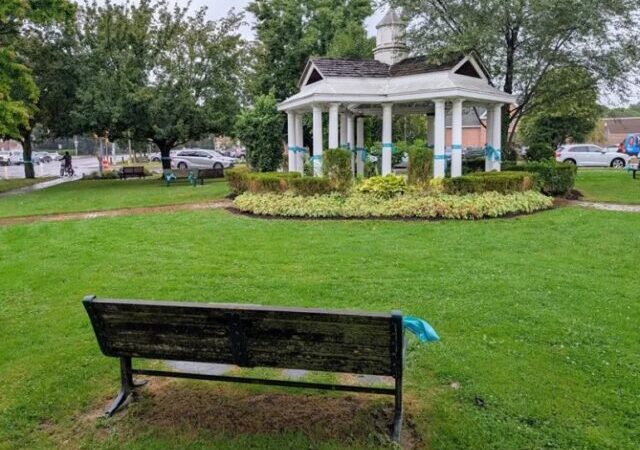
This article first appeared in The Rochester Beacon and is reprinted with permission. Featured image Twelve Corners Memorial Park credit The Rochester Beacon.
———-
The heart of the town of Brighton is the intersection known as Twelve Corners, and in the middle of Twelve Corners is a little park, a triangular island of greenery with benches and a gazebo, surrounded by traffic.
Small as it is, Twelve Corners Memorial Park has become a town focal point, the site of public ceremonies, political rallies, and holiday displays. These include a large Menorah, a Jewish candelabrum traditionally used during Hanukkah, and a banner with crescent moon and the words “Ramadan Mubarak” (Blessed Ramadan) for the Muslim holiday of Ramadan—both erected by private organizations with permission from the town.
And now, Twelve Corners Memorial Park has also become the focus of a federal lawsuit.
“I would drive by there and it was uplifting to see the Menorah, a religious symbol of hope,” Gennaro Polverino M.D., a 10-year Brighton resident, recalled to me in a phone call. “It was wonderful to see that the town was allowing the religious display. “
(A sign each year near the Menorah states it is sponsored by a private organization, not the town of Brighton.)
“But then after a few years,” Polverino continued, “I wondered, ‘How come nobody’s ever also put up a Nativity, which also invites people to have hope? So, I thought I’d look into how to do that.”
A Nativity scene is a Christmas display depicting the birth of Jesus.
Polverino, 60, has practiced family medicine and urgent care for 20 years. He’s also a devout Catholic. Raised on a small family farm near Newark, he went to Catholic school through eighth grade and later attended Gannon University, a private Catholic university in Erie, Pa. He and his wife are parishioners of Sacred Heart Cathedral, the Mother Church of the Roman Catholic Diocese of Rochester.
In December 2023, he called Brighton Town Hall asking how to gain permission to erect a Nativity scene at Twelve Corners Memorial Park.
“I thought maybe there’re some forms I would need to complete,” he said. “But I never heard back.”
He didn’t know it then, but that call would be the first of nearly two dozen fruitless attempts he’d make—by phone, email, in person, and certified mail—over nearly two and a half years, to get an answer. He says that no matter which town officers or employees he contacted, they all either ignored his requests, passed him from one office to another, or said they’d get back to him but never did.
In the legal complaint filed on his behalf, Polverino’s counsel lists the following examples of attempts he says he made to get information from Brighton town officials:
Dec. 29, 2023—meets with commissioner of public works who promises to convey request to supervisor. No response.
Jan. 5 and 23, 2024—phones public works commissioner and assistant to the superintendent. No reply.
May 31, 2024—phones supervisor requesting meeting. No reply.
Aug. 17, 2024—sends certified letter to supervisor requesting meeting. No reply.
Aug. 26, 2024—visits supervisor’s office during normal business hours. Supervisor sees him but rather than meet, goes into his office and tells an employee to speak with him instead.
Sept. 10, 2025—hand-delivers information packet for town attorney. No response.
Oct. 20, 2025—calls town attorney. No reply.
March 12, 2026—emails supervisor, chief of staff, and town attorney. No reply.
June 12, 2026—counsel for Polverino writes supervisor detailing record of ignored requests and asking client to be permitted to erect Nativity. No reply.
If these claims are correct, it’s not clear why Supervisor Bill Moehle and other town officials ignored Polverino’s requests for information.
I called Moehle, town attorney John Mancuso, and town chief diversity officer Marianne Moore-Burt for comment. None of the calls were returned.
The town’s legal response to Polverino’s complaint is due Sept. 11.
During the decade he’s lived in Brighton, Polverino says, his previous contacts with Town Hall—once to get a dog license and another time to ask about a permit to convert his garage to an in-law suite—went fine, and his requests were approved.
“The process was clear, and everybody was pleasant,” he said.
So, why in the case of the Nativity scene, does he think the town supervisor and other officials ignored him?
“I have no idea,” he said. “I’m not going to speculate; only God knows the hearts of man.”
The lawsuit

Polverino is represented in his lawsuit, filed July 21 in federal District Court in Rochester, by the American Center for Law and Justice, a conservative Christian legal advocacy group headquartered in Washington, D.C. The group is handling the case pro bono.
I asked Polverino how he connected with the ACLJ.
“I was searching the internet about how other towns set up Nativity scenes,” he recalled, “and I ran across a fact sheet by the ACLJ, which outlined what a citizen’s rights are for that.” He forwarded the fact sheet to the Brighton town attorney, he recalls, but got no response.
Polverino’s suit claims that Brighton’s “sustained pattern of non-response, spanning multiple Christmas seasons, constitutes a de facto denial of (his) constitutional rights to free speech, free exercise of religion, and equal protection of the law.”
It alleges that by allowing some religious groups but not others to put up displays in a public square, the town has engaged in “viewpoint discrimination.”
Courts have ruled that the government may allow free expression of viewpoints, including religious viewpoints, in a traditional public forum such as a park, so long as it’s a private organization or individual that is expressing the religious views, and not the government itself. Once having done that, the government can set reasonable restrictions on use—such as time, place, and manner of display—but it cannot allow the public space to be used for the expression of some religious views while excluding others.
Polverino, the complaint notes, “does not seek removal” of the Menorah, but seeks only “neutral and even-handed treatment” of his Nativity display.

The complaint asks the court to order the town of Brighton to permit Polverino to erect a Nativity scene each Christmas on the same terms as it permits other religious holiday displays. It also seeks compensatory or, alternatively, nominal damages.
“For two years, Dr. Polverino attempted, in good faith, to approach the town,” Abby Southerland, the ACLJ attorney handling the case, told me in a phone call. “I don’t know many people who have made so many attempts to resolve a matter without litigation. He saw the Menorah as a sign of hope and inspiration during the holiday season and his intent is not to compete with that—it’s just that the Nativity also brings a sense of hope to many people.”
Polverino said, “I want to be sure the Menorah has its place.”
Reactions
I asked Rabbi Nechemia Vogel of Chabad Lubavitch, the group that annually sponsors the Menorah at Twelve Corners Memorial Park, for a comment on Polverino’s case, but he declined to speak publicly about it.
Monica Gebell, director of Community Relations for the Jewish Federation of Rochester, stated: “If Dr. Polverino had reached out to us we might have been able to support him. Federation believes everyone should have the right to display meaningful symbols publicly that celebrate religious holidays. This same right should be granted our Christian neighbors.”
A message left at the Islamic Center of Rochester was not returned.
From EMT to urgent care
Growing up in Wayne County, Polverino remembers as a child going to the Hill Cumorah Pageant in Palmyra. “We’d take relatives visiting from Italy to see the Pageant—it was a spectacular display,” he says. “We’ve always been open to other people’s ways of living their lives; it’s strange to want to share a Nativity with others in the community and not be able to do that.”
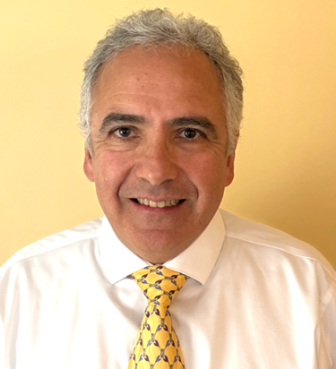
Gennaro Polverino M.D. | Photo courtesy M. Hemple
In high school, Polverino joined Newark Volunteer Ambulance and took training as an emergency medical technician. After college, he attended medical school at Michigan State University College of Human Medicine and did his residency at Forbes Hospital, Allegheny Health Network, outside Pittsburgh.
For a time, he lived out West, practicing emergency medicine and primary care with the U.S. Department of Veterans Affairs, but later returned to this area.
“My father had died and my mother was living alone,” he recalls, “and later as her health began to fail, as the only child I came back home in 2012 to assist her.”
He practiced urgent care at St. Mary’s Hospital, subsequently part of Rochester Regional Health, and later did urgent care and then primary care at an RRH facility in Newark. Most recently, he worked full-time for a year at the VA in Canandaigua.
A planned return to RRH was delayed due to a dispute about his request for religious accommodation. He asked RRH to allow him, due to religious beliefs, not to perform or refer patients for contraception, abortion, gender transition, vasectomy, and related procedures. An agreement was not reached and, as a result, he is currently not practicing medicine. In June, a discrimination complaint was filed with the U.S. Department of Health and Human Services on his behalf by the ACLJ, the same group that is representing him in the suit against Brighton.
I asked Polverino if he sees himself as an activist for religious rights.
“Am I an activist? No, I’m just living my life,” he said, “and these are things I’ve run up against.”
Why is it important to him to have a Nativity scene displayed in a public place?
“There seems to be a lot of animosity and conflict in our community right now, and I see the Nativity as an invitation to everyone to pause, think, repent, and realize our common humanity. The Nativity is a wonderful symbol of that, ever since it was first put up by St. Francis of Assisi in 1223.”
Peter Lovenheim is Washington correspondent for the Rochester Beacon. He is author of “In the Neighborhood” and other works. His most recent book, “Gift Shop of Gratitude,” was published in 2024. He can be reached at PeterLovenheim.com.
Donations tax deductible
to the full extent allowed by law.


Comments
They allow “a banner with crescent moon and the words “Ramadan Mubarak” (Blessed Ramadan) for the Muslim holiday of Ramadan”? There are Islamic NO equivalents to a Nativity scene or a Menorah display. A crescent moon was originally emblematic of Islamic imperial conquest and its use on flags today is a political symbol used by islamic states.
Now it may be a public manifestation of pretend Islam common here. But people should be aware that its use here is not really religious, it’s Islamic political propaganda. Makes city the objection to a Nativity scene even more suspicious in my view.
Shurtleff v. Boston, 596 U.S. 243 (2022), was a 9-0 decision.
Which is why the town has carefully not told him “no”, it’s just ignored him and hoped he would go away. The town has surely taken legal advice and been told that once they engage him they can’t refuse his request, so they’re avoiding him.
I would suggest their clear pattern of avoidance is the answer.
Good for him
America needs more like the good Dr!!
The city doesn’t have a choice. If they allow a Menorah (Jewish) and a banner with a crescent moon “Ramadan Mubarak” (islam) then they must give permission for a Nativity scene to be displayed in the same location. Period. They have no choice in the matter. Allow one or two religions you must then allow all religions the opportunity to set-up a religious display.
EoT
I’m pretty blase about most religious symbols especially when they are presented in a historical context and most Christmas expressions have become as much secular as religious. However I’ve always drawn the line at overt expressions of a religion on public grounds even if attempts are made to have representations from many religions which is usually not the case. No. I object. Keep your religious displays at your houses of worship where they belong.
No. I’ll display my religious symbols where I please. Bigots like you can avert your eyes.
Spoken like a true supporter of the constitution. NOT. I’m sure you’ll feel the same way when you have to suffer sharia police and listen to the call for prayer five times a day.
The constitution agrees with Irish. Private people and organizations are entitled to display religious symbols in any place and under the same terms as they’re entitled to display non-religious things.
Sharia “police” are entitled to operate in the same manner as any other private “police” administering the private rules and etiquette of any private society. They can’t use force just like anyone else can’t.
Calls for prayer can’t be banned, so long as they adhere to the relevant noise regulations, which of course vary by time of day. So the dawn and late-night calls must be at a lower volume, but the midday ones can be louder. If anyone else can make a public announcement at a particular decibel level at a particular time and place, then so can a mosque. If an ice cream truck is allowed to play its annoying jingle, and a church is allowed to ring its bells, then a mosque can play the adhan.
It’s easy to ban calls for prayer. “No private or public structure shall emit a sound pressure level greater than 55dBA from 6pm to 10am and 63dBA all other times and no such noise shall be greater than 42dBA one foot from the interior of a closed residential window.”
This guarantees no one will hear it past 25 feet from the source or when indoors.
Just train dogs to bark at calls to prayer.
That’s easier than it sounds. In our extended family, all the dogs have trained THEMSELVES to bark at annunciators like doorbells, Ring camera motion chimes, driveway alerts, and so on. It’s harder to STOP them from barking at them.
Sharia police attempt to enforce private rules aka muslim religious rules in public spaces. F them, They have no authority to do so and their rules are their own.
George, as I wrote, “Calls for prayer can’t be banned, so long as they adhere to the relevant noise regulations, which of course vary by time of day.” And of course those noise regulations must not have been made with this purpose in mind. They must be the normal regulations that the town has always had, before adhan became an issue, and they must be enforce equally on all sources of noise.
With those limitations in mind, no one disputes that adhan would be subject to the same regulations as everything else. No one is demanding a special exception for it. But that means they can still do the daytime adhans at full volume, and they can still do the early and late ones at reduced volume.
Also, I don’t think you’d get away with having quiet time from 6 PM, or until 10:00 AM. That’s just not reasonable, and no one else would be adhering to it. If you were to try enforcing it on everyone you’d have a revolt, and you can’t enforce it selectively against adhan.
I just looked up NYC’s noise regulations. Quiet time is 10 PM to 7 AM. In quiet time noise can’t be more than 7 dB above whatever the ambient noise level is, and during the day it can’t be more than 10 dB above ambient. Short and abrupt sounds can be up to 15 dB above ambient at all times. Garbage trucks can apparently go up to 80 dB. There are other limits for various things. My point here is that adhan must be allowed the most lenient regulation applicable at any given time. If you impose a stricter standard on adhan than on some other noise source, then you have to be able to justify that difference, and explain why you can’t give it the same treatment.
The god that the religion of secularism worships is a jealous god.
Like or not we are a secular county purposely that welcomes and does not discriminate against any religion and that it how it should be. You speak from the position of never have been in the minority and it shows.
By the way the Abrahamic god is a jealous god.
The USA is a secular country, but not a secularist one. The founders gave religion a privileged legal position over all other kinds of thought. That means that in the USA the government, while not taking any religious opinions itself, and not favoring one religion over another, must regard religion in general benevolently.
And I have no problem with that as stated.
I’ve use the term: “a separate, honored space” for the US construction on religion. That seeks to capture the perspective, laws constructed to realize.
Contra France, “secular society uber alles”, and Islamic “religion over secular society” — it means something being a revealed, totalitarian theocracy.
None honored perfectly, but the aspirations are these.
Define religion.
define religion of secular worship.
Coward.
The supreme court disagrees. Any time the government allows people to exhibit private displays on its property, it may not discriminate against religious expression by refusing to allow it the same facility that it allows to non-religious expression. For instance if the Boy Scouts or the Chamber of Commerce are allowed to put up a display in the town hall lobby, then religious groups must be allowed the same.
But the government must make sure that no one will mistake the display for a government-sponsored one that reflects its own opinion. Governments are allowed to have and express non-religious opinions, but not religious ones.
Then the supreme court erred as they often do and opened up an enormous can of worms,
The constitution is pretty explicit about this. The government can’t adopt its own religious views but may not discriminate against any one religion or against religion in general. That’s the free exercise clause.
Allowing use of public lands by a religious group is tantamount to adopting religious views because like it or not it is frequently limited who gets to use the public lands, What is worse members of the majority feel entitled to do so and damn the minorities, You can see elements of that feeling here in this chat. Best to have government steer clear of anything smacking of religion so as not to play favorites, This is not banning religion,
The Lemon Test as I understand it is applied in these cases. Religious symbols are allowed to be displayed on public grounds when they are within a secular context. Many perhaps most Nativity scenes lack this secular context or at least the ones I encounter do, As such they may be forbidden on public groups as they should be. Those that are part of a larger display that is secular maybe allowed.
No, it isn’t at all. Whatever limitations necessarily exist must be applied equally to all users, religious or secular. If secular users are allowed to use public lands, then religious users must be allowed to use them too, on the same terms.
If a minority religious group thinks it’s being discriminated against it can sue. But what we have here, and what used to be pervasive, is discrimination against all religion, majority and minority. And that is unconstitutional.
No, it’s not banning, but it is discrimination. Outright banning is not the standard.
That is where you are wrong, and is the source of your entire error. The Lemon test is dead, and good riddance to it. The Supreme Court has killed it dead, some time in the last 20 years; it hasn’t officially said so, but it hasn’t used it, and individual justices have explicitly said it’s dead.
This is not a constitutional fight as there are no issues to fight about. This is just another poisonous outcome of the feminist movement corrupting our government institutions. The issue to them is the unfairness, non-inclusiveness and the all around offended-ism they perceive in the values of Judeo-Christian teachings– not the establishment of a religion or the free exercise thereof.
Tolerance is a one way street with the secular progressives, who reliably support every single religious display…up to and including Satanic symbols…with the exception of Christianity; that should tell us all something very important.
“If these claims are correct, it’s not clear why Supervisor Bill Moehle and other town officials ignored Polverino’s requests for information.”
Did anybody take the time to ascertain that any of them spoke English?
Because these days, that’s a thing, too.
I doubt that’s an issue here. Wikipedia informs me that “The racial makeup of the town was 86.09% White, 8.13% Asian, 3.70% African American, 1.33% from two or more races, 0.10% Native American, 0.03% Pacific Islander and 0.63% from other races. Hispanic or Latino of any race were 2.34% of the population.”
Local knowledge…
Brighton is particularly adverse to anybody making a scene. They’re the aspirational suberb.
The passive-aggressive non-response described is right on brand for them.
Freedom of Religion is baked into our laws – but not the knee-jerk secularism of Freedom from Religion.
FFR – It’s the exact same viral sickness that has poisoned traditional Liberalism into its modern form in the sphere on Freedom of Expression – which knee-jerk (L)s now interpret as their right to Freedom from Expression.
Some one wearing non-secular Jewelry or asking for a permit for a non-secular display at a public (ie govt owned) site no more “damages” the public than someone (say Charlie Kirk) engaging in public debate “damages” the (L)s who fervently wish never to acknowledge the very existence of opposing views or arguments.
The quote goes something like “Modern Liberals claim to support the expression of opposing views – all while being surprised they exist and disbelieving that such views actually have any right to exist”.
Modern evangelical secularists are as opposed to competing belief systems’ existence as the most fundamentalist and intolerant of religious sects are to competing religious faiths.
History shows many religions have an intolerant phase. Some still do, Some adherents of religions that are supposed to be tolerant are intolerant. Tyranny of the majority when it comes to religion is very real. A lot of it I chock up to lack of common sense and empathy,
Many atheists are equally intolerant. I often find a lot of their law suits absurd. They seem to have too much time on their hands and to be too obsessive. Kind of like vegans,
“Liberals claim to want to give a hearing to other views, but then are shocked and offended to discover that there are other views.”
― William F. Buckley, Jr.
I fail to understand the problem. In the one instance you have a bunch of candles, in another you have a group of people standing around a manger holding a baby boy in swaddling clothes.
OTOH a flag, by its very nature, is an aggressive piece of cloth used at the head of an invading army.
Well, if the crescent flag is imperial conquest, I propose that rather than ban that hegemony entirely we offer to replace it for them with an image of their prophet. I hear that Charlie Hebdo has some sketches.
Since we’re being pantheistic, maybe we could add some pagan representation, like a nice standing Cernunnos, and Baron Samedi for color. Tis the season, and all that. Blessed be.