


From Sonic Strike to Mining Deals: Washington’s Moves to Make Venezuela a Resource Partner
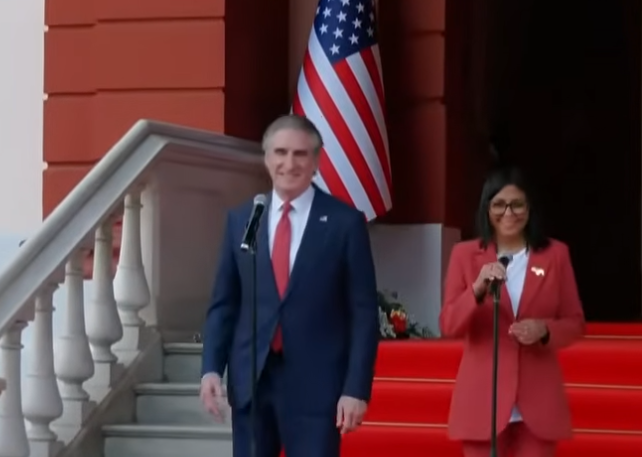
U.S. Interior Secretary Doug Burgum “pushed for greater U.S. access to Venezuela’s reserves of critical minerals and gold during a visit” to Caracas.
At the height of the Biden administration, Venezuelan President Nicolás Maduro appeared emboldened enough to threaten neighboring Guyana’s oil-rich region.
Then came a surprise overnight strike on Caracas by U.S. special operations forces. In my last report on that nation, a Venezuelan guard who managed to survive the raid asserted that our military had used an intense sound‑like weapon during the night raid on Maduro’s compound, describing it as a powerful “sonic weapon” that instantly incapacitated defenders.
In just six weeks, U.S. policy toward Venezuela has completely reversed course, and the early stages of alliance-building are now underway.
On March 4, Interior Secretary Doug Burgum met with officials in Caracas to discuss mining investments, He noted that American firms are “lining up” to access Venezuela’s gold and critical minerals.
The pivot comes as the U.S. seeks to diversify supply chains and secure materials completely independent of China.
Just wrapped a trip to Venezuela to advance U.S. interests in the region and strengthen bilateral cooperation on critical minerals and energy.
At @POTUS’ direction, we are moving at TRUMP SPEED to usher in a Golden Age for the Western Hemisphere where America leads. 🇺🇸 pic.twitter.com/SIsOeD75ma
— Secretary Doug Burgum (@SecretaryBurgum) March 6, 2026
With a couple dozen representatives of American mining companies and other firms in tow, the U.S. interior secretary, Doug Burgum, pushed for greater U.S. access to Venezuela’s reserves of critical minerals and gold during a visit to the country’s capital on Wednesday and Thursday.
Mr. Burgum’s visit was the latest meeting between a high-ranking U.S. official and Venezuela’s new interim government, led by Delcy Rodríguez, aimed at opening up the South American country’s economy to U.S. investors. Previous visitors have included the energy secretary, Chris Wright; the Southern Command chief, Gen. Francis Donovan; and the C.I.A. director, John Ratcliffe.
On Wednesday, Ms. Rodríguez pledged to work at “Trump speed” in accelerating U.S. access to Venezuelan minerals. She promised to introduce a new mining measure to national lawmakers in the coming days that would allow foreign companies to extract gold, diamonds and rare earths. She didn’t offer any further details about the possible proposal.
Venezuela possesses the world’s largest oil reserves — over 300 billion barrels — along with vast deposits of gold and other minerals vital to modern technology.
In addition to enormous oil reserves, Venezuela has the most significant gold reserves in Latin America, located in a mineral-rich region known as the Guyana Shield, a 1.7-billion-year-old geological formation that is also home to about 18 percent of the world’s tropical rainforests.
The bulk of the country’s mining is happening in a sprawling district that Maduro created in 2016 in the country’s southern reaches. As the country’s oil industry collapsed, Maduro signed a decree creating the Orinoco Mining Arc in an area of about 112,000 square kilometers covered in tropical jungle — roughly the size of Portugal — south of the Orinoco River. Maduro attempted to lure investment to the region to bolster mining of gold, diamonds, coltan, nickel and some rare earth elements, and has claimed the region could contain more than 7,000 metric tons of gold.
The U.S. Geologic Survey released a report in the 1990s — following a five-year collaboration with Venezuela — that found more than 450 mines, prospects and mineral occurrences covered the Guyana Shield, the bulk of which were diamond and gold mines. The report also found “occurrences” of iron ore, bauxite, manganese, alluvial tin, titanium, barite, kaolin, dolomite, molybdenum, uranium, rare earth element minerals and tungsten. The USGS said it could not offer additional information when asked for more current data.
Venezuela’s interim leaders are revising mining codes to attract foreign capital, effectively transforming Venezuela into a dual resource hub: oil to offset the Middle East’s current market complexities as well as a source of minerals to fortify U.S. strategic supply.
Venezuela’s interim President Delcy Rodriguez said on Wednesday a reform of the country’s main mining law will be submitted in coming days to the country’s legislature, after a meeting in Caracas with US Secretary of the Interior Doug Burgum, where the two officials hailed cooperation on minerals and a shared desire to pave the way for investment.
…
The mining law, expected to include provisions that would allow foreign companies to exploit gold, diamonds and rare earths, will be proposed in the coming days, Rodriguez said, adding she hopes it will be passed swiftly.
“We want the successful models of the hydrocarbons law to also be reflected in the mining sector,” she said.
Rodriguez said the meeting built on previous work with US Energy Secretary Chris Wright, who visited the country in February. She said the agenda focused on “metallic minerals, non‑metallic minerals, strategic and non‑strategic minerals”. Energy topics would be covered in meetings on Thursday, she added.
While Venezuela may have awesome gold and mineral resources, they would have to be robustly developed. Mining regions would have to be wrested from criminal control, and basic security restored along the roads, rivers, and ports that move ore out of the rainforest to market.
This work is in addition to the actual development of mines and processing plants. So, hopefully, Venezuela can contain and control its environmental zealots.
On top of that, Caracas would need to pass and actually enforce a modern mining framework that honors contracts and allows real foreign ownership or control. And if Venezuela wants its gold and rare earth elements to be a key part of American supply chains, any “formal” mining boom would have to come with tough anti-money laundering rules and scrupulous supply‑chain tracking.
Additionally, these mines should never be at risk of being “socialized” again.
If Rodríguez can actually deliver real security, real legal reform, and real respect for contracts, those “potential” reserves could turn into genuine, long‑term partnerships of benefit to everyone. For now, the Orinoco Mining Arc is essentially a high‑risk, high‑reward test of whether post‑Maduro Venezuela can finally choose markets over cartels and prove it is a reliable partner for peace and prosperity.
Full remarks from a joint press conference with Burgum and Rodríguez can be viewed here.
Donations tax deductible
to the full extent allowed by law.



Comments
Good news!
Orinoco River….reminds me of that song Orinoco Flow.
socialism..you will buy our way or gulag
capitalism: you will see the advantages and get to choose..good life or more socialist misery
btw…hey what about those wht christian nationalists who attacked muslims/mammmadame??!
ohhhh wait!!!!!!!
Proactive thinking is what it takes.
Sonic strike? I guess I need to go to White Castle.
I suppose food is being delivered and distributed by trustworthy aid groups? No ordinary Venezuelan can afford 400% inflationary staple foods.
Maduro’s military leaders simply vanished? What about his secret police?
Cuba is next and we’re going to need cargo ships ready-loaded with corn, rice, beans, flour vegetables and potable water. And lots of competent engineers and industrial workers.
Leave a Comment